
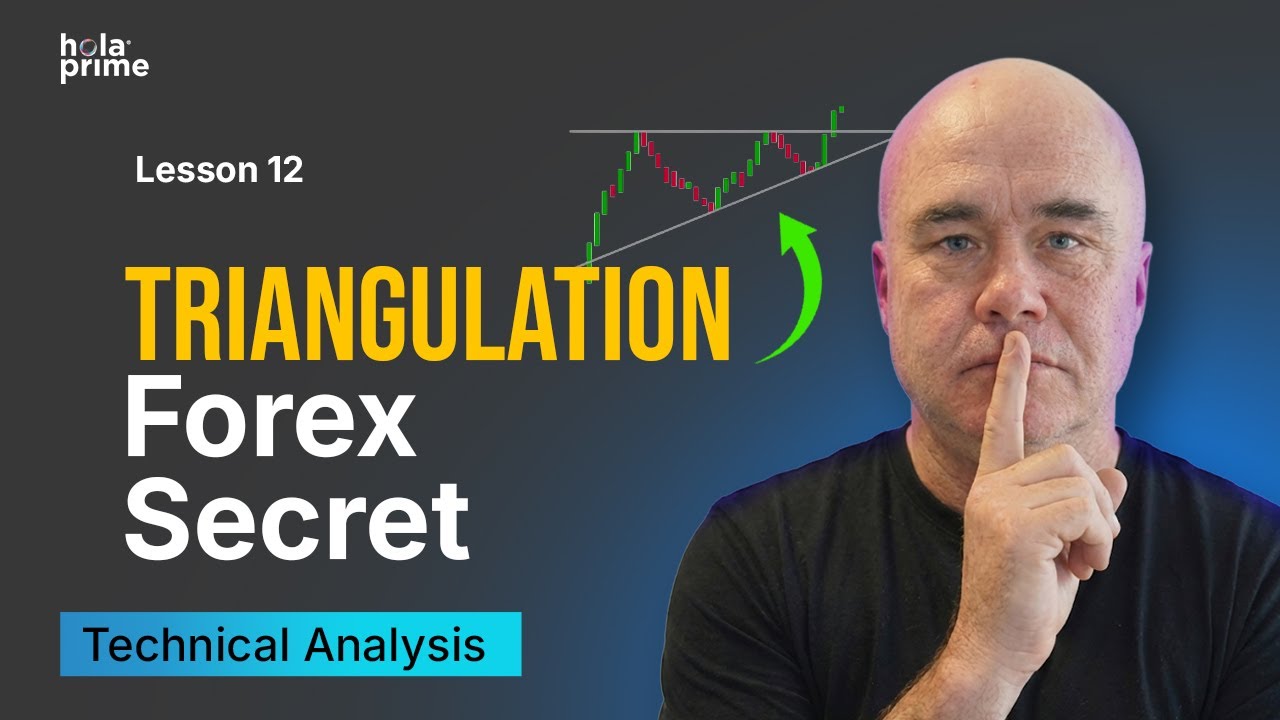

Introduction
In the currency markets, every trade is a measurement of relative value. When traders say "the Pound is rising," they are almost always referring to the Pound against the US Dollar (GBP/USD). However, a professional strategy called Triangulation allows you to look beyond a single pair to identify which currency is truly the strongest or weakest. By analyzing how three different currencies interact, you can ensure that you are always "pairing the best against the worst," maximizing your potential profit and momentum.
The Concept of Relative Value
Everything in trading is about comparing one asset's worth to another.
-
Currency Pairs: Since currencies trade in pairs, you are simultaneously buying one and selling another.
-
The Goal: To find the biggest mismatch in value—where one currency is gaining strength while its partner is losing it.
What is Triangulation?
Triangulation is a fundamental tactic where you analyze three currencies to decide which specific pair offers the best trade setup.
-
The Three Components: Typically, this involves the US Dollar (as the base), and two other currencies, such as the Euro and the British Pound.
-
Cross-Currency Clues: By looking at a "cross-pair" like EUR/GBP, you can determine which of those two is fundamentally weaker or stronger, regardless of what the US Dollar is doing.
Using the US Dollar Index (DXY) as a Base
The US Dollar Index (DXY) is the primary tool for understanding broad Dollar behavior.
-
Measure of Strength: It tracks the Dollar against a basket of currencies, including the Euro (the largest component), Yen, Pound, and Canadian Dollar.
-
The Directional Filter: If the DXY is grinding higher on the hourly chart, your overall bias should be to buy Dollars. The next step is to decide which currency you should sell against it.
Identifying Strong vs. Weak Peers
Once you know you want to buy (or sell) the Dollar, use cross-pairs to find the best candidate:
-
Euro vs. Pound: If the EUR/GBP pair is plummeting, it tells you the Euro is weaker than the Pound.
-
Decision: If the Dollar is strengthening, you should short the Euro (EUR/USD) because it is the weaker link, likely leading to a deeper drop than GBP/USD.
-
Decision: If the Dollar is weakening, you should buy the Pound (GBP/USD) because it is the stronger link and will likely rally more than the Euro.
Practical Examples: Euro/Pound and Aussie/Kiwi
The video highlights how these "cross-border" relationships provide clarity:
-
Aussie/Kiwi (AUD/NZD): If the Aussie Dollar is strengthening more than the New Zealand Dollar, and the US Dollar is generally weakening, the smartest trade is to go long AUD/USD.
-
USD vs. Mexican Peso (USD/MXN): If the Dollar is strengthening and the Mexican Peso is plummeting against the Yen, you will get "more mileage" out of buying USD/MXN than USD/JPY because the Peso is fundamentally weaker.
Applying Technical Setups to Triangulated Ideas
Triangulation provides the fundamental direction, but you still need a technical setup to time your entry.
-
The Final Step: Once you have identified the strongest-against-weakest pair (e.g., Short EUR/USD), look for a technical trigger on that specific chart.
-
Triggers: Common entry signals include bullish/bearish engulfing candlesticks, hammers, or pullbacks to the 50% Fibonacci retracement level.
.png)
.png)
.png)
.png)
.png)
.png)