

Introduction
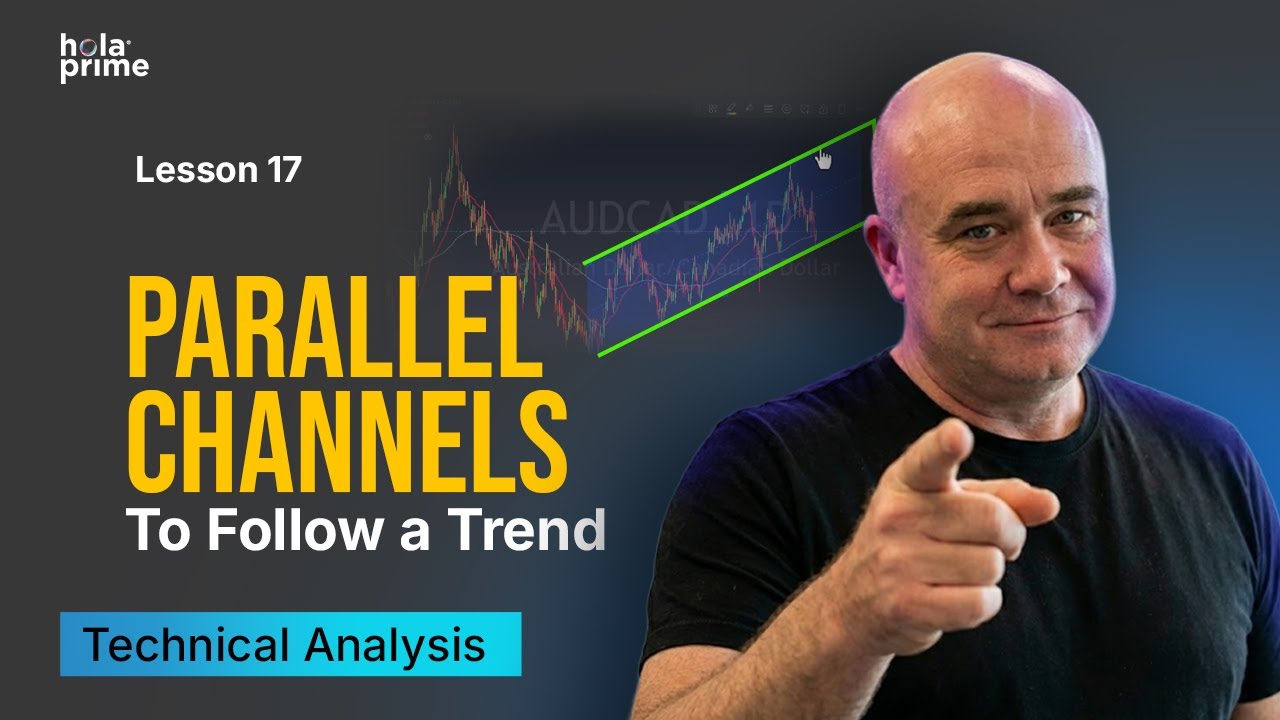
Trading with the trend is often considered the most reliable way to navigate the markets. Parallel channels are a versatile tool that helps traders visualize this trend while identifying overbought and oversold areas within it. Unlike traditional trendlines, a parallel channel provides a structured boundary for price action, offering clear zones for potential entries and exits. This lesson covers how to set up these channels and integrate them with other technical indicators to stay on the right side of the market.
What is a Parallel Channel?
A parallel channel consists of two parallel trendlines that encompass price action over a specific period.
-
Trend Following: It is used primarily to track the direction of a market's momentum.
-
Oversold/Overbought: The bottom trendline acts as an "oversold" area in an uptrend, while the top trendline serves as an "overbought" area.
-
Sideways Markets: While most effective in trends, channels can also be applied to sideways consolidation to identify a range's boundaries.
Trend Identification
Before drawing a channel, it is essential to determine the overall market direction using moving averages.
-
Key Indicators: Use the 50-day EMA and the 200-day EMA on the daily chart.
-
The Filter: If both EMAs are sloping higher, you are in an uptrend and should only look for buy signals at the bottom of the channel. Avoid "counter-trend" strategies (shorting at the top of an uptrend), as they are often less reliable.
Trading the Channel: Entries and Profit Taking
The channel provides a clear roadmap for your trades:
-
Entry (Uptrend): Look to buy when the price touches or nears the bottom trendline of the channel.
-
Exit (Uptrend): Use the top trendline as a signal to take profit or reduce your position size. Do not use this as a signal to short the market against the trend.
-
Downtrend: In a downtrend, look to short at the top of the channel and take profit at the bottom.
The Equilibrium Point (Midpoint)
Most parallel channel tools include a dashed line running through the center, known as the midpoint or equilibrium point.
-
Dynamic Support/Resistance: Much like Bollinger Bands, this midpoint often acts as a secondary area of interest where price may react.
-
Scaling Out: A common strategy is to take half of your profit when the price reaches the midpoint and let the remainder ride to the opposite side of the channel.
Managing Breakouts and False Signals
Price does not always stay within the channel boundaries perfectly.
-
False Breakouts (Throwovers): A move that spikes outside the channel and then immediately forms a reversal pattern (like a shooting star) is often a sign that the move was overextended and price is returning to the channel.
-
Trend Changes: If the price breaks and stays outside the channel, especially after a period of sideways action, it may be a signal that a major trend change is occurring.
Risk Management: Stop-Loss Placement
The boundaries of the channel offer logical points for protecting your capital.
-
Uptrend: Place your stop-loss underneath the bottom trendline.
-
Downtrend: Place your stop-loss above the top trendline.
-
Moving to Break-even: Once the price reaches the midpoint, many traders choose to move their stop-loss to the entry point (break-even) to eliminate risk.
.png)
.png)
.png)
.png)
.png)
.png)