

Introduction
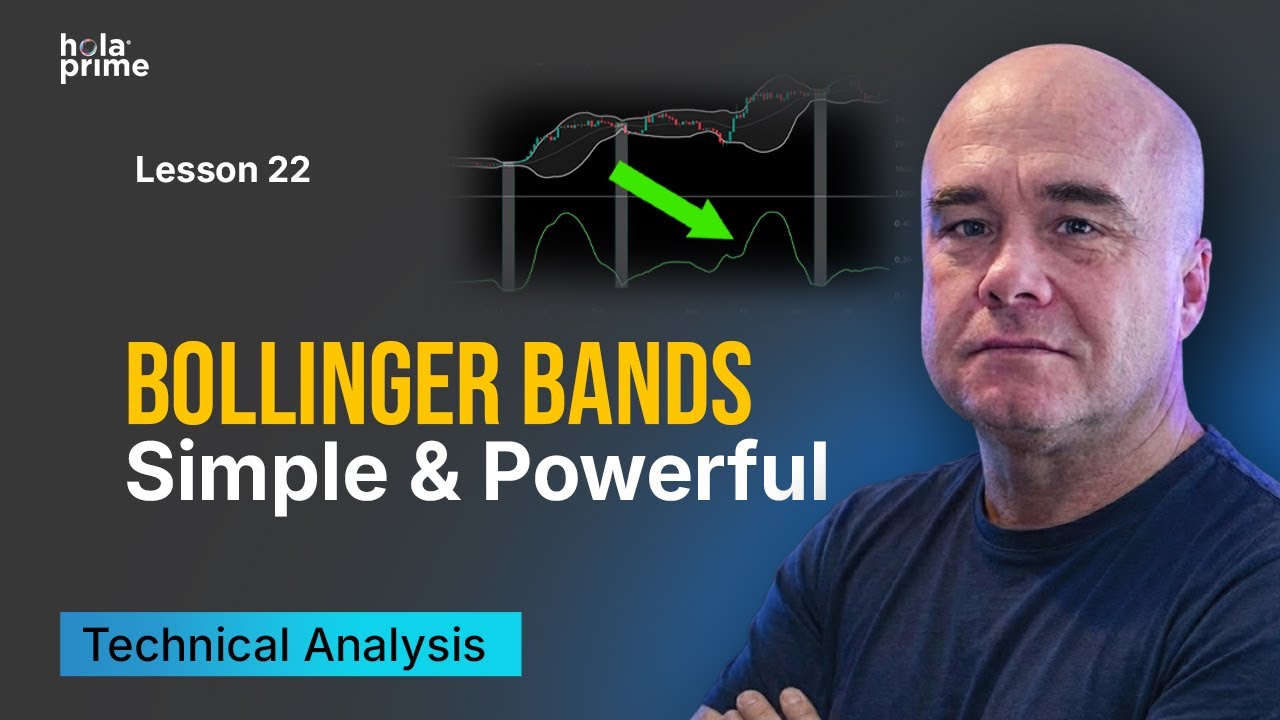
Developed in the 1970s, Bollinger Bands are a technical indicator designed to measure market volatility and identify potential overbought or oversold conditions. The indicator is based on the mathematical concept of the bell curve, assuming that approximately 95% of all price action will occur within two standard deviations of the average price. This lesson explores how to use Bollinger Bands to follow trends, anticipate explosive breakouts, and use price action for confirmation.
What are Bollinger Bands?
Bollinger Bands provide a visual representation of a market's "normal" flow and its volatility extremes.
-
Core Logic: Price eventually tends to return to its "norm" or average.
-
Volatility Adaptation: The bands automatically widen when the market is volatile and shrink (compress) when price action is quiet.
The Structure: Moving Averages and Standard Deviations
The indicator consists of three distinct lines:
-
Middle Band: A 20-period Simple Moving Average (SMA).
-
Upper Band: Set at two standard deviations above the 20 SMA.
-
Lower Band: Set at two standard deviations below the 20 SMA.
Trading with the Trend: "Walking the Band"
One of the most effective ways to use Bollinger Bands is as a trend-following tool.
-
Trend Confirmation: In a strong uptrend, price will often "walk the band," staying close to the upper deviation line for an extended period.
-
Dynamic Support/Resistance: In a trending market, the middle 20 SMA often acts as a reliable area of support (in an uptrend) or resistance (in a downtrend). For example, every time the AUD/USD reached the middle line during a downtrend, it provided an opportunity to short again.
The Bollinger Band Squeeze (Compression)
When the upper and lower bands contract and get very tight, it is known as a Bollinger Band Squeeze or compression.
-
The Signal: This indicates that volatility is unusually low and a major, explosive move is likely to occur soon.
-
Execution: Wait for a large impulsive candlestick to break out of the squeeze. If a large positive candle closes above the squeeze, it signals a bullish move; a large negative candle signals a bearish move.
Avoiding "Getting Too Cute": Reversal Risks
A common mistake among retail traders is treating a touch of the outer bands as an automatic signal to trade a reversal.
-
The Trap: In a strong trend, a market can stay outside the two standard deviations for a long time. Fading an explosive move just because it's outside the band can be "disastrous".
-
sideways Markets: In range-bound markets (like EUR/CHF), using the bands for reversals often results in poor risk-to-reward ratios.
Using Confluence: Bands, Candlesticks, and Levels
Bollinger Bands should never be the only reason to take a trade.
-
Candlestick Confirmation: Always look at the candlestick pattern. Don't short just because you're at the top band; wait for a shooting star or another bearish reversal signal.
-
Horizontal Support/Resistance: You cannot lose sight of major historical levels. If a price pullback hits both the middle Bollinger Band and a previous area of support, the probability of a successful bounce increases significantly.
-
Index Caution: Be extra careful with shorting indices using Bollinger Bands, as most indices are not equal-weighted and are "designed to rise" over the long term.
.png)
.png)
.png)
.png)
.png)
.png)