Choosing the right prop firm can accelerate your trading journey—if you match the model, rules, and tools to your trading style. This guide walks you through a step-by-step, expert-backed approach to finding the best Forex prop firm for both beginners and pros. A Forex prop firm provides simulated capital to traders who pass the challenge phase and shares profits according to pre-defined rules; the right prop firm aligns with your goals, risk tolerance, platform preferences, and payout expectations. As the market evolves with instant funding, stronger compliance, and transparent payout structures, firms like Hola Prime are setting higher standards with rapid one-hour payouts, clear rules, and resources designed to help mid-career traders scale. For a deeper primer on how prop models work, see Hola Prime’s guide to forex prop trading.
Define Your Trading Goals and Preferences
Start by writing down exactly what you expect from a prop firm. Your goals should drive firm selection, not the other way around.
- Account size targets: What funds do you need to implement your strategy credibly? Start modestly, scale as performance stabilizes.
- Strategy fit: Scalping, swing, and algorithmic systems require different rule flexibilities (e.g., holding periods, news trading, and platform automation).
- Costs and fees: Consider evaluation fees, platform add-ons, data/VPS, and withdrawal thresholds.
- Risk parameters: Your acceptable drawdown, leverage needs, and instrument coverage must map to the firm’s rules.
Instruments and sessions: Forex majors, minors, metals, indices, and commodities —ensure your core instruments and trading hours are supported. Table: Map your goals to firm features
|
Your goal or constraint
|
What to look for in a firm
|
Why it matters
|
|
Funding size (e.g., 25k–200k+)
|
Scaling roadmap, capital tiers, evaluation options
|
Ensures you can grow without switching firms
|
|
Strategy type (scalping/swing/algo)
|
Holding rules, news-trading policy, platform automation
|
Avoids rule conflicts that invalidate your edge
|
|
Acceptable drawdown (e.g., 5–10%)
|
Daily loss and max drawdown definitions, buffer rules
|
Prevents unexpected breaches on normal variance
|
|
Leverage needs (e.g., 1:30–1:100)
|
Asset-specific leverage caps
|
Impacts position sizing and risk
|
|
Instruments (FX, metals, indices, crypto)
|
Asset coverage, spreads, execution quality
|
Keeps core markets tradable with reliable fills
|
|
Timeline (part-time vs. high-frequency)
|
Trading hour flexibility, weekend policies
|
Aligns with your schedule and workflow
|
|
Cash flow expectations
|
Payout frequency, thresholds, speed guarantees
|
Supports predictable income and reinvestment
|
For a structured checklist, see Hola Prime’s guidance on how to choose the right prop trading firm.
Understand Prop Firm Evaluation and Funding Models
Most prop firms use evaluations that validate consistency under defined risk. Two common models:
- One-step evaluations: A single phase with a profit target and risk rules. These are faster and emphasize performance under real constraints.
- Multi-step evaluations: Two or more phases, often with distinct objectives (profit target, minimum days, max loss), designed to test consistency across conditions.
Many prop firms now offer both one-step and two-step options so traders can choose a preferred path. A funded account means you manage simulated funds connected to real pricing/execution or a live account—and earn a share of profits.
Pros and cons at a glance:
One-step
- Pros: Faster time-to-funding.
- Cons: Tighter risk rules; less room for error.
- Best for: Experienced traders with proven strategies and tight execution.
Multi-step
- Pros: Gradual proving ground; more time to adapt to rules.
- Cons: Longer path.
- Best for: Beginners refining discipline and process.
Prefer instant funding or a single phase? Explore Hola Prime’s one-step program. Prefer a staged path? See Hola Prime’s two-step funding model.
Compare Trading Platforms and Technology
Execution quality is a cornerstone of performance. MT4 and MT5 are industry standards; many firms also support cTrader or proprietary platforms, often with mobile apps and API access, as summarized by FXTrustScore’s guide to top prop platforms. Latency—the delay between sending an order and its execution—matters because lower latency increases the likelihood of accurate fills, especially for scalpers and news traders. Also assess data quality, stability, integrated analytics, and whether a VPS is recommended for algorithmic or low-latency strategies.
Comparison of MT4, MT5, cTrader, and Prop Firms’ Platforms
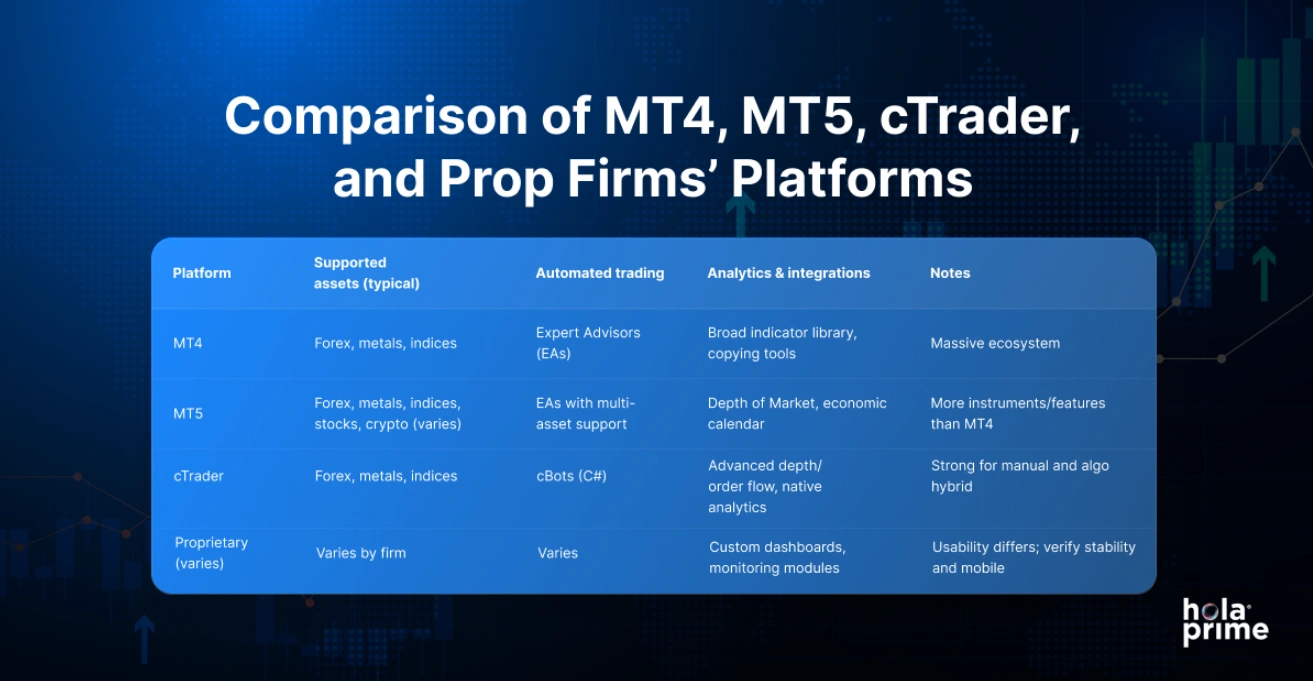
Some firms build proprietary, mobile-friendly systems that streamline rule tracking and performance review; test usability on your devices before committing.
Analyze Risk Rules and Trading Restrictions
Every prop firm enforces rules to protect capital. Scrutinize these before you trade, as they directly influence strategy compatibility and risk.
Key terms:
- Maximum drawdown: The largest allowed equity decline from peak before violating rules.
- Profit target: The profit threshold required to pass an evaluation phase or unlock a payout/milestone.
What to review closely:
- Daily loss limits and overall max drawdown
- Holding-period restrictions (intraday-only vs. swing)
- Leverage caps and margin rules
- News-trading policies and EA/automation permissions
- Instrument access and spreads/commissions
Common restrictions to confirm:
- Weekend holdings: Some prop firms prohibit open positions over weekends or major holidays and may flatten positions automatically.
- Leverage caps: Certain accounts restrict leverage (e.g., 30:1), which can constrain advanced short-term strategies.
- Strategy limits: A subset of firms restricts scalping, grid/martingale, or high-impact news trading.
For a practical sense of how rule nuances impact execution and cash flow, compare policy clarity and examples across firm rulebooks, a point reiterated by roundups of top prop programs.
Evaluate Profit Splits, Payouts, and Scaling Opportunities
Profit split is the percentage of trading gains you keep versus what goes to the firm; typical splits range from 80% to 95% for traders. Payout speed and reliability are essential to cash flow; look for clear timetables, thresholds, and any guarantees or compensation policies for delays, as emphasized in industry comparisons of best prop trading firms. Clarity matters as much as generosity: you want published steps, documented timelines, and visible support for payout issues.
Hola Prime’s one-hour payout guarantee reduces cash-flow uncertainty and reflects our commitment to operational transparency. For longer-term growth, review Hola Prime’s scaling framework to see how performance unlocks higher capital tiers.
Assess Transparency, Customer Support, and Reputation
Reputation is earned through clarity and consistency. Before you commit:
- Verify published rulebooks (with examples), including payouts and risk definitions.
- Test support responsiveness with real questions; slow or generic replies are common trader complaints.
- Cross-check independent reviews on Trustpilot, forums, and educator channels; many analysts treat Trustpilot sentiment as a core selection factor, as seen in video analyses of prop firm Trustpilot reviews.
Hola Prime publishes daily price-transparency reports, maintains fast, knowledgeable support, and is building industry trust through clear policies and documented payout performance.
Signals of a reliable firm:
- Clear, public rules and payout timelines
- Fast, helpful customer service
- Consistently positive community feedback
Test the Fit with Demo Accounts and Trial Challenges
Simulated or demo-phase trading is invaluable for learning rule dynamics and execution friction before you risk fees or time on a full challenge—an approach echoed in overviews of leading prop programs. Some platforms provide real-time metrics, rule tracking, and structured reviews to support decision-making. Favor firms that offer low-fee or refundable trials so you can validate compatibility with minimal downside. If you prefer to move quickly, Hola Prime’s instant funding overview explains how to balance speed with discipline.
Start Small and Develop a Data-Driven Trading Plan
Start with a smaller evaluation or lower capital tier and scale as your edge proves out over dozens of trades. Real trader stories show that disciplined, incremental approaches lead to durability in funded trading.
A simple data-driven process:
- Define your playbook: setups, entries/exits, risk per trade, invalidation.
- Track every trade: screenshot, rationale, metrics (R multiple, MAE/MFE, slippage).
- Review weekly: identify rule conflicts, time-of-day edges, and mistakes.
- Optimize: adjust risk, filters, and sessions based on evidence.
- Align with firm rules: stress-test against daily loss and max drawdown.
- Scale deliberately: increase size only after consistent expectancy over a meaningful sample.
Multi-timeframe reviews and built-in analytics can accelerate development; use your platform’s dashboards or third-party tools to make evidence-based adjustments.


 EN
EN DE
DE