Play DUNK Trade & Get 15% OFF
Play Now
Hola PrimeLogin/Register

How to Build a Data-Driven Trading Workflow: Tools and Best Practices

Jan 5, 2026
How to Build a Data-Driven Trading Workflow: Tools and Best Practices

If you look at the traders who stay consistent year after year, there is usually one common thing that sets them apart. They do not trade based on random ideas or emotions. They make decisions on data that gives them confidence and direction. A data-driven trading workflow helps you remove guesswork, track what works, and improve your strategy with evidence instead of hope. When you build this kind of workflow, you do not panic when a trade goes wrong, and you do not feel lost when the market environment changes. You have numbers and insights guiding every step. In this guide, we will walk through how you can build your own data-driven system, the tools you can use, and the habits that will help you grow as a trader.

One Time

20% discount

on all accounts
Get Funded

Why Data Matters in Modern Trading

Trading has become faster, more competitive, and more influenced by technology. Retail traders who only rely on gut feeling or rumors usually get left behind. Data helps you understand what is happening in the market and how your strategy performs in different conditions. Instead of thinking a setup is strong, you know the probability behind it. Instead of hoping for profit, you track whether you have a real edge. Data turns trading into a repeatable process that you refine over time.
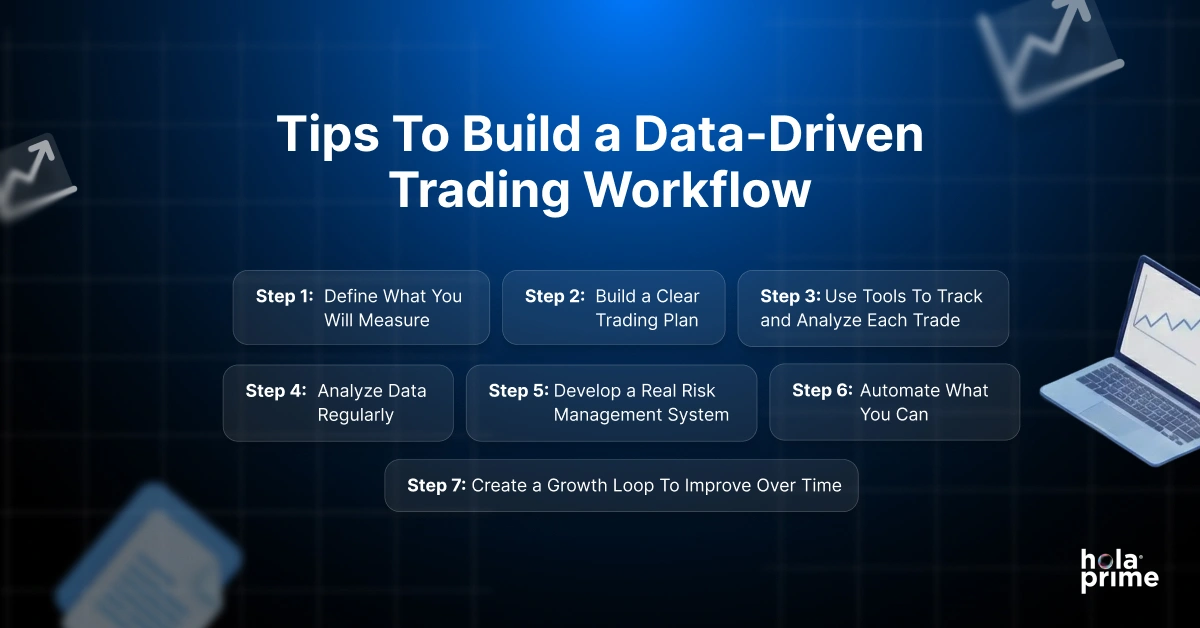
Infographic with title, Tips to Build a Data-Driven Trading Workflow and 7 steps mentioned as subpoints.

Step 1: Define What You Will Measure

What performance metrics matter

You want to track numbers that help you understand both risk and skill. Important ones include win rate, average reward to risk, maximum drawdown, profit factor, and expectancy. These show whether your strategy has a real advantage or just occasional lucky trades.

Track behavior as much as results

Performance is not only about profit. You should also track behavior such as whether you followed your plan, whether you respected stop loss levels, and whether emotions influenced decision-making. The goal is to improve execution along with profits.

Focus only on useful data

If you collect too much information, it becomes noise. Start with the key metrics that actually drive improvement, and then expand once your workflow becomes comfortable.

Step 2: Build a Clear Trading Plan

Define your setups

Write down what a valid trade looks like. Include entry rules, time of day, position sizing, and exit conditions. When everything is clear, you avoid random decisions.

Know when to trade and when to stay out

Market conditions change. A trending strategy does not do well in a choppy environment. A data-backed workflow shows when your plan performs best so you can avoid low-quality times.

Make it simple to follow

Plans work only if you can execute them under stress. Keep your rules clear and easy to review quickly before entering any trade.

Step 3: Use Tools to Track and Analyze Each Trade

Trading journal tools

You can record your trades manually or use platforms that capture your entries and exits automatically. A journal helps you see patterns that you may not notice day to day.

Chart analytics and screenshots

Adding a screenshot of the chart where you entered helps you review your behavior later. You can clearly see whether the setup matched your plan.

Tag and categorize your trades

Tagging lets you filter by specific conditions. You will discover which setups perform the best and which ones cause the most losses. This helps you shift focus toward high-edge opportunities.

Step 4: Analyze Data Regularly

Weekly reviews

End each week by going through your trades as a group. Look for themes like late entries, oversized positions or trading outside plan hours. Small improvements made every week bring major long-term growth.

Monthly performance deep dives

A monthly review tells you whether your strategy is improving or if something in the market has changed. You can adjust rules, tighten risk, or refine targets based on the data you see.

Measure change, not perfection

Data-driven traders do not try to win every trade. They try to keep improving the overall system. Growth is what matters most.

Step 5: Develop a Real Risk Management System

Position sizing rules

Decide how much you will risk per trade. Many traders risk a small percentage of their account so losses stay manageable. When sizing is consistent, results become more predictable.

Protect yourself during volatility

Some market events can create big moves and wider spreads. If your journal shows poor performance during news releases, your workflow can include staying out during those times.

Review worst-case outcomes

It may feel uncomfortable, but checking your largest losing streak helps you prepare mentally. Data removes fear of the unknown.

Step 6: Automate What You Can

Alerts and watchlists

You can set alerts for your setups so you are not staring at charts all day. This protects your energy and ensures you react only to valid opportunities.

Use spreadsheets or analysis software

Automation handles calculations and sorting, freeing your mind to focus on decisions. The less manual work, the fewer mistakes.

Keep the human judgment

Even with automation, you remain the decision maker. Data guides you but does not replace your awareness of market context.

Step 7: Create a Growth Loop to Improve Over Time

Test new ideas with data

When you want to change something, run a backtest or trial before fully applying it. This helps you avoid switching strategies too often.

Track improvements over months

You can look at how your metrics move over time. If drawdowns shrink and expectancy rises, you know you are on the right path.

Celebrate small wins

Consistency comes from building good habits daily. Recognizing each improvement helps you stay motivated.

Common Mistakes Traders Make When Using Data

Collecting too much information

Too many numbers cause confusion and slow decisions. Start small. Expand only when the workflow is smooth.

Ignoring the emotional side

You can have a strong strategy and still lose if you cannot follow it. Track discipline and mindset alongside technical metrics.

Changing the plan too often

It is easy to get distracted by results over a short time period. You must give yourself ample amount of time and sample size before you make any changes to your strategy.

How a Data-Driven Workflow Changes Your Trading Mindset

Traders who utilise a data-driven workflow have a different perspective on the market. They view it as many different trades across multiple time frames and thus, the success or failure of one trade does not dictate the success or failure of their trading plan. This mindset creates a less stressful trading environment when going through drawdowns because they are aware of their superior edge that can be achieved over the long term through the use of data-driven methods and decision-making. This mindset allows traders to make better decisions and create a more sustainable growth plan through consistent execution of their established processes, rather than responding to every small movement (candle) with emotion.

About the Author: Sam Saleh

Sam Saleh, a London-based trader, began his trading journey at 19 while studying Business at the University of Bedfordshire. With expertise in trading and a background in marketing, he now coaches at Hola Prime, where he develops educational content aimed at building trader confidence, consistency, and financial literacy.

FAQs

Still Have Questions?

Feel free to get in touch with us today!

Book a MeetingArrow
Data-Driven Trading Workflows Use Performance Data to Make Trading Recommendations Rather than a Trader’s Arbitrary Emotions or Gut Instincts
Monitoring Each Trade Will Enable Traders to Identify Their Most Successful Strategies, as Well as Common Mistakes and Optimal Trading Conditions; This Data Will Help All Traders Improve Their Effectiveness as a Trader Quicker.
Advanced Tools are Not a Requirement for Analyzing Your Trades; You Can Begin Tracking Your Trades Using Basic Journals or Spreadsheets; Eventually, you’ll want to use advanced Trading Analytics Platforms.
Most Traders Review Their Performance on a Weekly Basis and Review Their Trading Strategies, and Evaluate New Strategies and Improvements on a Monthly Basis.

Disclaimer

All information provided on this site is for educational purposes only, related to trading in financial markets. It is not intended as financial advice, business or investment recommendation, or as an opportunity or recommendation to trade any investment instruments. Hola Prime only provides an educational environment to traders, including tools, materials and simulated trading platforms which have data feed provided by Liquidity Providers. The information on this site is not directed at residents in any country or jurisdiction where such distribution or use would be contrary to local laws or regulations.

Our Community

Join our discord server to connect with our community of active traders.

Join Discord

24/7 Customer Support

Our support staff is available to you 24/7.

About: Simulated trading operations are managed by Hola Prime Limited, a company registered at L1, Shaw House, 201 Wan Po Road, Tseung Kwan O, Hong Kong.
Holaprime Limited a company registered in Cyprus having registration number HE 454359 is a 100% subsidiary of Holaprime Limited Hong Kong.
For MT4 And MT5: Hola Prime Limited, with Company registration number 220248, and registered office at 4th Floor, Docks 4, The Docks, Caudan, Port Louis, Mauritius, is authorized and regulated by the Financial Services Commission (FSC) of Mauritius as an Investment Dealer (Full Service Dealer, excluding underwriting) under license number GB24203729.
For DXTrade, cTrader and MatchTrader: Gooey Trade, GT Tech LLC 6800 Broken Sound Parkway Northwest Suite 150 Boca Raton, FL 33487 US

RISK DISCLOSURE:
All of the information provided on this website and by Hola Prime Ltd, or its affiliates, is intended solely for Educational purposes. Nothing on this website is to be construed as investment advice, nor an offer or invitation to buy or sell any financial instrument, nor does it endorse, recommend, or sponsor any financial product, company, or fund. Testimonials on the Company’s website may not be reflective of the experience of other clients or customers and should not be considered as an assurance of future performance or success. Hola Prime only provides services of simulated trading and educational tools for skill assessment and enhancement of traders. Hola Prime does not act as a broker and does not accept any deposits. Any purchases made should not be regarded as deposits. There are no promises of rewards or returns. Trading in financial markets is inherently high-risk and speculative. The content and information provided on this website are not intended for distribution to, or use by, any person or entity in any jurisdiction or country where such distribution or use would be contrary to local law or regulation.

HYPOTHETICAL PERFORMANCE DISCLOSURE:
ACFTC Rule 4.4-Hypothetical performance results have many inherent limitations, some of which are described below. No representation is being made that any account will or is likely to achieve profits or losses similar to those shown. In fact, there are frequently sharp differences between hypothetical performance results and the actual results subsequently achieved by any particular trading program. One of the limitations of hypothetical performance results is that they are generally prepared with the benefit of hindsight. In addition, hypothetical trading does not involve financial risk, and no hypothetical trading record can completely account for the impact of financial risk of actual trading. For example, the ability to withstand losses or to adhere to a particular trading program in spite of trading losses is material points, which can also adversely affect actual trading results. There are numerous other factors related to the markets in general or to the implementation of any specific trading program, which cannot be fully accounted for in the preparation of hypothetical performance results and all of which can adversely affect trading results. Testimonials appearing on this website may not be representative of other clients or customers and are not a guarantee of future performance or success.

EVALUATION DISCLOSURE:
The customer pass rate of the Challenge/Evaluation program was 35% between 10th November, 2024 – 29th May, 2025, who traded at least one evaluation and obtained a Hola Prime Account during this time period. The Challenge and Hola Prime Accounts are meant to be a realistic simulation of trading under actual market conditions, including commissions, to mimic real market conditions, as much as possible. The evaluation is difficult to pass even for experienced traders. The Evaluation is not suggested for individuals with little to no trading experience.

CUSTOMER COMPENSATION DISCLOSURE:
All trades presented for compensation to customers should be considered hypothetical and should not be expected to be replicated in a live trading account. Hola Prime Accounts may represent simulated accounts or live or copied accounts. Hola Prime does not provide services to the residents of certain countries including – Afghanistan, Belarus, Burundi, China, Cuba, Congo, Sudan, Sri Lanka, North Korea (Democratic People’s Republic of Korea) and Yemen.

This is the only website for Hola Prime. We are not using any third party websites or links. Any link, outside of this website that claims to be ours, could be fraudulent and users are advised to not use it.