
If there’s one habit that separates consistently profitable traders from the “I hope this works” crowd… it’s not the strategy.
It’s not the indicators.
Trade Journaling & Data Analytics: Turning Stats into Strategy
It’s not even discipline.
It’s journaling - but not in the boring, diary-style way most traders imagine.
The truth?
Trade journaling is the closest thing to a cheat code in trading.
Because the moment you track your decisions objectively…
you start seeing patterns the market has been trying to show you for years.
Let’s break down the real reason trade journals matter, the mistakes traders make, and how analytics turn raw stats into repeatable, reliable strategies.
1. Why Most Traders Avoid Journals (And Why That’s a Huge Loss)
Let’s be honest.
When you hear “journal,” you probably think of:
- writing every trade manually
- filling spreadsheets
- noting every tick
- typing long paragraphs
- math formulas you’ll never revisit
No wonder 99% avoid it.
But here’s the twist:
Trade journaling isn’t about paperwork.
It’s about truth.
Truth about:
- what’s working
- what’s not
- why certain trades succeed
- why you repeat the same mistakes
- what hours you trade best
- what markets drain you
- what emotional triggers kill your performance
In trading, your brain lies to you.
Your journal doesn’t.
2. What a Real “Journal of Trading” Actually Looks Like
Forget the textbook definition.
A real-world journal isn't a diary - it’s a data weapon.
A proper journal answers five critical questions:
A. What did you trade?
Instrument, entry, exit, direction, size - the basics.
B. Why did you trade it?
Your reason. Your setup. Your rule.
Not “it looked good.”
C. What happened emotionally?
This is where the truth hides:
- Did you hesitate?
- Did you chase?
- Did you revenge trade?
- Did you cut winners early?
D. What’s the measurable outcome?
Not just P/L.
Think:
- risk multiple
- drawdown impact
- expected value
- volatility conditions
E. How will you adjust next time?
This is where trading becomes self-improvement with proof.
This isn’t journaling.
This is a strategy building on autopilot.
3. Why Stats Matter More Than Setups
Most traders obsess over entries.
Professionals obsess over statistics.
Because your stats reveal what your eyes can’t:
Your win rate by time of day
You may discover you’re a monster from 9:30–11:00, but terrible after lunch.
Your performance by market condition
Trending? Range? High volatility?
Your style thrives in one of these and chokes in another.
Your most profitable instrument
You might think you’re an NQ trader…
but your data quietly shows you crush gold or micros instead.
Your emotional risk factors
Your losses have patterns:
- boredom
- fear
- FOMO
- overconfidence
- revenge
A journal exposes them like a spotlight.
4. The Best Trading Journal Isn’t a Notebook - It’s a System
Some people still use notebooks.
Others use Excel.
Some buy expensive software.
None of those matters if you don’t have the right structure.
A real "best trading journal" includes:
- screenshots
- tags
- emotional ratings
- time filters
- market context
- entry reasoning
- exit reasoning
- EV calculations
- outcome breakdown
- performance categories
- rule violations
- goal tracking
If your journal doesn’t do this, it’s not a journal - it’s a list of trades.
5. The Hidden Benefit: Eliminating Decision Fatigue
When you track your data long enough, something magical happens.
Your strategy becomes automatic.
Because you now know:
- what time you should trade
- what setups you must avoid
- what mistakes you repeat
- what market conditions you perform best in
- what emotion kills your consistency
- what instrument drains your account
- what R-multiple gives you the highest win rate
Suddenly:
Trading becomes lighter.
Decisions become simpler.
Your confidence becomes real.
Not because you’re lucky -
because you’re informed.
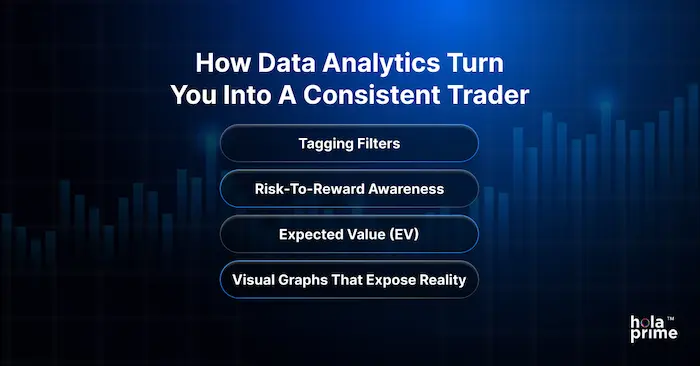
6. How Data Analytics Turn You Into a Consistent Trader
Here’s where things get powerful.
A journal itself is good.
But analytics transform raw data into gold.
A. Tagging Filters
Imagine filtering trades like:
- “all losing breakout trades”
- “all winning mean reversion trades in low volatility”
- “all revenge trades after a loss”
- “all Friday afternoon trades”
Patterns jump out instantly.
B. Risk-to-Reward Awareness
Your journal shows:
- whether your 1:3 target is realistic
- whether your 1:1 RR wins more
- whether you exit too soon
- whether your losers are too large
C. Expected Value (EV)
Professionals trade by EV.
Not emotions.
Not signals.
Your journal quietly calculates which setups have:
- positive EV
- neutral EV
- negative EV
Once you see it, you naturally stop taking low-EV trades.
D. Visual Graphs That Expose Reality
Graphs don’t lie.
They show:
- your growth curve
- your peak performance windows
- your worst market hours
- your risk exposure
- your win/loss streaks
- your consistency rating
This is where traders evolve.
7. Journaling Prevents the Mistakes You Don’t Even Know You Make
Every trader has blind spots.
Maybe you:
- overtrade after a good day
- size up after a big win
- chase trades after missing a move
- move stops when emotional
- exit early when scared
- hold losers hoping they turn around
- break rules only when stressed
Your journal catches these behavior loops like a security camera.
8. Journaling Turns Chaos Into a Repeatable Blueprint
The goal of a trading journal isn’t to create a scrapbook.
The goal is to create a system.
A system that clarifies:
- your best setups
- your worst decisions
- your strengths
- your weaknesses
- your edge
- your blind spots
- your ideal risk parameters
Once you know these, your strategy becomes:
Repeatable.
Predictable.
Scalable.
Professional.
9. Why Every Prop Firm Trader Should Journal
Prop firms want one thing:
consistency.
A journal helps you:
- meet consistency targets
- understand your risk profile
- avoid rule violations
- prevent emotional spirals
- keep your equity curve smooth
- justify your decisions
- trade with accountability
Prop firms love traders who track data -
because data-driven traders stay funded longer.
10. The Final Truth: Journaling Is the Strategy Behind Your Strategy
Here’s the simple reality:
You can’t grow what you don’t measure.
You can’t correct what you don’t track.
You can’t improve what you don’t analyze.
Your journal becomes:
- your coach
- your mirror
- your accountability partner
- your risk manager
- your blueprint for improvement
- your most underrated trading edge
Most traders try to become consistent without data.
That’s like trying to build a house without measurements.
If you want trading to finally make sense -
your journal is where it starts.

About the Author: Sam Saleh
Sam Saleh, a London-based trader, began his trading journey at 19 while studying Business at the University of Bedfordshire. With expertise in trading and a background in marketing, he now coaches at Hola Prime, where he develops educational content aimed at building trader confidence, consistency, and financial literacy.
FAQs
Still Have Questions?
Feel free to get in touch with us today!

It helps you understand your trading habits and highlights the decisions that shape your results over time.
Most traders include entry and exit details, position size, reasons for taking the trade, emotional notes and the final outcome.
By studying performance stats, you can see which setups work best, which times of day suit your style and where you tend to make mistakes.
Yes. Journaling helps new traders build structure and gain clarity on what is helping or hurting their progress.
It can. When you follow numbers instead of impulse, decisions become more consistent and less influenced by mood or pressure.
They do. Regular review helps them stay within rules, improve discipline and build repeatable setups that meet challenge requirements.
Disclaimer
All information provided on this site is for educational purposes only, related to trading in financial markets. It is not intended as financial advice, business or investment recommendation, or as an opportunity or recommendation to trade any investment instruments. Hola Prime only provides an educational environment to traders, including tools, materials and simulated trading platforms which have data feed provided by Liquidity Providers. The information on this site is not directed at residents in any country or jurisdiction where such distribution or use would be contrary to local laws or regulations.