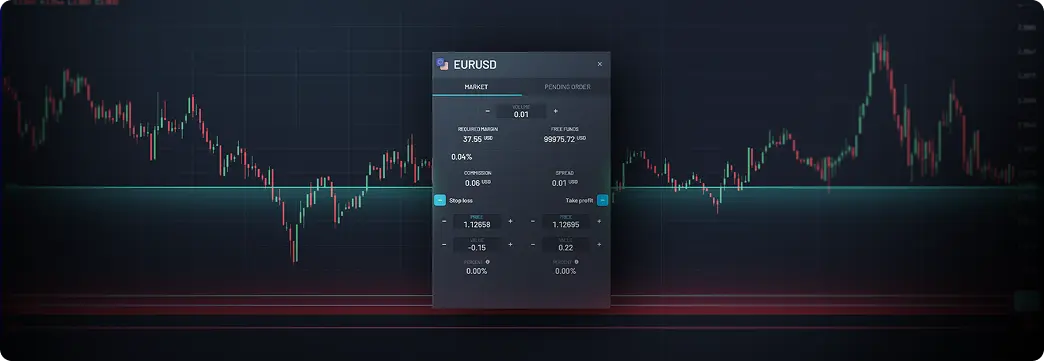
In the world of trading, every entry is a calculated risk, but it's the exit that determines success or failure. Many traders obsess over finding the perfect entry point, yet neglect what truly matters—how and when to exit a trade.
This is where Stop Loss (SL) and Take Profit (TP) orders come into play. These tools are essential for managing risk, locking in profits, and removing emotional decision-making from trading. Whether you're trading forex or any other CFDs, understanding how to properly set SL and TP levels is the key to long-term profitability.
Let's dive deep into why every trader should use SL and TP orders, some of the best strategies to implement them, and common mistakes to avoid. Remember, every trader is unique, and there is no single rule to trading. The information below is only a guide for our traders.
What Are Stop Loss and Take Profit Orders?
Stop Loss (SL)
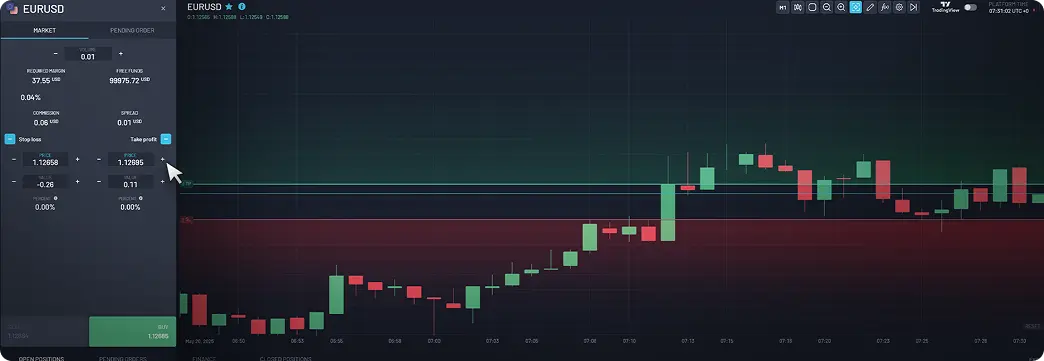
A Stop Loss order is a pre-set price level at which your trade will automatically close to prevent further losses.
Example: You open a buy trade of EUR/USD at 1.1200, and set a SL to close the trade at 1.1150 if the market moves against your trade. If the price drops to 1.1150, your position automatically closes, limiting your loss.
Purpose: To protect your trading capital and prevent a small loss from turning into a disaster.
Take Profit (TP)
A Take Profit order is a pre-set target price where your trade will close automatically when the market moves in your favor.
Example: If you open a buy trade of EUR/USD at 1.1200, and set a TP at 1.1250, your position will close when the price reaches 1.1250, securing your profit.
Purpose: To lock in profits before the market reverses.
Why Using SL and TP is Non-Negotiable
Remember, no exit strategy is perfect, but having one is always better than making emotional decisions.
1. Protects You from Catastrophic Losses
The markets are unpredictable—news, economic reports, or unexpected geopolitical events can cause massive price swings. Without an SL, you risk losing far more than expected. For instance, In March 2020, during the COVID-19 market crash, the S&P 500 dropped over 30% in just one month. Traders without an SL suffered severe losses.
2. Eliminates Emotional Trading
Without SL and TP orders, traders often make impulsive decisions. Common psychological pitfalls include:
- Fear → Closing winning trades too early.
- Greed → Holding onto trades too long, hoping for bigger profits.
- Hope → Refusing to close losing trades, expecting a reversal that never comes.
A data-driven exit strategy removes emotions from the equation.
3. Helps Maintain a Favorable Reward-Risk Ratio
Professional traders never enter a trade without knowing their Reward-Risk Ratio (RRR).
If your SL is 50 pips and TP is 100 pips, your RRR = 2:1.
Data Insight: Studies show that traders who consistently use an RRR of 2:1 or higher, achieve sustainable profits over time, even with a win rate between 40- 50%.
Data Insight: Studies show that traders who consistently use an RRR of 2:1 or higher, achieve sustainable profits over time, even with a win rate between 40- 50%.
When a trader doesn't have the appetite or psychological strength to absorb losing trades that don't turn out in their favour, it can be a huge problem. Amateur traders often feel that they can wait when some trades are open, and eventually close them without losing a lot of money. In fact, the opposite of this is true.
For most traders who trade with stop loss and take profit, they know right from the opening of the trade how much money they will lose if the market does not move in the right direction. They don't have to keep sticking with the screen to keep watching their trades all the time. This creates a lot of comfort and peace of mind for the trader.
At Hola Prime, we believe that consistency separates professional traders from the rest. Those who apply structured trading strategies, control risk effectively, and maintain steady habits are the ones who thrive in prop trading. By focusing on consistency, you can enhance your trading performance and increase your chances of long-term success in the financial markets.
How to Set Effective Stop Loss and Take Profit Levels
Margin is a double-edged sword. It allows traders to control larger positions with small capital, but using more than 70% of your margin is an invitation to disaster. Many traders misuse leverage, holding large positions with insufficient capital to sustain losses, which often results in forced liquidations and margin calls.
1. Using Common Technical Indicators
Traders use several technical indicators to set optimal SL and TP levels
a) Average True Range (ATR)
ATR measures market volatility and helps in placing dynamic stop loss levels.
- If ATR = 50 pips, a trader may set an SL at 1.5x ATR (75 pips) to account for fluctuations.
- TP can be set at 3x ATR (100 pips) for a 2:1 RRR.
b) Support and Resistance Levels
Placing stops below key support levels or above resistance levels helps avoid premature trade exits.
Example:
- If EUR/USD has strong support at 1.1100, a trader might set the SL below 1.1100 to avoid random stop-outs.
- If EUR/USD has strong resistance at 1.1250,TP can be placed above this level to capture profits.
c) Moving Averages
Moving averages act as dynamic support/resistance levels. Example: A trader using the 50-day EMA may place SL just below it(for long trade) in an uptrend ensures you exit if the trend reverses.
2. Reward-Risk Ratio (RRR) Strategy
This ratio measures how much you are willing to risk (SL) compared to how much you are aiming to win (TP). Maintaining a consistent RRR improves profitability.
Reward Risk Ratio = Take Profit/Stop Loss
Comparison of Different Risk-Reward Approaches:
| Reward Risk Ratio | Win Rate Required for Profitability |
|---|---|
| 1:1 | 50% |
| 1.5:1 | 40% |
| 2:1 | 33% |
| 3:1 | 25% |
A higher RRR ratio is not for everyone. It means that the trader has to set Take Profits very far away, and Stop Losses very tight. Losses will be more often that profits. Finding the right RRR for yourself is the base for any successful trading strategy.
3. Adjusting Stops with Trailing Stop Loss
A trailing stop loss moves with the trade, locking in profits as the market moves favorably.
Example of Trailing Stop
- Entry: Buy USD/JPY at 145.00
- Trailing Stop Loss: 50 Pips
- Initial SL: 144.50 (50 pips below)
- Price moves to 146.00, trailing SL adjusts to 145.50
- If price retraces, trade closes at 145.50, securing 50 pips profit.
4. Scaling Out of Trades
Instead of closing a trade all at once, professional traders exit in portions.
Example: A trader with 3 lots might:
- Close 1 lot at +30 pips (secure partial profit).
- Move SL to breakeven.
- Let the remaining 2 lots run for a bigger move
5. Back testing
Backtesting is an important part of creating any effective trading strategy. The trader needs to look at sufficient sample size to formulate an effective and sustainable strategy. Backtesting can be both manual and automated. To optimise the stop Loss and Take Profit values, two important concepts to understand are:-
Maximum Favorable Excursion: Tracks the highest unrealized gain a trade reaches from the entry point to its peak—before either hitting a profit target or being closed. It shows how much profit was possible at the trade's best moment. MFE helps assess the trade's full profit potential and gives insight into what the ideal outcome could have been.
Maximum Adverse Excursion: Measures the biggest loss a trade experiences from the time you enter it to its worst point—before you either close the trade or a stop-loss kicks in. In simple terms, it shows how far a trade goes against you at its worst. This helps traders understand the potential downside and risks involved in their strategies.
Practical Application of MAE and MFE
To illustrate how MAE and MFE can be applied in a real-world trading scenario, let's consider two hypothetical trades:
Trade 1
Entry Price
$100
Lowest Price
$95
Highest Price
$115
MAE (Risk)
$5
MFE (Potential)
$15
Closing Price
$105
- Analysis
The MAE indicates a potential risk of $5, while the MFE shows a possible profit of $10. Given the closing price of $105, a trailing stop could have captured additional profit of $10 ($15-$5).
Trade 2
Entry Price
$200
Lowest Price
$180
Highest Price
$20
MFE (Potential)
$5
Highest Price
$225
Closing Price
$210
- Analysis
With an MAE of $20, this trade had significant risk. However, the MFE of $20 shows strong potential profit. The closing price suggests a partial realization of the MFE. You might evaluate whether the stop-loss was set too wide.
Key Takeaway:
MAE (Maximum Adverse Excursion) measures the maximum risk during a trade, while MFE (Maximum Favorable Excursion) shows the maximum potential profit. Analyzing these metrics helps optimize stop-loss placement and profit-taking strategies.
Common Mistakes to Avoid When Setting SL & TP
Setting SL Too Tight → Leads to unnecessary stop-outs.
Solution:
Use ATR or support levels for a buffer.
Ignoring Market Conditions → Static SL & TP don't work in volatile markets.
Solution:
Adjust exits based on news events and volatility.
Not Using TP at All → Leads to price reversal, potentially hitting SL.
Solution:
Predefine your profit targets based on technical analysis.
Pro Tip:
Always backtest your SL & TP strategy before applying it in live trading. What works in one market condition may not work in another.
Final Thoughts: Mastering the Art of Trade Exits
The entry gets all the attention, but the exit determines your success.
By implementing SL and TP effectively, you will:
- ✔️ Protect your capital from massive drawdowns.
- ✔️ Remove emotions from trading decisions.
- ✔️ Increase consistency and profitability over time.
Next time you enter a trade, ask yourself: “Where am I exiting?” If you don't know, you shouldn't be in the trade.
Trade Like a Professional, Not a Gambler
By adopting a professional trading approach, you can preserve capital, manage risk, and achieve long-term profitability, rather than falling into the gambling trap that has led so many traders to financial ruin.
Long-term Profitability
Risk Management