
In the world of trading, every entry is a calculated risk, but it's the exit that determines success or failure. Many traders obsess over finding the perfect entry point, yet neglect what truly matters—how and when to exit a trade.
This is where Stop Loss (SL) and Take Profit (TP) orders come into play. These tools are essential for managing risk, locking in profits, and removing emotional decision-making from trading. Whether you're trading forex or any other CFDs, understanding how to properly set SL and TP levels is the key to long-term profitability.
Let's dive deep into why every trader should use SL and TP orders, some of the best strategies to implement them, and common mistakes to avoid. Remember, every trader is unique, and there is no single rule to trading. The information below is only a guide for our traders.
Understanding the Importance of Drawdown
The performance of a strategy is not determined by the size of profits it generates, but by what results it brings in volatile or not-expected market conditions. Drawdown is a crucial metric for evaluating the risk of a trading system. While the saying "no reward comes without risk" holds true, the real question is: how much risk is too much? By looking at the drawdown, traders can quickly gauge the extent of losses an investment has experienced. It represents the largest decline from a peak (highest value) to a trough (lowest value), expressed either as a percentage or in dollar terms.
For instance, if an investment has a 50% drawdown, it means that at some point, its value dropped by half—whether the loss was realized or not.
Lets try to understand this better with the help of these examples:-
Example 1: Sprint vs. Marathon
High Risk, High Reward, High Drawdown
The Sprinter
Think of a 100-meter sprinter. They explode with power and speed but burn out quickly. If they trip (a big loss), the race is over instantly.
Steady, Consistent, Lower Drawdown
The Marathon Runner
Like a marathon runner, who maintains a steady pace over a long distance. They might not be as fast at any single moment, but they have the endurance to finish strong.
Example 2: Flash Sales vs. Regular Business
High Risk, High Reward, High Drawdown
Flash Sale Frenzy
A store runs a massive flash sale, making huge profits in one weekend. But once the sale is over, the store is left with no customers, leaving overall margins shrunk.
Steady, Consistent, Lower Drawdown
Steady Business
A store that consistently sells products at a stable rate, ensuring steady revenue and growth over time with minimal risk.
Example 3: Non Consistent Vs Consistent Trading Strategy
High Risk, High Reward, High Drawdown
- A trader takes 5 trades over a week, using large position sizes.
- Account Size: $100,000
- Trade Performance:
- 3 wins (60%) of $40,000 each
- 2 losses (40%) of $40,000 each
Total Profit: $40,000 (+40%)
For simplicity, let's assume that after one win, there is one loss of $40,000 each.
Drawdown:
(Peak Balance - Lowest Balance) / Peak Balance x 100
→ (140,000 - 100,000) / 140,000 x 100 = 28.57%

Outcome:
While the trader made strong profit, the drawdown is extremely high. Just a few losses in a row would blow up the account.
Low Risk, Steady Growth, Lower Drawdown
- A trader takes 20 trades over a week, using smaller position sizes.
- Account Size: $100,000
- Trade Performance:
- 12 wins (60%) of $2,000 each
- 8 losses (40%) of $2,000 each
Total Profit: $40,000 (+40%)
For simplicity, let's assume that after 3 wins, there are two losses of $2,000 each
Drawdown:
(Peak Balance - Lowest Balance) / Peak Balance x 100
(106,000 - 104,000) / 106,000 x 100 = 1.88%
Outcome:
The trader earns steady profit with much lower risk. A small losing streak wouldn't wipe out the account, making it more sustainable.
Why Strategy 2 Wins?
- Lower drawdown, reduced risk of blowing up, and better compliance with risk limits
- Better risk-adjusted returns resulting in less volatility, more consistency, and effective compounding
- Smoother equity curve which reduces emotional stress, revenge trading, panic exits, and overconfidence after large wins.
Key Comparison
Trades
5
vs
20
Position Size
$40K
vs
$2K
Drawdown
29%
vs
11%
Final Comparison
| Reward Risk Ratio | Strategy 1 | Strategy 2 |
|---|---|---|
| Total Trades | 5 | 20 |
| Total Profit | $40,000 (+40%) | $8,000 (+8%) |
| Win % | 60% | 60% |
| Drawdown | 29% | 2% |
| Risk Level | High | Low |
Why Strategy 2 Wins:
- More consistent profits
- Lower drawdown, reducing risk of blowing up
- Smoother equity curve, making it psychologically easier to follow
- Even though Strategy 1 has higher profit potential per trade, Strategy 2 is much safer and better for long-term growth.
Understanding the Consistency Score
At Hola Prime, we encourage traders to maintain steady trading habits. One way this is assessed through consistency score, which evaluates how evenly a trader distributes their risk and volume across different trading days.
Based on an in-depth analysis of many traders' long-term performance, we have identified some indicators. A Consistency Score above 20% is considered excellent, as it indicates that a strategy is likely to be sustainable over time. At Hola Prime, we value traders who not only generate profits but also maintain a disciplined and consistent trading approach.
Those who demonstrate such consistency can benefit from our Scaling Plan. They can achieve the highest stature of being an Alpha Prime member, and avail up to 50% increase on their initial balance with every successful scaling, up to an account size of $4 million. More information can be found here- https://holaprime.com/forex/scaling
However, traders should not worry about their Consistency Score affecting their ability to pass the Challenges. Successfully completing the evaluation is based solely on meeting the required Trading Objectives, unless a specific Challenge or Account includes a Target Consistency Score, like our Direct Account.
Some traders may feel that the Consistency Score imposes restrictions or disadvantages on certain strategies, but that is not its purpose. Aiming for consistency does not prevent traders from achieving exceptional returns. While an occasional highly profitable trade may momentarily lower the score, trading success is about sustained performance over time, not a single lucky win.
How the Consistency Score is Calculated
The consistency score requirement currently only applies to Hola Prime accounts issued under the Direct Model. To ensure fair and steady trading, traders on these accounts must achieve a 15% consistency score. This is calculated using the following formula:
Consistency Score = (Biggest Winning Day / Current Total Account Profit) x 100%
If a trader has not yet met the 15% consistency score, they must continue trading until this requirement is achieved. This ensures that profits are earned through steady, disciplined trading rather than relying on one or two large wins.
Key Factors Affecting Consistency
Risk Allocation -A consistent trader avoids excessive risk on individual trades. Instead, they spread their risk evenly to ensure stability in performance.
Trading Frequency -Trading every day with a disciplined approach rather than overtrading on some days and skipping others helps maintain steady progress.
Position Sizing -Keeping a uniform approach to position sizes reduces unnecessary fluctuations in performance and makes risk management more effective.
How to Improve Your Consistency in Trading
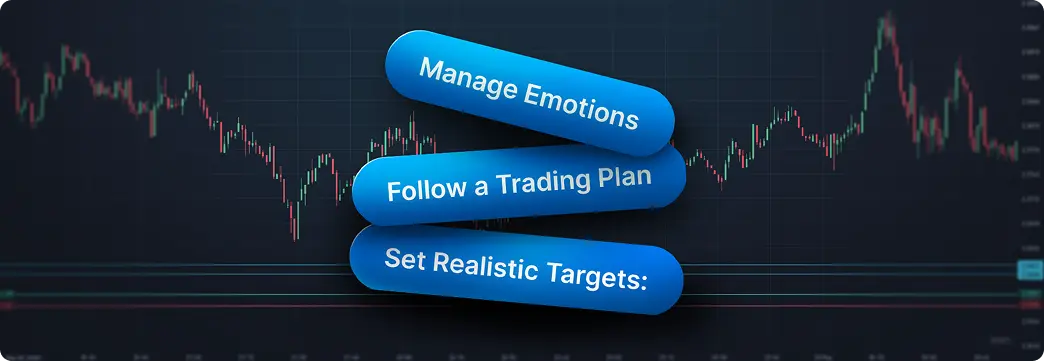
Follow a Trading Plan:A structured trading plan minimizes impulsive decisions and ensures that every trade aligns with a well-thought-out strategy.
Set Realistic Targets:Unrealistic profit goals often lead to erratic trading behavior. Instead, focus on steady and achievable targets.
Manage Emotions:Fear and greed are major hurdles to consistency. Sticking to your plan and not deviating based on emotions is key to long-term success.
Review and Adjust:Regularly analyzing your trading performance allows you to identify patterns and adjust strategies to maintain steady growth.
Conclusion
The Consistency Score is not designed to restrict trading strategies but rather to encourage stability and discipline. While a trader might occasionally land an exceptionally profitable trade that slightly lowers their Consistency Score, long-term success in trading isn't about a single big win. Instead, it's about maintaining steady and sustainable results over time.
Maintaining consistency is especially crucial during challenging periods. When traders react emotionally to losses by increasing position sizes or making impulsive trades—commonly known as "revenge trading"—they expose themselves to unnecessary risks. In trading environments like the Hola Prime Challenge or a Hola Prime Account, where certain risk parameters exist, such actions can easily result in reaching the Daily or Maximum Loss limits, leading to account termination.
Trade Like a Professional, Not a Gambler
By adopting a professional trading approach, you can preserve capital, manage risk, and achieve long-term profitability, rather than falling into the gambling trap that has led so many traders to financial ruin.
Long-term Profitability
Risk Management