

Introduction
In the world of Smart Money Concepts, two of the most powerful tools for identifying liquidity and potential price reversals are Fair Value Gaps (FVGs) and Order Blocks. While traditional support and resistance levels are helpful, these concepts allow you to see where large institutions and market makers have left "unfinished business." By understanding how to spot these imbalances and clusters of orders, you can align your trades with the "whales" rather than fighting against them. This lesson covers the mechanics of both tools and how to use them to create a high-probability trading strategy.
Defining Fair Value Gaps (FVG)
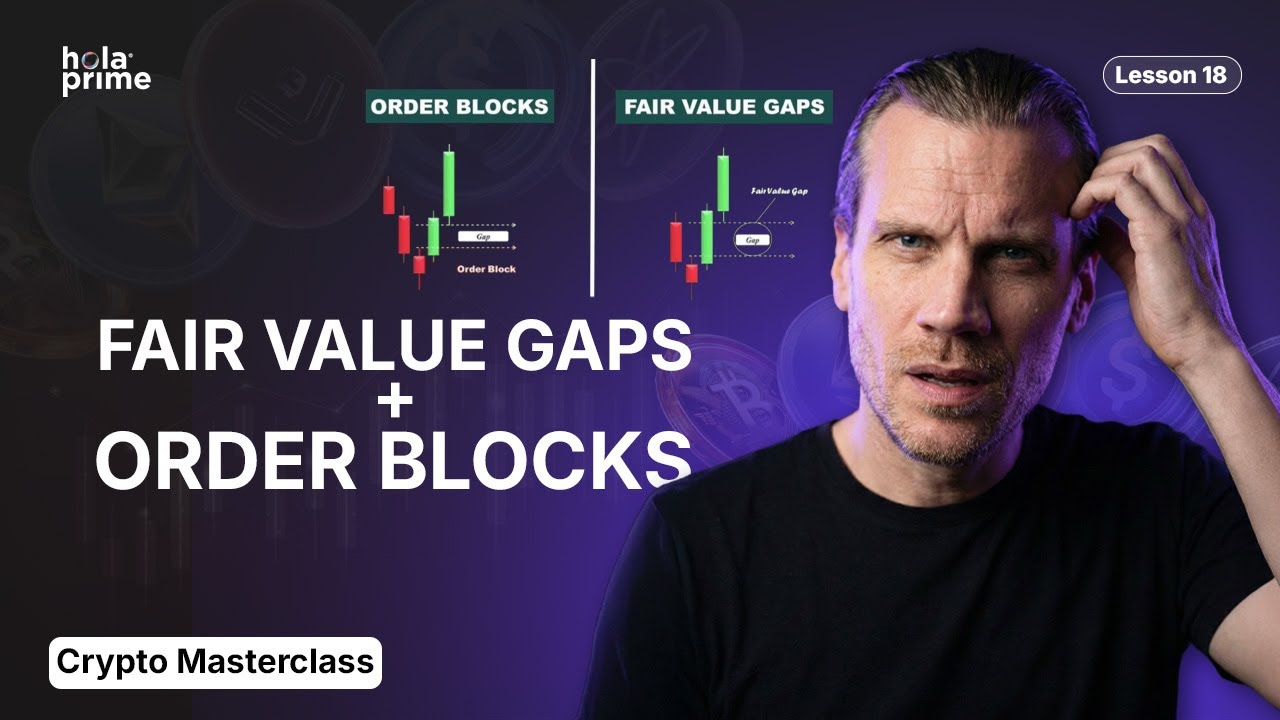
A Fair Value Gap is a temporary price discrepancy caused by an extreme imbalance between buyers and sellers. It is typically identified as a triple candle pattern where the high of the first candle and the low of the third candle do not overlap, leaving a "gap" in the middle candle's range. This gap represents an unadjusted area on the chart where price moved so quickly that many orders were left unfilled.
The Psychology of the Gap: Why Markets Fill Them
Fair value gaps act like magnets for price action. This is because:
-
Exchange Fees: Exchanges only make money when orders are filled. It is in their interest for the price to return to these gaps to process unfulfilled transactions.
-
Whales and Institutions: Market makers who couldn't get their full positions filled during a sharp move will often manipulate the price back into the gap to complete their orders before the trend resumes.
Identifying and Filtering Effective Fair Value Gaps
Not every gap is worth trading. To find the most profitable FVGs, follow these five tips:
-
Unmitigated Gaps: Focus on gaps that have not yet been touched or retested by price action.
-
Size Matters: Larger gaps represent stronger imbalances and are more likely to act as significant turning points.
-
Discount vs. Premium: Use a tool like the Gan Box to divide a price move in half. Focus on bullish gaps in the "discount" (lower) half and bearish gaps in the "premium" (upper) half.
-
Avoid Major Resistance: If an FVG forms right in front of a major historical resistance level, it is often better to ignore it as the key level may cause a rejection first.
-
Break of Structure (BOS): Gaps that form immediately after a trend change or "break of structure" have the highest win rates.
Understanding Order Blocks as Supply and Demand Zones
Unlike FVGs, which are imbalances, Order Blocks are specific price levels where market participants have placed large clusters of buy or sell orders.
-
Bullish Order Blocks (Green): Zones where massive buying interest exists. These act as high-probability support levels for a bounce.
-
Bearish Order Blocks (Red): Zones where heavy selling pressure resides. These act as reliable resistance levels for an exit or a short entry.
Order blocks give you a direct insight into investor interest at certain price points, allowing you to place your trades exactly where the "big money" is active.
Practical Execution: Combining FVGs and Order Blocks
The ultimate strategy involves looking for confluence between these two indicators.
-
The "Super Zone": If a green order block perfectly aligns with an unmitigated fair value gap, you have identified an extremely high-probability entry zone.
-
The Trade Setup: You can set a long entry at the start of the order block, targeting a bearish order block overhead for your profit-taking.
Strategic Confluence for High Win-Rate Trades
Using these tools in isolation is risky. For example, a fair value gap is not a "floor"—price can barrel straight through it if momentum is too strong. Always combine these concepts with wider market signals, such as Bitcoin’s direction, RSI divergence, or Fibonacci levels. By waiting for an FVG to be filled within a confirmed order block, you ensure you are entering the market at the most efficient price possible, following the path of institutional liquidity for maximum gain.





.png)
.png)
.png)

.png)
.png)
.png)