If you have spent some time inside any active trading community, you have probably heard the phrase “Price tells you what is happening, but volume tells you the truth behind it”. The reason is simple. Price can move for many reasons, but volume reveals interest. It shows whether buyers or sellers truly support the move or if it’s just noise. In prop trading, where your capital isn’t unlimited, and rules can be tight, volume becomes an important filter that keeps you away from weak setups and helps you stick to solid opportunities that have real participation behind them. This guide will help you understand how professional futures traders use volume to improve accuracy, reduce overtrading, and stay consistent enough to pass and keep funded accounts.
Why Volume Matters So Much to Prop Traders
Volume doesn’t just confirm moves. It helps you avoid emotional entries because the market reveals its real intentions. In prop challenges, where daily drawdown and rule deviations can quickly end your journey, avoiding low-quality moves becomes your biggest advantage. When there is strong volume behind a breakout, the market is essentially saying, “many traders agree with this direction.” That confidence can help you hold trades longer, scale up smartly, and improve your win rate. When volume is weak, a breakout may be a trap, especially in fast instruments like the Micro E-mini S&P 500 or Nasdaq futures. So your job becomes waiting for those moments where both price and participation align.
How Volume Works: A Quick Foundation
What volume actually measures
Volume counts how many contracts were traded during a specific bar. It represents activity and interest in that price range. When traders and algorithms push volume higher, money is flowing strongly and the move is more likely to continue.
What high volume means in real decisions
High volume during a breakout often shows institutional interest, not just random retail trading. In a prop setting, where you want clean setups, this is what you wait for so you can reduce failed breakouts.
What low volume means when price moves
Low volume can be misleading. Price may move only because liquidity is thin, not because real demand exists. Taking trades in these conditions often leads to stop-outs and violations of risk rules.
Volume-Based Strategies Prop Traders Use
These are the kinds of setups that prop firms love to see because they rely on confirmation instead of guessing.
1. Breakout Confirmation with Volume Surge
When price breaks through a key support or resistance level, volume needs to jump. If the breakout happens on low participation, the market may snap back and punish traders chasing the move. Funded traders look for breakouts that show commitment from major market participants.
2. Volume Divergence for Reversal Spots
A market still pushing higher while volume is falling suggests the move is losing energy. That can be an early clue to tighten your stop, scale out, or wait for a reversal signal. The key here is not predicting the reversal but preparing for it with clear risk boundaries.
3. Volume Cycles During Ranging Conditions
Markets rotate between expansion and consolidation. In sideways environments, volume usually stays low. You can use that to avoid entries that go nowhere. When volume suddenly increases again, it often marks the start of a fresh impulse move worth trading.
Indicators That Help Traders Track Volume Clearly
Volume itself is useful, but tools can make patterns easier to read and act on.
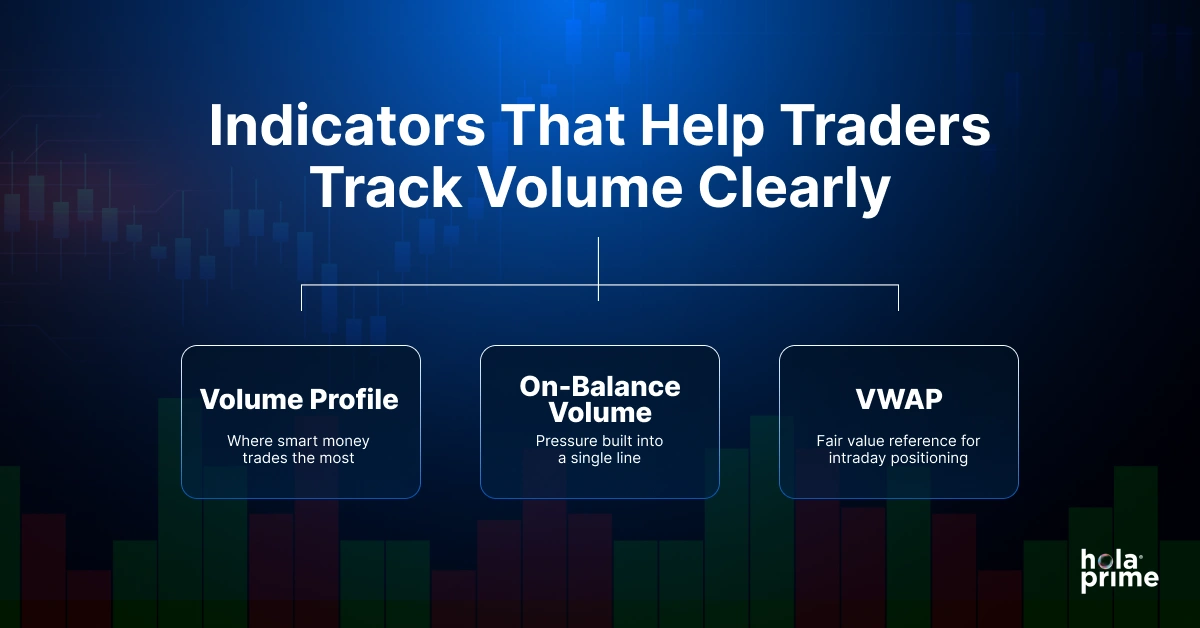
Volume Profile: Where smart money trades the most
Volume Profile shows which price levels have dense trading activity. Prop traders use these zones as targets, protective areas, or places where they want to avoid initiating new trades because price often stalls there.
On-Balance Volume: Pressure built into a single line
This indicator adds volume on up moves and subtracts on down moves, creating a trend line of participation. It helps you see whether volume supports the current direction or if momentum is quietly fading.
VWAP: Fair value reference for intraday positioning
VWAP works like a magnet for price. Most institutional trades execute near VWAP. For prop traders, entering near VWAP with volume alignment helps keep stops tight and targets clear.
Practical Rules for Staying Within Prop Firm Requirements
Volume helps you find better trades, but risk discipline keeps you funded.
Respect daily drawdown like a professional
Volume can give you confidence, but confidence isn’t a license to go bigger than your plan allows. Stick to your sizing rules.
Wait for volume confirmation even if you fear missing out
Many challenge failures happen because traders jump the gun. If the setup is strong, the market will show interest through participation.
Do not overtrade in dead volume hours
Low-volume sessions can lead to increased chop and sudden spikes. Reducing your trades during those hours protects your account and mental focus.
Use volume zones for targets
When price runs into high-volume nodes from the past, it often pauses or reverses. Use these areas to scale out or move to break even, especially during funded phases.
How Volume Can Boost Consistency in Funded Accounts
Prop firms watch performance stability closely. If your results show less randomness and more controlled execution, you are more likely to unlock scaling plans and maintain your funded capital. Volume helps you take fewer trades but with higher conviction. You avoid overreaction and stick to what the market clearly supports. Over weeks and months, this builds a profitable data profile that firms love to see.
Final Thoughts
Volume is a tool that experienced futures traders rely on every single day. It is less about predicting the future and more about reading the present with clarity. For prop traders, this clarity matters more than anything because you have rules to protect, targets to hit, and consistency to deliver. The more you base your decisions on real market participation, the easier it becomes to trade with patience and confidence.

 EN
EN DE
DE