Understanding Prop Firm Futures Challenges
Before we jump into strategies, it’s important to understand how these evaluations actually work. Prop firms design challenges to test your ability to trade with control, not luck. You’ll usually have targets like hitting a specific profit percentage, staying within daily and overall drawdowns, and trading for a minimum number of days. These rules are there for a reason - they test how well you handle both opportunity and restraint. Many traders fail not because they lack skill, but because they forget the challenge is about risk discipline as much as profits. So, the right strategy is the one that balances aggression with patience.
Core Elements That Define a Successful Futures Strategy
To pass a prop challenge, your trading plan should be built on a few strong pillars.
Consistency over high returns - that’s the first one. You don’t need to double your account; you just need steady growth without breaking rules. Prop firms reward stability over flashy gains.
Then comes adaptability. Markets don’t move the same way every week, so your approach should handle both trending and ranging periods.
Defined risk management is another non-negotiable part. Knowing how much to risk per trade and when to cut losses keeps you in the game longer.
Finally, emotional discipline. Even the best setups fail sometimes, and being able to manage your reactions is what separates funded traders from failed ones.
The Best Futures Trading Strategies for Prop Challenges
Let’s walk through the most effective trading strategies that can help you pass a futures prop firm challenge. Each one has its strengths, but your goal is to find which suits your style and fits within the firm’s rules.
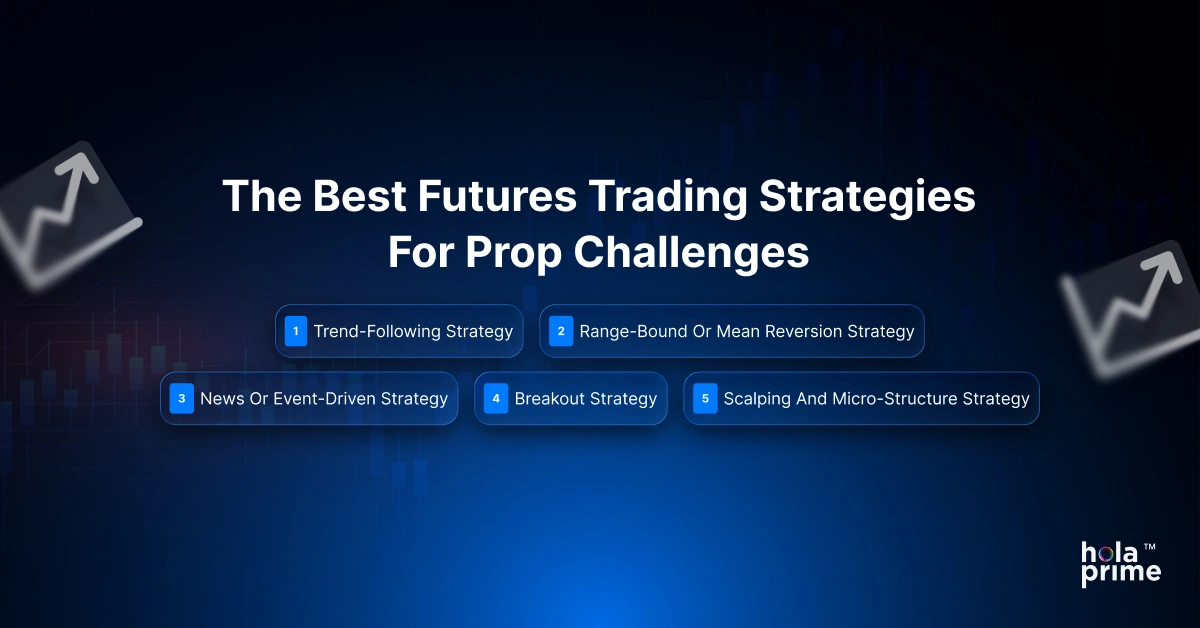
1. Trend-Following Strategy
Trend-following is one of the oldest and most reliable futures strategies. The idea is simple - find the direction of the market and trade with it. You’re not trying to predict tops or bottoms; you’re trying to ride the middle of the move. Tools like moving averages, trendlines, and momentum indicators help you identify when a trend is gaining strength.
For example, if the market is making higher highs and higher lows, you look for pullbacks to enter long trades. Trend systems work well on contracts like Crude Oil, Nasdaq, or S&P 500 where sustained moves are common. The key here is patience - let your winners run, but manage stops tightly to protect capital when the trend reverses.
2. Range-Bound or Mean Reversion Strategy
When markets aren’t trending, they tend to move sideways, bouncing between defined levels of support and resistance. That’s where range trading comes in. Mean reversion traders buy near the bottom of a range and sell near the top, expecting price to return to its average level.
To confirm these setups, tools like RSI, Bollinger Bands, or VWAP can help identify overbought or oversold zones. This approach is especially useful in contracts like Gold or the S&P 500 during quieter market sessions. It’s all about timing - get in when price stretches too far and take profit when it returns to balance. The risk is overtrading, so discipline is key.
3. News or Event-Driven Strategy
Economic reports and global events often move futures markets sharply, and skilled traders use that volatility to their advantage. Announcements like FOMC meetings, CPI releases, or weekly oil inventory reports can trigger strong short-term trends.
Before trading news, preparation is crucial. Study the expected impact, plan your entry zones, and use smaller lot sizes to manage unpredictable spikes. Avoid overreacting to the first market move - often, the best trades come from the post-news reaction rather than the initial shock. Event-driven trading can be rewarding, but only if you keep emotions in check and protect your drawdown limits.
4. Breakout Strategy
Breakout traders look for markets that have been consolidating and are ready to make a strong move in one direction. You mark key levels of support or resistance, and when price breaks out with volume confirmation, that’s your cue.
Breakouts are popular among prop traders because they fit the short evaluation period - clear entries, defined stops, and strong momentum potential. But they come with one big challenge: false breakouts. To avoid being trapped, always wait for confirmation such as a candle close beyond the level or a volume surge that validates the move.
5. Scalping and Micro-Structure Strategy
Scalping in futures involves making several small trades to capture quick moves within the day. Scalpers rely on order flow, volume profile, and short-term momentum. This strategy works best in highly liquid contracts like E-mini S&P (ES), Nasdaq (NQ), or Crude Oil (CL).
While scalping offers more trading opportunities, it also requires extreme discipline. You must know your setup, act fast, and cut losses instantly if the market turns. The biggest mistake is overtrading - taking setups out of boredom or emotion. If done right, scalping can help maintain consistency, but it’s mentally demanding and not ideal for every trader.
Risk and Money Management in Futures Challenges
Even the best strategy fails without solid risk management. During a prop challenge, you’ll have strict drawdown limits, and once you breach them, your evaluation ends. That’s why it’s better to risk small per trade - ideally 0.5% to 1% of your capital.
A simple rule: if your challenge allows a 5% overall drawdown, don’t lose more than 1% in a single day. Diversifying across contracts can also help smooth out volatility. The traders who pass most often aren’t the ones who make the biggest profits - they’re the ones who survive long enough to let their edge play out.
Psychology and Discipline Under Evaluation Pressure
Passing a prop challenge is as much a mental test as it is a trading one. The pressure to perform can easily lead to overtrading or revenge trading after a loss. This is where emotional control comes in.
Set routines help - like reviewing charts before trading hours, taking short breaks, or journaling trades daily. Many traders fail not because their strategy was wrong but because they couldn’t stick to it under stress. The ability to stay calm when things don’t go your way often determines whether you pass or start over.
How to Backtest and Build Confidence Before the Challenge
Confidence is derived from being prepared, so before you engage in a challenge in the futures market, put your strategy to work on historical data. Choose one contract, backtest it for six months or more, and record the win rate, reward-to-risk ratio, and drawdown.
This will demonstrate if and when your strategy is effective, but it will also illustrate the natural rise and fall of your strategy. Therefore, when you face a losing streak during the challenge itself, you won’t panic-because you understand that this is simply part of the game. Backtesting establishes trust in your strategy and decreases emotional trading.
Example: Applying a Strategy in a Prop Challenge Scenario
Let’s say a trader uses a simple trend-following setup on Micro Crude Oil. They risk 0.5% per trade, wait for moving average alignment, and trail stops as the price moves in their favor. Over 12 trading days, they reach the profit target without violating any drawdown limits.
This example shows how a consistent and low-risk approach can achieve the challenge goal faster than chasing big wins. It’s not about the number of trades - it’s about taking the right ones.
Common Mistakes Futures Traders Make During Prop Challenges
Many traders fail their evaluations for avoidable reasons. Over-leveraging is the biggest one - taking oversized trades because of overconfidence or frustration. Others break firm rules unintentionally, like hitting daily loss limits. Some switch strategies mid-way, losing consistency. And then there’s emotional fatigue - trading too often or ignoring rest. Passing a prop challenge is a marathon, not a sprint. Focus on staying disciplined instead of trying to prove something to the market.
Conclusion: Strategy Meets Discipline
At the end of the day, passing a futures prop firm challenge comes down to balance. You need a strategy that fits your personality, a risk plan that protects you from big losses, and a mindset that keeps you focused through ups and downs.
It’s not about trading perfectly - it’s about trading consistently. When you treat each rule as part of your edge rather than a limitation, you’ll find that passing the challenge becomes much more achievable. In futures trading, discipline is the real differentiator between potential and performance.


 EN
EN DE
DE