In this guide, we will explain what forex correlations are, why they are important, and how to apply them to mitigate risk and use them in your forex trading strategy.
What is Correlation in Forex Trading? A Simple Breakdown
Correlation in forex trading explains how two different currency pairs behave to one another. When both move in the same direction, it is generally referred to as positive correlation. In contrast, if they tend to be directed opposite to one another, this is referred to as negative correlation.
To make sense of this, think of it like friendships. Imagine you have two friends who are always doing the same thing. If one goes to the cafe, the other is likely there too. This works like EUR/USD and GBP/USD, which often copy each other’s moves since both are affected a lot by the strength or weakness of the U.S. dollar.
Some people always seem to disagree. If one enjoys summer, the other prefers winter. That’s pretty much how EUR/USD and USD/CHF act. When one rises, the other drops.
You can measure this connection with numbers between +1 and -1:
+1 shows a perfect positive link (they nearly match each other's moves).
-1 shows a perfect negative link (they move opposite each other).
0 means no clear link (they don’t affect each other much).
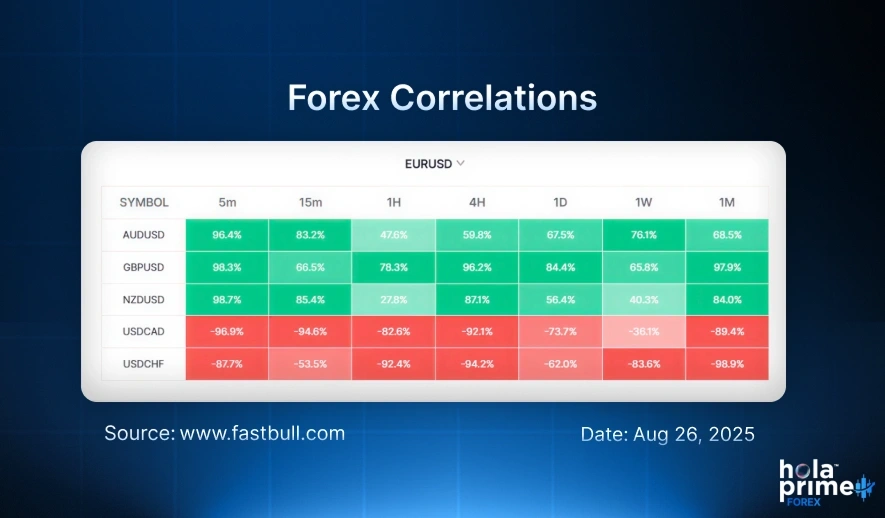
The math behind correlation might seem complex, but the main point is simple. By understanding these connections, you can avoid taking on double the risk without knowing it, for example, trading two pairs that have a positive correlation of more than .80 and improve how you manage trades overall.
Why is Correlation Important in Forex?
In forex, overlooking correlation in forex trading is similar to juggling without knowing that two of the balls stick together. You might believe you are balancing different trades, but you are often just exposing yourself to the same risks in different forms.
Let’s say you buy EUR/USD because you think the dollar will get weaker. At the same time, you also decide to buy GBP/USD for the same reason. Doing this puts you at double the risk. If the dollar gets stronger, both trades will go against you. Instead of just one small loss, you'd end up with two.
Now imagine you buy EUR/USD but sell USD/CHF instead. These pairs move in opposite directions. So when one trade struggles, the other can often balance it out. Traders use these kinds of correlations not to manage risk but to build portfolios that feel more balanced overall.
Does Correlation Always Remain the Same?
Another trait of correlation is that it shifts over time. A strong correlation this month might fade away next month because of changing political situations, movements in interest rates, or the way the market feels about things. Smart traders don’t just learn correlations and leave them; they review them and tweak their plans.
Key Types of Currency Correlations You Should Know
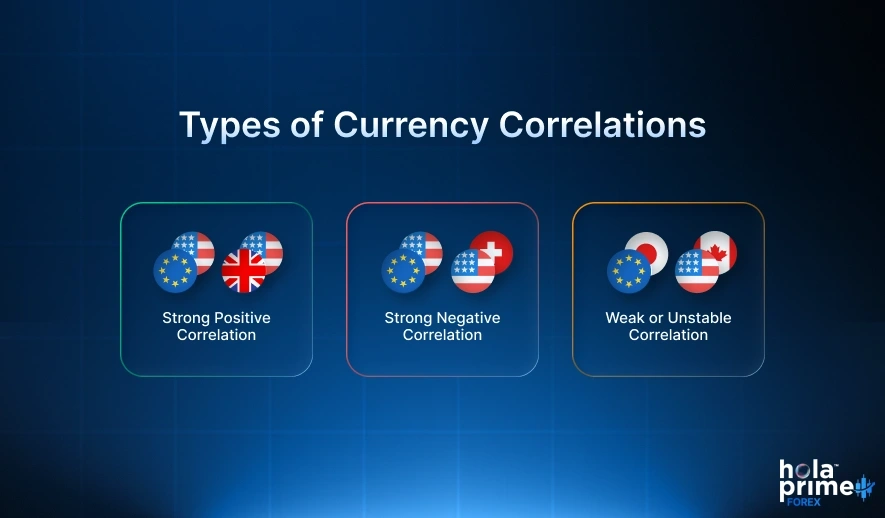
Correlations aren’t all the same. Some stay solid and predictable, while others are shaky and less dependable. Below are the main types you’ll notice:
1. Strong Positive Correlation: Pairs That Move Almost the Same Way
This happens when two currency pairs almost mirror each other’s movements. A clear example is EUR/USD and GBP/USD. Both pairs connect to the U.S. dollar so they tend to respond to changes in the dollar's strength. If you trade both at the same time, you might repeat the same trade.
2. Strong Negative Correlation: When Pairs Move Opposite Ways
One pair going up means the other is heading down. A good example is EUR/USD and USD/CHF. People trading these often look at both because they balance each other out. If you lose on one, the other could help cover it.
3. Weak or Unstable Correlation: Pairs Without a Clear Link
Some pairs don’t show strong connections. They might line up now and then but tend to go their own ways depending on things like news, decisions by central banks, or specific events. Weak correlations aren’t solid enough to build a strategy around. For example, EUR/JPY and USD/CAD pair has unstable correlation.
How to Measure Forex Correlations
To use correlations in trading , you can’t rely on guesses. You need methods you can trust.
One easy way is to check the correlation tables that brokers often provide. These tables display how currency pairs relate to each other across different periods, like a week, a month, or six months.
You can also choose to calculate correlations on your own in Excel. By examining past price data, you can figure out how pairs have moved in relation to each other. This method needs more effort but gives you control over the time periods you study.
The main thing to keep in mind is that correlations can change over time. They adjust when economies evolve, interest rates fluctuate, or major global events take place. A pair that had a strong positive correlation last year might behave differently now. This makes it essential to check correlations.
How to Use Correlation in Trading?
It’s one thing to understand correlation, but the real value comes from putting it into action in your actual trades. Here’s how you can do that:
1. Managing Risk with Opposing Trades:
Imagine you’ve bought EUR/USD but feel unsure because the dollar could get stronger. Instead of just closing your position, you might decide to sell USD/CHF. This second trade can offset some of your potential losses if the dollar gains value.
2. Avoiding Hidden Overexposure:
Some traders assume opening several trades means reducing risk, but that isn’t true when the currency pairs are linked and in positive correlation. Checking correlations can show if you’re diversifying or just repeating the same risk in a different trade.
3. Boosting Trading Signals:
Spotting two positively correlated pairs moving the same way at once can indicate stronger momentum in the trend. For instance, if EUR/USD and GBP/USD both break important levels at the same time, it adds more confidence to your setup.
Easy Steps to Hedge Using Different Currency Pairs
Here’s a simple way to use correlations when building a hedging plan:
Pick Your Primary Trade: Decide on the main position you plan to trade. For example, you could go long on EUR/USD.
Review Pair Correlations Before Adding Trades: Pay attention to how other currency pairs behave compared to the one you’ve chosen.
Choose a Pair to Balance Your Trade: If you picked EUR/USD, you might pair it with USD/CHF as a hedge since they often move in opposite directions.
Manage Position Sizes: Don’t make both trades the same size. Adjust lot sizes so your hedge reduces risk but still leaves room for profit.
Watch and Adapt: Track if the correlation stays steady. If it gets weaker, you might have to change or close your hedge.
Hedging doesn’t guarantee you’ll dodge every loss. It does, however, help even things out and can make your trading feel less overwhelming.
Advantages and Drawbacks of Correlation:
Just like other forex strategies, correlation trading has its pros and cons.
One big advantage lies in risk management. You can spread out your risk by using related currency pairs instead of relying on a single trade. It also helps to avoid risks like putting too much on the line, which is a mistake many new traders often fall into. When several pairs support your analysis, it can make you feel more confident about your trade plan.
A big drawback of correlation in forex trading is that it needs regular checking. Pair relationships don’t stay the same and can shift. Using old data might lead you to hedge the wrong way. You also need to account for transaction expenses. Each extra trade adds spreads or swaps, which can reduce gains. Mastering correlation strategies takes effort and experience. You won’t become an expert at it right away.
Conclusion:
Correlation in forex trading holds a lot of value. Without knowledge about correlation, there are chances that you might end up placing trades on two pairs that are positively correlated to each other. This way, you might end up amplifying your risk. Hence, when used mindfully, correlation in forex trading can be a great tool that you can use in your forex trading strategy. It can help you hedge risk, choose the right pairs to trade, and take your overall forex trading game to a whole new level.


 EN
EN DE
DE