In this blog, we’ll discuss what ATR is, why it’s important, and how you can use it for position sizing. We’ll also walk you through step-by-step examples so you can see how ATR sizing works in real-world trading. Whether you’re trading forex, stocks, or crypto, the principle remains the same: ATR helps you balance your risk with market volatility.
What is ATR?
The Average True Range (ATR) is a volatility indicator developed by J. Welles Wilder. Unlike momentum or trend indicators, ATR doesn’t care whether a market is bullish or bearish. Instead, it looks at the size of price movements - in other words, how much the price is fluctuating over a given period.
The calculation involves measuring the “true range,” which accounts for the current high-low range, gaps from the previous close, and intraday swings. The most commonly used setting is 14 periods, meaning the ATR shows the average of the last 14 periods’ ranges.
For example, if the EUR/USD has an ATR of 50 pips on the daily chart, it means the pair has been moving, on average, about 50 pips per day. Traders can use this information to decide how far to place stop losses, how much to risk, and ultimately, how big their position should be. Unlike arbitrary stop levels or fixed lot sizes, ATR adapts automatically to changing conditions, making it a far more practical approach.
How to Calculate ATR?
The ATR is calculated using True Range (TR). True Range captures the most realistic measure of how much price has moved during a period, accounting for gaps and sudden jumps. Once you calculate the True Range, ATR is just the moving average of those values.
The formula looks like this:
True Range (TR) = max [(High – Low), |High – Previous Close|, |Low – Previous Close|]
In simple words, you take the greatest value among:
- Today’s high minus today’s low
- Absolute value of today’s high minus yesterday’s close
- Absolute value of today’s low minus yesterday’s close
This ensures gaps between sessions are included, not just intraday ranges.
Once you have TR, you calculate ATR like this:
ATR = (Previous ATR × (n – 1) + Current TR) ÷ n
Where n is the chosen period (most traders use 14).
This formula is called Wilder’s smoothing method, and it’s very similar to an exponential moving average.
Why Position Sizing Matters in Trading
One of the fastest ways traders blow accounts is by trading the wrong position size. Think about it this way: you can be right about market direction, but if you’re oversized, even a small pullback can wipe out a major chunk of your capital. On the other hand, if you’re undersized all the time, you might protect your capital but never grow it meaningfully.
The real goal of position sizing is balance. You want to take enough risk so that your wins matter, but not so much that one losing streak ends your journey. ATR helps by linking your position size directly to market volatility. When the market is calm, you might take a slightly larger position since the risk of large swings is lower. But when the market is volatile, ATR signals you to reduce your size so you don’t overexpose yourself.
Without this kind of adaptive method, traders often stick to fixed lots or arbitrary stop-loss and take-profit levels. That’s like driving at the same speed whether it’s a sunny day or a snowstorm - it works fine until conditions change suddenly. ATR ensures your “speed” matches the road conditions of the market.
ATR and Volatility: The Connection
Volatility is the heartbeat of the market. Sometimes price crawls in tight ranges, and other times it moves like a roller coaster. The ATR is essentially a volatility meter, showing you how much breathing room the market needs.
When ATR is low, it means the market is quiet. Placing a stop that’s too wide in such conditions might unnecessarily shrink your position size. On the flip side, when ATR is high, it means the market is making larger moves. Using a tight stop in these moments often leads to getting stopped out prematurely. That’s why ATR-based sizing is powerful: it ensures you always give the trade enough room, but without risking more than your account can handle.
How to use ATR in a trading strategy?
1. Fixed Percentage Risk with ATR-Based Stops
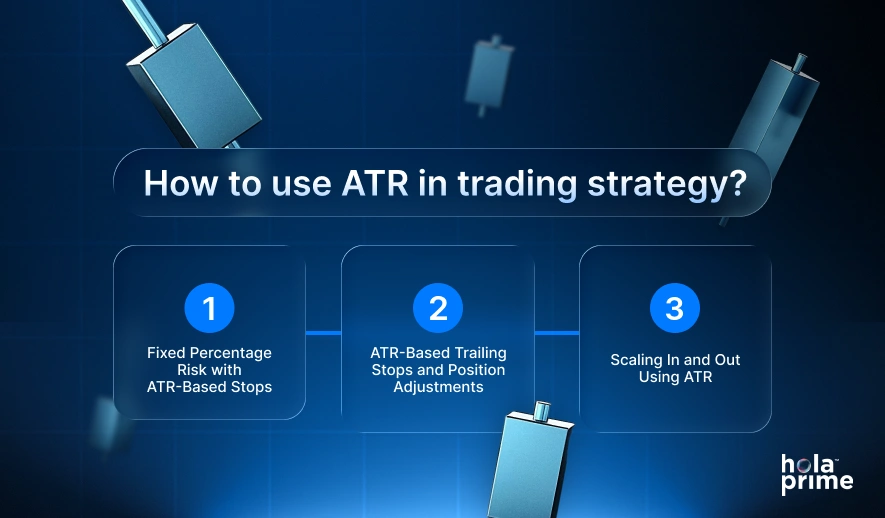
This is one of the most popular systems. You first decide your risk per trade as a percentage of your account. For example, let’s say you want to risk 1%. Next, using the ATR, you would set up your stop distance. For example, if your ATR is 50 pips and your stop is 2x ATR, or 100 pips, then that means you are risking 1% on $10,000 account, which means $100. You then set your position size to where a 100-pip loss will equal your $100 risk.
This method is powerful because it allows you to keep your risk the same for all trades, regardless of the pair or instrument. So you could be on EUR/USD with 50 pips of ATR or GBP/JPY with 150 pips of ATR, but your risk is 1%.
2. ATR-Based Trailing Stops and Position Adjustments
ATR isn’t just for initial stops. Many traders use it for trailing stops, too. For example, once your trade is in profit, you can trail your stop at 1.5x ATR behind the price. This way, you lock in profits while still allowing room for normal price fluctuations.
In volatile markets, ATR trailing stops adapt automatically. If volatility spikes, your trailing stop widens to give the trade breathing room. If volatility contracts, the stop tightens, helping you secure more profits. This dynamic approach works much better than arbitrary trailing stops.
3. Scaling In and Out Using ATR
An even more sophisticated way to use ATR is when you are adding to or reducing your position. For example, you could start with a half-sized position and add to it if the market moves 1x ATR in your favor. Just as you could scale out on a position by taking partial profits for every 1 ATR distance that the price moved.
This alone would allow you to keep your risk adaptive, but more importantly, it allows you to not become too committed too soon when the market is volatile. It will allow you to remain in a trend with less discomfort, knowing you are varying your level of exposure to the trend as the market actually behaves.
Advantages of ATR-Based Position Sizing
The biggest benefit is consistency. ATR makes sure that no matter what market you trade, your risk stays stable. It prevents you from taking massive risks on volatile pairs like GBP/JPY while taking tiny, almost meaningless risks on calm pairs like EUR/USD.
Another advantage is adaptability. Markets change - sometimes they trend smoothly, sometimes they chop violently. ATR adapts instantly to these conditions, keeping your stops and sizes in line with reality.
Lastly, ATR is universal. It works in forex, stocks, futures, and even crypto. Wherever volatility exists, ATR can help you size smarter.
Limitations of ATR
The biggest drawback of ATR is that it just reflects the volatility of the instrument, but not the direction. By seeing the ATR of 70, you might get an idea that the market is very volatile, but you’ll not get an idea about which way the market would go.
Another drawback is that it is a lagging indicator and does not show the live volatility of an instrument. This is so because it is based on the previous data.
For the best use of ATR, it can be used along with other indicators. It will not only help you judge the market right, but also choose the right positions.
Tips to Use ATR
If you are new to using the ATR, stick to 14 for your first use of the ATR. When you assess your own trading goals and your own timeframe involves smaller movements (faster capitalization), you can then experiment with shorter ATR calculations (fast response), or even longer ATR (smoother).
Always backtest your ATR sizing and strategy. All (or most) traders will have different holding times and risk tolerance on any instrument. Each trader wants to see how their ATR (setting) will fit into their system. Many traders will also utilize the ATR in combination with more tools like moving averages and/or Fibonacci levels to assist in refining their entry and stop orders.
Remember you are using ATR and Institute it toward consistency and not perfection. The trading with the ATR will have losing trades. Your goal is to ensure those losses are managed and survivable, so you can trade again for the next opportunity.
Conclusion:
Position sizing is one of the most neglected aspects of trading, but it is what distinguishes the professional from the hobbyist. ATR-based size is an excellent way to size positions while still controlling risk and offering you the potential to stay consistent across trades. It allows you the flexibility to account for volatility, keeps your losses manageable, and avoids the extremes of being overexposed or worse, under-traded.
To trade like a pro, you need to spend less time thinking about how much you can make and more time thinking about how much you can afford to risk. Using ATR to size your positions is an extremely straightforward and effective way to do this; it is no guarantee of winning, but it guarantees that you will survive, and survival is everything in trading.

 EN
EN DE
DE