
At its core, a forex technical strategy is simply a structured way of making trading decisions based on chart analysis. Instead of watching news headlines or central bank reports, technical traders believe that price already reflects everything.
At its core, a forex technical strategy is simply a structured way of making trading decisions based on chart analysis. Instead of watching news headlines or central bank reports, technical traders believe that price already reflects everything.
Imagine it like this: the chart is a giant memory bank of trader behavior. Every candle, every spike, every sideways move is a reflection of fear, greed, supply, and demand. By studying these movements, technical traders try to predict the next wave.
In practical terms, forex technical strategies might involve looking for repeating chart patterns (like head and shoulders), following momentum with indicators (like moving averages), or simply tracking support and resistance zones.
The beauty of technical strategies is their visual simplicity. You don’t need a PhD in economics. You just need a chart and some tools. But this simplicity can also become a trap, especially in prop firm challenges where rules are rigid, and small mistakes get amplified.
Before we dive deeper, let’s clear up the age-old debate: technical vs. fundamental analysis.
In reality, both approaches have strengths. But here’s the catch: in prop firm challenges, traders often lean entirely on technical strategy for forex because it feels easier to systematize. Unfortunately, ignoring fundamentals can create blind spots that sabotage their progress.
There’s no shortage of forex technical analysis strategies. YouTube is flooded with “foolproof systems” that promise riches. Let’s look at the most common ones:
The classic “trend is your friend” strategy. Traders use moving averages or price action to identify direction and ride the wave. Works beautifully - until markets enter consolidation.
Here, traders wait for the price to break out of a consolidation zone or key level. The hope is that the breakout will lead to strong momentum. The problem? False breakouts are everywhere.
This involves buying at support and selling at resistance in sideways markets. It feels logical—until sudden news smashes through the range.
Quick-fire trades that aim for small profits multiple times a day. Great in theory, but prop firm spreads, commissions, and time constraints often make it unprofitable.
Holding trades for days or weeks to catch medium-term moves. While effective, swing trading collides with prop firm deadlines, where traders often need to show results within 30 days.
Each of these strategies can be profitable in the right conditions. But in the rigid world of prop firm evaluations, they often stumble.
Indicators are the bread and butter of most technical strategies. They’re like glasses - helping you see the chart more clearly. But just like glasses, if you rely too heavily, you may stop trusting your own eyes.
Popular ones include:
These tools are valuable, but prop firm challenges often expose their weaknesses. For example, indicators lag behind price, which can cause missed entries or premature exits.
For beginners, indicators feel like a safety net. They give a sense of certainty: “If the RSI is overbought, I’ll sell. If the moving average crosses, I’ll buy.”
But in reality, indicators aren’t crystal balls. They’re mathematical reflections of past price, not predictors of the future. Prop firm traders often fail because they treat indicators as infallible signals instead of just one piece of the puzzle.
One of the biggest traps in technical trading is the search for the “perfect setup.” Traders scroll charts endlessly, hoping to find that textbook pattern that guarantees profit.
The truth? Perfect setups rarely exist in live markets. Most signals are messy, filled with noise, and don’t play out as expected. This obsession with waiting for perfection can cause traders to overtrade when something finally “looks good,” only to break prop firm rules in the process.
A proprietary trading firm (prop firm) is like a financial sponsor for traders. Instead of risking your own money, you trade with the firm’s capital. In exchange, you share a percentage of the profits - often 70% to 90% goes to you, and the rest to the firm.
Sounds like a dream, right? You trade big accounts (sometimes $100,000 or more) without putting in your own savings. But here’s the catch: before you get access to the firm’s funds, you must prove you’re disciplined and skilled enough to handle the risk.
This is where the infamous prop firm challenges come into play.
A prop firm challenge is essentially a trading audition. The firm sets specific rules and targets, and you must follow them precisely while trading. If you pass, you move on to verification. If you succeed there, you get funded.
The most common structure looks like this:
Many new traders underestimate how mentally demanding these stages are.
So even though traders rely on their forex technical analysis strategies, the mental game of passing these stages is a much bigger deal than most anticipate.
Prop firm rules vary, but here are some that commonly trip traders up:
Most forex technical strategies aren’t built with these constraints in mind, which is why they break down during challenges.
You might wonder: why are these rules so strict?
It’s simple - risk management. Prop firms survive because they don’t let reckless traders blow their accounts. By setting hard drawdown limits, they filter out gamblers and undisciplined traders.
Think of it this way: if you were lending someone $100,000 to trade, wouldn’t you want to make sure they could handle risk? That’s exactly why prop firms enforce these parameters.
Many traders who are profitable in their personal accounts still fail challenges because they’ve never trained to work within such tight guardrails.
Another underestimated factor is the psychology of trading with someone else’s money.
When it’s your own cash, you might shrug off a $200 loss. But when you know the firm is monitoring every move, those same $200 losses feel magnified.
This psychological pressure often makes traders abandon their carefully crafted forex technical strategies and fall into emotional traps like revenge trading, fear of pulling the trigger, or over-leveraging just to meet targets.
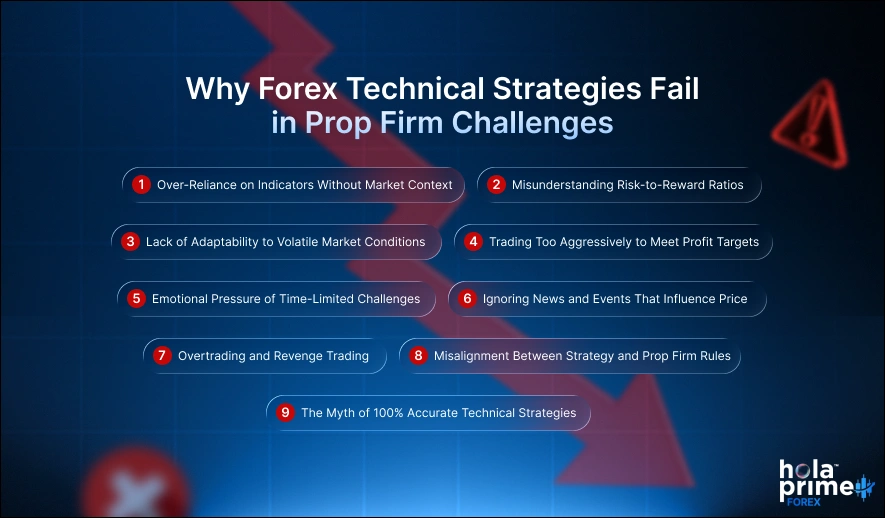
One of the biggest reasons forex technical strategies collapse in prop firm challenges is that traders lean too heavily on indicators.
Indicators like RSI, MACD, or Bollinger Bands are great tools, but they’re not magic. They’re lagging reflections of past price action. If you only trade based on what your indicators say, you’re often reacting after the market has already moved.
In prop firm challenges, where drawdowns are unforgiving, relying on indicators without considering price action and market context almost always leads to premature stop-outs. For example:
In short: indicators should support, not lead, your decisions. Prop firms punish traders who forget this.
A technical setup may look perfect, but if the risk-to-reward ratio doesn’t align with prop firm rules, it’s doomed from the start.
For example, many traders chase trades with a 1:1 risk-reward ratio. That might work in personal trading, where you have flexibility, but in a prop firm challenge, you need to account for:
The winning formula is usually around 1:2 or 1:3 risk-to-reward, combined with strict position sizing. Unfortunately, many forex technical strategies found online ignore this reality.
Prop firm challenges don’t give you the luxury of waiting for perfect markets. You’re often forced to trade in whatever market environment exists during your challenge window - ranging from trending markets to choppy, news-driven volatility.
Technical traders who only know how to trade one type of condition (like trends or ranges) often fail when markets shift. For example:
Prop firm challenges demand adaptability. Traders who fail to adjust their strategies to volatility conditions usually don’t make it past Phase 1.
Here’s a classic trap: you see the target is 10% in 30 days, and panic. Suddenly, your normal 1% risk per trade becomes 3%, then 5%. You start over-leveraging because the deadline is looming.
This approach almost always leads to disaster. Why? Because it violates the number one rule of trading: protect your capital first, grow it second.
Prop firms design their rules this way intentionally. They want to see if you can stay disciplined under pressure. Sadly, most traders abandon discipline and go “all in” chasing targets. That’s why forex technical analysis strategies that work in personal accounts collapse under challenge pressure.
In your personal trading, if you don’t see a setup today, no problem - you wait. In a prop firm challenge, every day without a trade feels like wasted time. That pressure forces traders into low-quality trades.
For example:
This emotional pressure sabotages otherwise sound technical strategies. A good system depends on patience, but the ticking clock makes patience feel impossible.
Many traders think, “I’m a technical trader. I don’t care about the news.” That mindset is dangerous in a prop firm challenge.
Take this scenario: You identify a beautiful support zone on GBP/USD and enter long. But in 20 minutes, the Bank of England announces a surprise rate hike. Your technical setup gets crushed instantly.
The lesson? Even if you’re focused on technical strategy for forex, you can’t ignore fundamentals - especially during prop firm challenges where one news-driven spike can ruin your entire evaluation.
Another common downfall is overtrading. After one loss, traders feel the urge to “make it back” quickly. So they jump into the next setup, even if it’s weak. Before they know it, they’ve violated the daily drawdown rule.
This emotional spiral, known as revenge trading, is the death of many prop firm accounts. The rules are designed to catch this exact behavior. Even if your forex technical analysis strategy is solid, once emotions take over, the system goes out the window.
This is perhaps the most overlooked point: not every technical strategy is compatible with prop firm rules.
For example:
Just because a strategy works in your personal account doesn’t mean it’s appropriate for a prop firm challenge.
Finally, let’s address the elephant in the room: there is no such thing as a 100% accurate technical strategy.
Many traders buy courses or systems promising “95% win rates.” But in reality, all systems have losing trades. In a prop firm challenge, traders often panic after a couple of losses and abandon their strategies altogether.
The key isn’t perfection - it’s risk management and consistency. Prop firms care less about your win rate and more about whether you can survive losses without emotional breakdowns.
“Trend is your friend” - every trader has heard it. And in theory, trend-following is one of the strongest forex technical strategies. But in practice, trend trading faces serious issues during prop firm challenges.
Here’s why:
In short, trend-following works, but unless adjusted for prop firm conditions (smaller position sizes, tighter stops, and realistic profit goals), it’s a recipe for failure.
Breakout trading is another favorite. Traders look for consolidations, wedges, or ranges and enter when the price finally “breaks out.”
The problem? False breakouts. Markets love to trick breakout traders:
In personal accounts, you can survive multiple false breakouts. In a prop firm challenge, just two or three failed breakouts may wipe out your daily drawdown.
The second issue is news volatility. Many breakouts occur around news events. If you trade without considering fundamentals, you’ll often get caught in whipsaw moves.
So while breakout trading is powerful, it’s one of the riskiest technical strategy forex approaches for strict prop firm conditions.
Range trading, buying at support, selling at resistance, works beautifully in calm, sideways markets. But during prop firm challenges, volatility is often high because of the very markets traders flock to: EUR/USD, GBP/USD, XAU/USD.
Here’s why range strategies fail:
This means range trading is often incompatible with the ticking clock of prop firm challenges.
Scalping is perhaps the hardest strategy to succeed with in a prop firm environment. On paper, it sounds perfect: take dozens of small trades, stack tiny wins, and slowly grind toward your target.
But the reality is brutal:
While some elite traders succeed at scalping in prop firms, for most, it’s a fast path to failure.
Swing trading is often marketed as the most “relaxed” forex technical strategy. Hold positions for days or weeks, catch bigger moves, and avoid noise. Sounds good, right?
Not in the prop firm challenges. Here’s why swing traders struggle:
Swing trading works brilliantly in personal accounts but needs serious tweaking to pass prop firm evaluations.
Lastly, let’s talk about strategies overloaded with indicators. Traders love stacking RSI, MACD, Stochastics, Bollinger Bands, Ichimoku clouds, and more - believing the more signals align, the stronger the trade.
The truth? Indicators lag. By the time they all align, the market has often already moved. In prop firm challenges, where timing is everything, this lag creates late entries and poor exits.
Worse, too many indicators cause analysis paralysis. You hesitate, second-guess, and miss the trade altogether. Then, pressured by time limits, you jump into the next setup without proper confirmation.
Prop firms expose the weakness of indicator-heavy systems. Pure price action, combined with a few carefully chosen tools, usually performs better.
When trading your own small account, a $200 loss might sting, but it’s your money—you accept it. In a prop firm challenge, however, traders are hyper-aware that they’re playing with “firm money.”
That fear of loss often translates into:
Ironically, this fear-driven caution often leads to breaking rules or missing profits, which is exactly what causes failure.
On the flip side of fear lies greed. Prop firm challenges often set targets like 10% in 30 days. This pushes traders to think: “If I just risk bigger, I’ll hit the target faster.”
Here’s what typically happens:
This is how greed sabotages even sound forex technical analysis strategies. The math of trading only works if risk is consistent. Prop firms use strict limits specifically to weed out greedy traders who treat challenges like lotteries.
Every solid technical strategy for forex relies on patience. The best setups don’t appear every hour, sometimes not even every day. But prop firm deadlines make traders restless.
This restlessness leads to:
Patience is a trader’s greatest edge, but the ticking clock of a challenge makes it incredibly hard to hold on to.
The first few trades in a challenge set the tone. If you start with 2–3 small losses, many traders spiral into doubt.
Thoughts creep in like:
This constant switching creates inconsistency, and inconsistency guarantees failure. The strategy itself might have been fine, but the trader lost faith before it could play out.
The opposite problem also happens. Let’s say you hit 3 great wins early in the challenge. Suddenly, you feel unstoppable. Confidence turns into overconfidence, and you start taking reckless trades.
This looks like:
Overconfidence is just as dangerous as doubt. In fact, many traders blow their accounts right after a winning streak because they abandon discipline.
Here’s something most traders skip: journaling.
In personal trading, you might shrug off losses and move on. But in a prop firm challenge, every trade matters. Without reviewing trades, you repeat mistakes blindly.
Journaling helps you:
Prop firms reward consistency, and journaling is the tool that builds it. Ignoring this step is like walking through a maze blindfolded.
The first step to building resilience is customizing your forex technical strategies to match the rules of the prop firm.
For example:
In other words, don’t just bring your personal trading system into a challenge unchanged. Instead, re-engineer it to fit the evaluation parameters. Traders who skip this step almost always fail.
Indicators can be helpful, but in prop firm challenges, price action often works better. Why? Because price is immediate. Indicators lag.
Here are some price-action techniques that improve resilience:
By simplifying your charts and relying more on raw price behavior, you’ll avoid analysis paralysis and trade faster, cleaner setups.
Even if you’re a technical trader at heart, ignoring fundamentals is dangerous.
Imagine trading EUR/USD purely based on moving averages, only to have the ECB announce a surprise policy shift. Your strategy gets blindsided.
The resilient approach is to combine both:
You don’t have to become an economist, but keeping an economic calendar open while trading can save your account.
Here’s a truth bomb: most traders don’t fail because of bad strategies; they fail because of bad risk management.
In prop firm challenges, risk is everything.
Resilient strategies are built on protecting capital first. Passing a challenge isn’t about hitting targets fast; it’s about avoiding disqualification.
Markets don’t stay the same. Sometimes they trend, sometimes they range, sometimes they chop.
Rigid strategies fail because they don’t adapt. Resilient strategies evolve:
Think of it like surfing: you don’t fight the waves, you ride them. The more flexible your strategy, the better your odds of passing.
A trade plan is your personal rulebook. Without it, emotions take over. Resilient traders write plans that include:
This plan isn’t just paperwork; it’s a lifeline. When stress hits, the plan keeps you grounded.
Many traders backtest strategies on old charts, but here’s the mistake: they test without considering prop firm rules.
A resilient trader backtests by asking:
This kind of rule-based backtesting ensures your system is not only profitable but also compatible with the evaluation.
Finally, one of the smartest steps is to simulate the challenge before paying for it.
Many platforms allow you to create demo accounts with similar rules to prop firms. By practicing under these conditions, you’ll:
This rehearsal prevents costly “first attempt” failures.
Many traders think: “If my forex technical strategies work, I’ll pass easily.”
But that’s not true. Prop firm challenges are not just about winning trades - they’re about discipline, consistency, and control.
You can have the most profitable technical system in the world, but if you break daily loss limits or get emotional, you’ll fail. That’s why smart traders approach the challenge holistically: strategy + psychology + routine.
A huge mistake is aiming to “smash the target fast.” Traders often go all-in, hoping to hit the profit goal in a week. That almost always ends in blown accounts.
Instead, break the target into small daily goals.
Trading with small daily goals reduces pressure and allows your technical strategy to work naturally without forcing trades.
Here’s an underrated tool: a trading journal.
A journal is more than just a record of wins and losses. It’s a mirror showing your habits. In it, write:
Over time, this journal becomes your best coach. It shows patterns like: “I lose more during news events” or “My Asian session trades are weaker than London session ones.”
Prop traders who journal grow much faster than those who don’t.
Prop firms don’t care if you take 100 trades or just 10 trades - they only care if you respect rules and hit targets.
Smart traders are selective. Instead of chasing every flicker on the chart, they wait for high-probability setups. Sometimes that means sitting out for a whole day.
Think of it like fishing: the best fishermen don’t cast their net every second. They wait for the right moment.
Even with solid forex technical analysis strategies, the real battle is often with your own mind.
Prop firm challenges are pressure cookers. You know money is at stake. You know you’re being evaluated. That pressure can trigger:
The smarter approach is to expect these emotions in advance. Build routines to manage them:
Here’s a secret: most successful prop traders didn’t pass on their first attempt.
Instead of treating a failed challenge as a loss, treat it as tuition. Each attempt teaches you something new about:
This mindset shift makes you smarter and calmer with each try.
Trading can feel lonely. But smart traders seek mentorship or join communities of other prop firm traders.
Learning from others shortens the painful trial-and-error process.
One final smart move: don’t let the challenge consume your entire life. Traders who obsess 24/7 often burn out.
Instead:
This balance gives you the clarity to make better trading decisions.
Many beginners think loading up their charts with indicators (MACD, RSI, Stochastic, Bollinger Bands, all at once) will make them invincible.
But here’s the truth: indicators lag. They only show you what has already happened. By the time all your indicators agree, the move may already be over.
Instead of using them as crystal balls, treat indicators as confirmation tools. Combine them with raw price action, support/resistance levels, and market context. Less is often more.
Some traders believe the more they trade, the faster they’ll hit profit targets. In prop firm challenges, this is a dangerous trap.
High-frequency trading without a tested edge usually leads to:
Passing a challenge isn’t about speed; it’s about consistency and survival.
Scalping seems attractive: quick entries, quick exits, small pips here and there. But in reality, scalping is extremely difficult in prop firm environments because:
Unless you’re a seasoned scalper with proven consistency, a swing or intraday approach is often safer.
Traders love bragging about win rates. But in prop firm challenges, win rate means little without proper risk management.
For example:
Prop trading isn’t about winning every trade; it’s about protecting equity and managing losses.
YouTube and Telegram are full of “secret forex technical strategies.” Many traders blindly copy them, thinking they’ve found the golden ticket.
But what works for one trader may not work for another. Why?
A strategy isn’t just rules; it’s a reflection of the trader behind it. That’s why adaptation and personalization are crucial.
This myth circulates often: “Prop firms design rules so you’ll fail.”
The reality is nuanced. Yes, firms know most traders won’t pass, but that’s not because of “rigged rules.” It’s because most traders lack discipline.
In fact, firms benefit from funding profitable traders (since they split profits). The rules are there to filter for consistency, not perfection.
Backtesting is useful, but it’s not the full picture. Historical data doesn’t capture:
A strategy that shines in backtests can collapse in live conditions if not forward-tested in a demo or small live account first.
Some traders think once they pass one evaluation, they’re set for life. The truth? The real challenge begins after funding.
Sustainable success in prop trading is about long-term consistency, not one lucky evaluation.
Finally, the biggest myth of all: believing that forex technical analysis strategies alone will guarantee passing.
The truth is:
Ignore one pillar, and the whole system collapses.
Passing a prop firm challenge isn’t just about being a good trader; it’s about being the right kind of trader for their rules.
Many strategies fail simply because they weren’t designed with these rules in mind. Let’s break down how you can adapt your approach.
Before applying any strategy, know the boundaries you’re working within.
Adjustment Tip: Scale position sizes down so you can survive losing streaks without breaking rules.
Many retail traders use inconsistent risk/reward ratios. But in prop trading, that’s a recipe for disqualification.
Adjustment Tip: Test how your strategy performs with higher R:R ratios while staying within firm rules.
Prop firm challenges usually give you 30–60 days. This time pressure can tempt traders to overtrade.
Adjustment Tip: Match your strategy’s natural rhythm to the challenge period; quality beats quantity.
Some strategies thrive on volatility, like trading NFP (Non-Farm Payrolls) or FOMC announcements. But in prop firm rules, that’s risky.
Adjustment Tip: If you’re a news trader, cut position sizes drastically during events or avoid them altogether during challenges.
Prop firms often use specific brokers or liquidity providers. Your strategy might behave differently due to spreads, commissions, or slippage.
Adjustment Tip: Simulate live conditions in advance; what worked in theory must work in the firm’s environment.
Prop firms don’t just want profits; they want sustainable traders.
Adjustment Tip: Prioritize rule compliance first. Think: Can this trade break the rules, even if it wins?
Many technical strategies assume constant trading. In prop firm challenges, sometimes not trading is the best trade.
Adjustment Tip: Add a built-in “preserve profits” phase into your strategy to secure passing.
Adapting strategy isn’t just about charts; it’s also about mindset.
Adjustment Tip: Create checkpoints to ensure discipline isn’t slipping under time pressure.
Prop firms love consistency. A flashy strategy that worked once but can’t be repeated isn’t valuable to them.
Adjustment Tip: Simplify until it’s foolproof, even on your worst trading days.
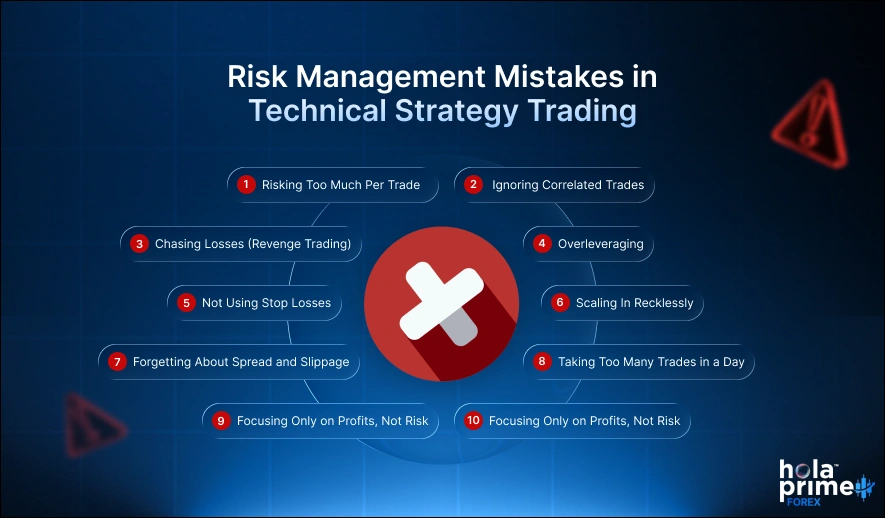
Risk management is often the silent killer of prop firm accounts.
You can have the sharpest forex technical strategies, spot the cleanest setups, and still fail, not because your strategy is bad, but because your risk management doesn’t match the rules.
Let’s break down the most common mistakes and how to fix them.
Many retail traders risk 2–5% per trade on small accounts. That might work personally, but in a prop firm environment:
Fix: Risk 0.25–1% per trade. This gives you space to survive multiple losses without violating limits.
Traders often open multiple trades across different pairs, thinking they’re diversifying. But if those pairs are correlated, they’re actually multiplying risk.
Example:
Fix: Limit correlated exposure. Count correlation trades as “one risk event.”
This is probably the biggest psychological trap.
Fix: Use a hard stop-loss on your daily loss. If you hit -2% for the day, stop trading and reset tomorrow.
Prop firms give high leverage (often 1:100 or more). Many traders misuse it, treating leverage as free money.
Reality: leverage magnifies both gains and losses.
Just because you can trade 10 lots on a $100,000 account doesn’t mean you should.
Fix: Treat leverage as flexibility, not necessity. Size positions based on risk %, not maximum margin allowed.
Some technical strategies rely on “mental stops” or manual exits. In a prop firm challenges, that’s a disaster waiting to happen.
Fix: Always place a stop loss - set it where the trade idea is invalidated, not where your emotions say.
Scaling into winners is fine if done carefully. But many traders scale into losers, hoping the price “will come back.”
That’s essentially martingale trading, which violates prop firm risk rules.
Fix: Only add to trades when already in profit, and only within your risk plan.
On demo accounts, spreads look tiny and fills are perfect. But in live prop firm environments:
Fix: Backtest your strategy with realistic spread/slippage assumptions. Don’t assume perfect conditions.
Overtrading isn’t just a psychological problem; it’s a math problem.
The more trades you take in a day:
Fix: Cap yourself at 3–5 trades per day. If your edge isn’t there, preserve capital.
Prop firm traders often fixate on the profit target (like 8% in 30 days). This causes reckless decisions.
But here’s the truth: you pass by not breaking rules, not by making the most money.
Even if you hit 20% gains, if you violate the rules, you fail.
Fix: Think defense first. Protect capital → follow rules → profits come naturally.
Most traders never review their risk management. They just trade, win/lose, and move on.
But every mistake leaves clues. If you don’t track them, you repeat them.
Fix: Keep a trading journal with:
This reflection builds discipline.
At the end of the day, passing a prop firm challenge isn’t just about having the perfect forex technical strategies. It’s about how well you can blend your strategy with risk management, psychology, and discipline.
Here are the key takeaways:
In simple terms, prop firm success is less about finding the “magic” technical strategy that forex traders dream of, and more about mastering yourself and your risk.
If you can combine your edge with strict discipline and a clear plan, you won’t just pass challenges - you’ll stay profitable long after.
Sam Saleh, a London-based trader, began his trading journey at 19 while studying Business at the University of Bedfordshire. With expertise in trading and a background in marketing, he now coaches at Hola Prime, where he develops educational content aimed at building trader confidence, consistency, and financial literacy.
Still Have Questions?
Feel free to get in touch with us today!

Disclaimer
All information provided on this site is for educational purposes only, related to trading in financial markets. It is not intended as financial advice, business or investment recommendation, or as an opportunity or recommendation to trade any investment instruments. Hola Prime only provides an educational environment to traders, including tools, materials and simulated trading platforms which have data feed provided by Liquidity Providers. The information on this site is not directed at residents in any country or jurisdiction where such distribution or use would be contrary to local laws or regulations.
About us
Affiliate
ISO 9001:2015
Quality Management System - QMS
ISO 22301:2019
Business Continuity
Management System - BCMS
ISO/IEC 27001:2022
Information Security
Management System - ISMS
About: Simulated trading operations are managed by Hola Prime Limited, a company registered at L1, Shaw House, 201 Wan Po Road, Tseung Kwan O, Hong Kong.
Holaprime Limited a company registered in Cyprus having registration number HE 454359 is a 100% subsidiary of Holaprime Limited Hong Kong.
For MT4 And MT5: Hola Prime Limited, with Company registration number 220248, and registered office at 4th Floor, Docks 4, The Docks, Caudan, Port Louis, Mauritius, is authorized and regulated by the Financial Services Commission (FSC) of Mauritius as an Investment Dealer (Full Service Dealer, excluding underwriting) under license number GB24203729.
For DXTrade, cTrader and MatchTrader: Gooey Trade, GT Tech LLC 6800 Broken Sound Parkway Northwest Suite 150 Boca Raton, FL 33487 US
RISK DISCLOSURE:
All of the information provided on this website and by Hola Prime Ltd, or its affiliates, is intended solely for Educational purposes. Nothing on this website is to be construed as investment advice, nor an offer or invitation to buy or sell any financial instrument, nor does it endorse, recommend, or sponsor any financial product, company, or fund. Testimonials on the Company’s website may not be reflective of the experience of other clients or customers and should not be considered as an assurance of future performance or success. Hola Prime only provides services of simulated trading and educational tools for skill assessment and enhancement of traders. Hola Prime does not act as a broker and does not accept any deposits. Any purchases made should not be regarded as deposits. There are no promises of rewards or returns. Trading in financial markets is inherently high-risk and speculative. The content and information provided on this website are not intended for distribution to, or use by, any person or entity in any jurisdiction or country where such distribution or use would be contrary to local law or regulation.
HYPOTHETICAL PERFORMANCE DISCLOSURE:
ACFTC Rule 4.4-Hypothetical performance results have many inherent limitations, some of which are described below. No representation is being made that any account will or is likely to achieve profits or losses similar to those shown. In fact, there are frequently sharp differences between hypothetical performance results and the actual results subsequently achieved by any particular trading program. One of the limitations of hypothetical performance results is that they are generally prepared with the benefit of hindsight. In addition, hypothetical trading does not involve financial risk, and no hypothetical trading record can completely account for the impact of financial risk of actual trading. For example, the ability to withstand losses or to adhere to a particular trading program in spite of trading losses is material points, which can also adversely affect actual trading results. There are numerous other factors related to the markets in general or to the implementation of any specific trading program, which cannot be fully accounted for in the preparation of hypothetical performance results and all of which can adversely affect trading results. Testimonials appearing on this website may not be representative of other clients or customers and are not a guarantee of future performance or success.
EVALUATION DISCLOSURE:
The customer pass rate of the Challenge/Evaluation program was 35% between 10th November, 2024 – 29th May, 2025, who traded at least one evaluation and obtained a Hola Prime Account during this time period. The Challenge and Hola Prime Accounts are meant to be a realistic simulation of trading under actual market conditions, including commissions, to mimic real market conditions, as much as possible. The evaluation is difficult to pass even for experienced traders. The Evaluation is not suggested for individuals with little to no trading experience.
CUSTOMER COMPENSATION DISCLOSURE:
All trades presented for compensation to customers should be considered hypothetical and should not be expected to be replicated in a live trading account. Hola Prime Accounts may represent simulated accounts or live or copied accounts. Hola Prime does not provide services to the residents of certain countries including – Afghanistan, Belarus, Burundi, China, Cuba, Congo, North Korea (Democratic People’s Republic of Korea) and Yemen.
This is the only website for Hola Prime. We are not using any third party websites or links. Any link, outside of this website that claims to be ours, could be fraudulent and users are advised to not use it.
© 2026 Hola Prime All rights reserved.