Volume Profile stands out as a tool that traders often talk about, but not many grasp the concept. Unlike regular price charts that just show how currency pairs move, Volume Profile adds an extra dimension - it points out how much volume was traded at which price point. This tool can show areas where buyers and sellers are most busy, giving a peek into possible support, resistance, and breakout spots. In this post, we'll dive into how Volume Profile works in Forex, how it can help you make trading choices, and hands-on ways to use it well.
What is Volume Profile?
Volume Profile serves as a chart method that shows traded volume at various price points during a specific time frame. While regular candlestick charts keep track of price shifts, Volume Profile reveals where traders make their trades.
Think of it as a terrain map of the market. Areas with high volume resemble low-lying valleys where traders have gathered, while spots with low volume are like open hills where the price can move more. These gatherings create support and resistance levels because prices often react when they revisit spots with a lot of trading activity.
How Does Volume Profile Work in Forex?
Volume Profile is common in futures or stock trading because exchanges report actual traded volume. In Forex, it’s slightly different because the market is decentralized. Brokers often provide tick volume - the number of price updates - to approximate real trading volume.
Despite this limitation, tick volume can still be very useful. It helps traders understand where the market is most active and where significant liquidity lies. Using Volume Profile, you can see price levels where buyers and sellers are most engaged, and where breakout or reversal points are more likely.
Key Components of Volume Profile
The Point of Control is the price level where the most trading occurred during the selected period. It’s often seen as a fair price where buyers and sellers agree. Traders watch POC for potential entries, exits, or stop placement.
These are areas with heavy volume, usually acting as strong support or resistance. Price tends to react in these zones because a lot of traders have positions here.
Low volume areas are often gaps where price moves quickly. These areas act like low-resistance paths for price, often used for breakouts or momentum trades.
The Value Area represents the range where 70% of the volume occurred. Traders use this zone to identify fair value for the asset. Prices moving outside the VA may indicate a trend or potential breakout.
Why Volume Profile Matters in Forex
Volume Profile is more than just a fancy chart. It provides context to price movements that pure price charts cannot. Here’s why it matters:
Identifying Key Levels: By showing where the most activity occurs, Volume Profile highlights natural support and resistance levels.
Understanding Market Sentiment: Large volume at certain levels shows where traders are confident or hesitant.
Planning Entries and Exits: Traders can use HVNs and LVNs to time trades with more precision.
Avoiding Fake Breakouts: Low-volume areas often attract quick moves. Knowing these areas helps traders avoid being trapped by fake breakouts.
How to Use Volume Profile in Forex
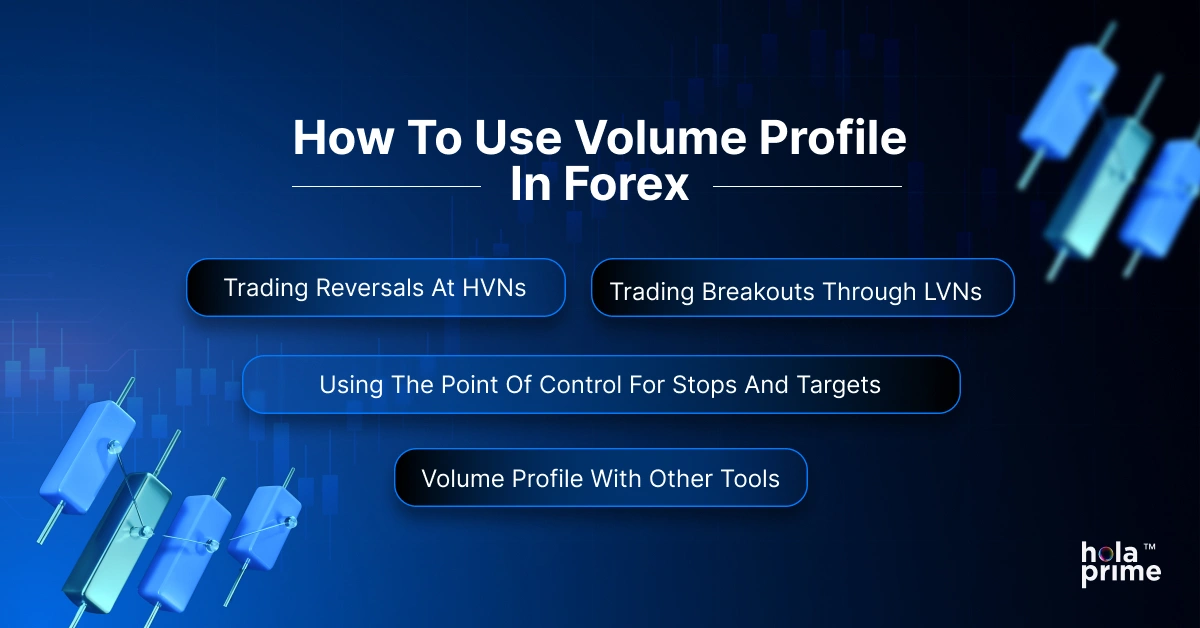
Trading Reversals at HVNs
High Volume Nodes act like magnets. If price approaches an HVN from above, it may bounce as sellers defend the level. Similarly, approaching from below, buyers may step in. For example, if EUR/USD is approaching a strong HVN around 1.1000, you might wait for confirmation of a bounce before entering a long trade.
Trading Breakouts through LVNs
Low Volume Nodes are like freeways for price. Breakouts through these levels are often quick. Suppose GBP/USD is trading in a narrow range and suddenly breaks through an LVN at 1.2500 with high momentum. Traders might ride the move until the next high-volume area.
Using the Point of Control for Stops and Targets
POC often represents fair value. Placing stops slightly beyond POC can reduce the chance of being stopped out by normal market noise. It also helps in defining realistic profit targets.
Volume Profile with Other Tools
Combining Volume Profile with moving averages, RSI, or Fibonacci levels can improve accuracy. For example, if price breaks an LVN but also aligns with a key Fibonacci level, the probability of a strong move increases.
Does Volume Profile Really Work?
The short answer: yes, but with caveats. Volume Profile is a tool, not a magic solution. It works best when combined with a solid trading plan, risk management, and other technical analysis tools.
Pros:
- Shows areas of real market activity
- Highlights key support and resistance levels
- Helps identify high-probability trade zones
Cons:
- Forex volume is not centralized; tick volume is an estimate
- Requires practice to read patterns effectively
- Not a standalone strategy; should be combined with price action, indicators, or fundamentals
The key is understanding the context. Traders who blindly follow Volume Profile without considering trends, news, or risk management may find it less effective.
Tips for Using Volume Profile Effectively
- Start with higher timeframes to identify strong HVNs and LVNs.
- Combine Volume Profile with trend analysis for better timing.
- Watch how price reacts at key nodes before taking positions.
- Use stop-loss and take-profit based on POC and volume nodes.
- Practice on demo accounts before trading live.
Conclusion
Volume Profile is a useful indicator to help you understand Forex market behavior, such as which levels attract the most trader activity, which price levels are likely to sustain value, and where possible breakouts and reversals may occur. It is not without flaws - especially because Forex volume is decentralized - but it certainly provides context that typical price charts do not offer. Volume Profile can provide you with better trade decisions when you combine it with sound money/risk management and other indicators.
As with any technique or tool, Volume Profile generally works better when you understand why and/or when to employ it rather than simply relying on Volume Profile without question.


 EN
EN DE
DE