This is where two strange-sounding terms, TWAP and VWAP, step in. They aren’t just acronyms thrown around by institutional traders; they’re practical tools that shape how your trades hit the market. Think of them as different “driving styles” for your trades: one spreads your journey evenly over time (TWAP), while the other adjusts to traffic flow (VWAP).
And here’s the real question: do these strategies actually matter for your Forex account, especially if you’re not trading billions like a hedge fund? That’s exactly what we’re going to unpack.
Foundations of TWAP and VWAP
What Does TWAP Mean?
Let’s start with TWAP, which is short for Time-Weighted Average Price. Now, that sounds a bit technical, but the idea is actually simple. Imagine you have a big order to buy euros against the dollar. If you throw the whole order into the market at once, you might push the price up (because your order is so big). Instead, TWAP breaks that order into smaller chunks and spreads them out evenly over a set period of time.
Think of it like sipping a cup of hot coffee. If you gulp it all at once, you’ll burn your mouth. But if you take small sips over time, it’s smoother, safer, and more enjoyable. That’s TWAP, it “sips” into the market over time, so the price impact is reduced, and the order looks more natural.
For retail traders, TWAP might sound like overkill, but it’s actually quite handy if you’re trading larger-than-usual sizes or want to avoid making your trade stand out.
Breaking Down VWAP in Simple Terms
VWAP, on the other hand, stands for Volume-Weighted Average Price. Instead of focusing on time, VWAP cares about volume.
Here’s a simple analogy: imagine you’re shopping at a market throughout the day. In the morning, it’s quiet, and only a few people are around. Later in the afternoon, the place is packed, with stalls buzzing and prices shifting faster. If you’re trying to “blend in” with the crowd, you’d probably buy more during the busy hours and less when it’s empty.
That’s VWAP; it adjusts your trade sizes based on how much market activity is happening. More volume means bigger slices of your order get executed, while quieter periods mean smaller slices.
VWAP is often seen as the go-to strategy for traders who want to “hide” their big orders by moving with the crowd.
TWAP vs VWAP: Core Differences Explained
At this point, you might be wondering: So, which is better? The truth is, neither TWAP nor VWAP is universally “better” - they’re just different tools for different situations.
- TWAP = Equal Slices Over Time. Great if you want predictability and don’t care about volume.
- VWAP = Volume-Based Slices. Great if you want to follow the market’s natural rhythm.
Here’s another way to think about it: TWAP is like setting a fixed alarm to take your medicine every two hours, no matter what’s going on. VWAP is like taking the medicine, depending on how active you feel throughout the day, more when you’re moving around, less when you’re resting.
Why Execution Strategies Are Crucial in Forex
Now, you might ask: Why should I care about this if I’m just a retail trader?
The answer is simple: execution strategies directly affect your trading costs. In Forex, even a tiny difference in entry or exit price can add up over hundreds of trades. Slippage, spreads, and poor timing can quietly eat into your profits.
Institutions use TWAP and VWAP because they’re trading massive volumes. But even for smaller traders, these algorithms can make trades smoother, less noticeable to other market participants, and sometimes cheaper.
In other words, learning about TWAP and VWAP isn’t just “academic.” It’s about being smarter with how your trades actually hit the market.
Understanding Algorithmic Execution
What is Algorithmic Trading?
When people hear “algorithmic trading,” they often imagine rows of servers in dark rooms, glowing monitors, and programmers typing in secret codes to make millions in seconds. While that’s not entirely wrong, the idea is much simpler at its core.
Algorithmic trading is just using computer programs to execute trades. Instead of manually clicking the buy or sell button, you give the algorithm a set of instructions, like “buy 100 lots of EUR/USD over the next hour using TWAP”, and the system does the heavy lifting.
It’s like setting your coffee machine to brew at 7 a.m. every morning. You don’t stand there measuring and pouring each time; you just program it once, and the machine follows your rules.
Role of Algorithms in Order Execution
Why do traders rely on algorithms for execution? Two main reasons: speed and discipline.
- Speed: The forex market moves fast. A manual trader might blink and miss a price. Algorithms don’t blink; they execute with precision, down to the millisecond.
- Discipline: Humans get emotional. Imagine you planned to spread your order evenly, but panicked when you saw a sudden spike. An algorithm doesn’t panic. It follows the plan, whether the market goes up, down, or sideways.
This discipline is especially important in execution strategies like TWAP and VWAP, where consistency is the goal.
Common Execution Algorithms Beyond TWAP and VWAP
Now, TWAP and VWAP are two of the most popular strategies, but they’re not the only ones. Traders, especially institutions, use a range of execution algorithms:
- POV (Percentage of Volume): Executes a percentage of the market volume at any given time.
- IS (Implementation Shortfall): Tries to minimize the difference between the decision price and the final execution price.
- Sniper Algorithms: These aim to detect hidden liquidity and execute at the best possible moment.
Think of it like driving. TWAP and VWAP are like cruise control - steady, predictable, and safe. Other algorithms are more like adaptive driving systems that respond to every curve, traffic jam, and weather change.
Why Execution Price Matters in Forex
Here’s the truth most beginner traders don’t realize: you can have the perfect strategy, the best technical setup, and flawless risk management, but if your execution is poor, your results will still suffer.
In forex, even half a pip of slippage can add up to hundreds or thousands of dollars over time. Imagine running a marathon and stopping every mile to tie your shoes - you might still finish, but you’ll lose valuable time.
Execution algorithms like TWAP and VWAP aim to reduce this “shoe-tying” problem. They give you cleaner entries and exits, reduce market impact, and help ensure that the price you want is closer to the price you get.
TWAP in Detail
How TWAP Works: Time-Weighted Average Price Explained
TWAP - Time-Weighted Average Price - sounds like something out of a finance textbook, but at its heart, it’s simple. Imagine you need to buy 1 million units of EUR/USD. If you dump the entire order into the market at once, two things happen:
- The market “sees” your big order and may adjust against you (widening spreads or moving price).
- You risk getting a worse average price because your trade eats through the available liquidity.
TWAP avoids this problem by slicing your order into equal parts and executing them at regular intervals over a set timeframe. It doesn’t care if volume is high or low, or if the market is calm or volatile. It just sticks to its clock: trade a little at 10:00, another slice at 10:05, again at 10:10, and so on.
It’s the “drip feed” method of trading. No sudden splashes, just steady drops.
Real-Life Example of TWAP Execution in Forex
Let’s put this into practice with a story.
Suppose a hedge fund wants to buy €50 million worth of EUR/USD during the London session. If they enter at once, they’ll push the price up against themselves. Instead, they program a TWAP strategy over two hours. Every 5 minutes, the algorithm buys a small portion of the order until the full €50 million is filled.
From the outside, it looks like normal market activity - nothing unusual, nothing that tips off other traders. And the fund gets its position at an average price that’s not distorted by its own buying pressure.
For retail traders, the numbers are smaller, but the principle is the same. If you’re trading 20 standard lots, TWAP can help you slip into the market more smoothly.
Strengths of TWAP for Traders
TWAP shines in situations where you want predictability and consistency. Some key strengths are:
- Simplicity: It’s easy to understand and implement.
- Predictable Execution: You know exactly when trades will happen.
- Reduced Market Impact: Instead of announcing your presence with a bang, you enter quietly.
- Good for Low-Volume Periods: Since TWAP doesn’t rely on volume, it keeps going even when the market is thin.
Think of TWAP as the friend who shows up exactly on time, every time. Steady, reliable, no surprises.
Limitations of TWAP: Where It Falls Short
Of course, TWAP isn’t perfect. Its biggest weakness is that it ignores what’s happening in the market.
- No Volume Sensitivity: If the market is suddenly very active, TWAP doesn’t adjust; it just keeps dripping at the same pace.
- Risk of Slippage in Volatility: If a sudden spike or drop happens, TWAP might keep trading into unfavorable prices.
- Less Flexible: It’s rigid by design. That’s both its strength and its weakness.
When TWAP Fits Best in Forex Trading
So, when should you use TWAP? Here are a few ideal scenarios:
- You want to stay invisible: Large trades can alert other participants. TWAP helps you blend in.
- The market is quiet: In thin liquidity, TWAP can be a safe way to enter without spooking prices.
- You care about consistency: If your main goal is to spread risk evenly, TWAP is your friend.
In short, TWAP is for traders who prefer “slow and steady” over “fast and reactive.”
VWAP in Detail
How VWAP Works: Volume-Weighted Average Price Explained
VWAP - Volume-Weighted Average Price - takes a different approach from TWAP. Instead of splitting trades evenly over time, it looks at how much trading is actually happening in the market and adjusts accordingly.
Here’s a simple way to think about it: imagine you’re at a concert and want to leave the venue. If you try to leave when the crowd is thin, you’ll stand out. But if you move with the big rush, you blend right in. VWAP works the same way - it executes bigger slices of your order when the market is busy (lots of volume) and smaller slices when it’s quiet.
This makes VWAP feel more “natural” in active markets. It doesn’t force trades when no one’s around; instead, it waits to move with the herd.
Real-Life Example of VWAP Execution in Forex
Let’s say a bank needs to sell $100 million worth of USD/JPY during the New York session. If they dump the full order at once, they risk pushing prices lower against themselves.
So, they use VWAP. The algorithm studies the market volume:
- At the 9:30 New York open, activity is high, so VWAP sells larger chunks.
- By lunchtime, volume drops, so VWAP slows down.
- When the afternoon surge comes, VWAP picks up again.
By the end of the day, the bank’s entire order is filled, and the execution looks like normal market flow - not a single giant dump that spooked other traders.
Retail traders can also use VWAP on a smaller scale. Suppose you want to enter 10 standard lots of GBP/USD. VWAP lets you slip in more smoothly by aligning your trades with active moments.
Strengths of VWAP for Traders
VWAP’s strength lies in its adaptability. It listens to the market and reacts accordingly.
- Market-Sensitive: Trades bigger when the market is busy, smaller when it’s not.
- Blends with Flow: Helps you hide large orders within natural activity.
- Better Average Prices: By leaning on high-volume times, VWAP often reduces slippage.
- Great for Active Pairs: Works especially well in liquid, high-volume markets like EUR/USD.
Limitations of VWAP: Where It Falls Short
VWAP is clever, but it’s not foolproof.
- Volume Dependence: If volume is thin, VWAP slows down, which could delay your order.
- Not Great in Very Quiet Markets: On exotic pairs with low activity, VWAP may struggle.
- May Miss Optimal Timing: Because it waits for volume, VWAP could execute late in a fast-moving market.
- Overcrowding Risk: If many traders use VWAP at the same time, it can actually create predictable patterns.
So, while VWAP is smarter than TWAP in many ways, it still has blind spots.
When VWAP Fits Best in Forex Trading
VWAP is best when you want to move with the crowd, not against it. It’s particularly useful in:
- High-volume sessions: London or New York overlaps are ideal.
- Liquid pairs: Major pairs (EUR/USD, GBP/USD, USD/JPY) suit VWAP best.
- Large institutional trades: Perfect for banks, funds, or prop traders who want to stay invisible.
For retail traders, VWAP can be helpful if you’re trading larger sizes or want to mimic institutional-style execution. It’s also a great learning tool; you can track VWAP to understand how volume flows in different sessions.
The Broader Picture of Algorithmic Execution
Why Execution Algorithms Shape Market Liquidity
Every time an algorithm like TWAP or VWAP runs, it leaves a subtle footprint on the market. Individually, you may not notice it. But when thousands of funds and traders use execution algorithms, they collectively shape liquidity.
Think of it like a school of fish. One fish swimming doesn’t change the ocean. But when thousands move together, they create patterns that even predators notice. In the same way, TWAP and VWAP orders contribute to the natural ebb and flow of the forex market.
This is why liquidity often looks “smooth” during busy sessions; it’s not just traders clicking buttons, but algorithms quietly distributing orders.
Comparing Forex Execution to Equities and Futures
TWAP and VWAP didn’t start in forex; they were borrowed from equities and futures markets. In stocks, for example, VWAP is a benchmark: traders compare their execution price to VWAP to see if they “beat the market.”
Forex is a bit different. Since it’s a decentralized market with no central exchange, there’s no single “official” VWAP. Brokers and platforms calculate their own VWAPs based on the data they see. This makes forex slightly trickier, but the principle still works.
In futures, TWAP and VWAP are deeply integrated into trading desks. Forex has been catching up, and now even retail platforms are starting to offer them.
The Impact of Market Sessions (London, New York, Asia) on Execution Strategies
One thing traders quickly learn: not all sessions are created equal.
- Asian Session: Quiet, low volume, tighter ranges. Here, TWAP is often more practical - it keeps execution steady without relying on volume.
- London Session: The busiest of all, with big liquidity. VWAP shines here because it can take advantage of the high trading flow.
- New York Session: Often volatile, especially at the open. VWAP again has an edge, since it scales with the heavy volume spikes.
In other words, your choice of algorithm might depend on when you trade as much as what you trade.
Spread, Slippage, and Their Connection to Algorithms
Two invisible costs every trader battles are spreads and slippage.
- Spread: The difference between the buy and sell price.
- Slippage: The difference between the price you expected and the price you got.
Execution algorithms directly help manage these costs. By spreading trades out (TWAP) or hiding them in volume (VWAP), they reduce the chance of eating through multiple price levels. That means tighter fills, less slippage, and sometimes even narrower effective spreads.
For example, if you try to sell 10 lots of EUR/USD manually during a thin market, you might get heavy slippage. But with VWAP, your trades get tucked into busy periods, reducing that cost.
Practical Application for Traders
How to Use TWAP in Forex Trading Accounts
Using TWAP in a forex account is like setting an autopilot for your trades. Instead of placing one large market order, you configure the algorithm to break it into equal parts over a defined timeframe.
Here’s what that looks like in practice:
- You decide you want to buy 10 standard lots of EUR/USD.
- Instead of placing it at once, you set a TWAP algorithm to execute the order over 2 hours.
- The algo slices your order into 20 trades of 0.5 lots each, placing one every 6 minutes.
This way, you don’t spook the market with a large single order, and your execution is spread evenly, giving you a smoother average price.
Retail platforms like MetaTrader don’t always offer TWAP by default, but brokers and third-party tools (like Hola Prime) often provide access to algorithmic execution strategies.
How to Use VWAP in Forex Trading Accounts
VWAP works a bit differently because it’s tied to volume. To use it effectively, you set a timeframe for the algorithm to operate and let it decide how much to execute based on how active the market is.
Example:
- You want to sell 15 lots of GBP/USD during the London session.
- You set a VWAP execution window of 3 hours.
- During the busiest times (London open, news releases), the algo sells larger chunks.
- During quieter moments (mid-session lull), it sells smaller amounts.
By the end of the period, your full order is filled, and it looks just like a natural trading flow.
For retail traders, some advanced platforms calculate VWAP as an indicator on charts. You can use it both as an execution strategy and as a benchmark - if your fills are consistently better than VWAP, you’re doing well.
Tools and Platforms Offering TWAP/VWAP Execution
Not every forex broker gives access to execution algorithms, but many professional or prop-style platforms do. Some examples include:
- Hola Prime Accounts: Provide access to advanced execution algos tailored for forex.
- FIX API Trading: Institutional-grade connections where traders can run TWAP/VWAP algos.
- ECN Brokers with Algo Add-ons: Some brokers allow VWAP/TWAP orders via plugins or advanced terminals.
If you’re serious about using these strategies, it’s worth checking if your broker supports algorithmic execution or whether you need to use third-party tools.
Common Mistakes Traders Make with TWAP and VWAP
Even though these strategies sound simple, traders often misuse them. Here are some common pitfalls:
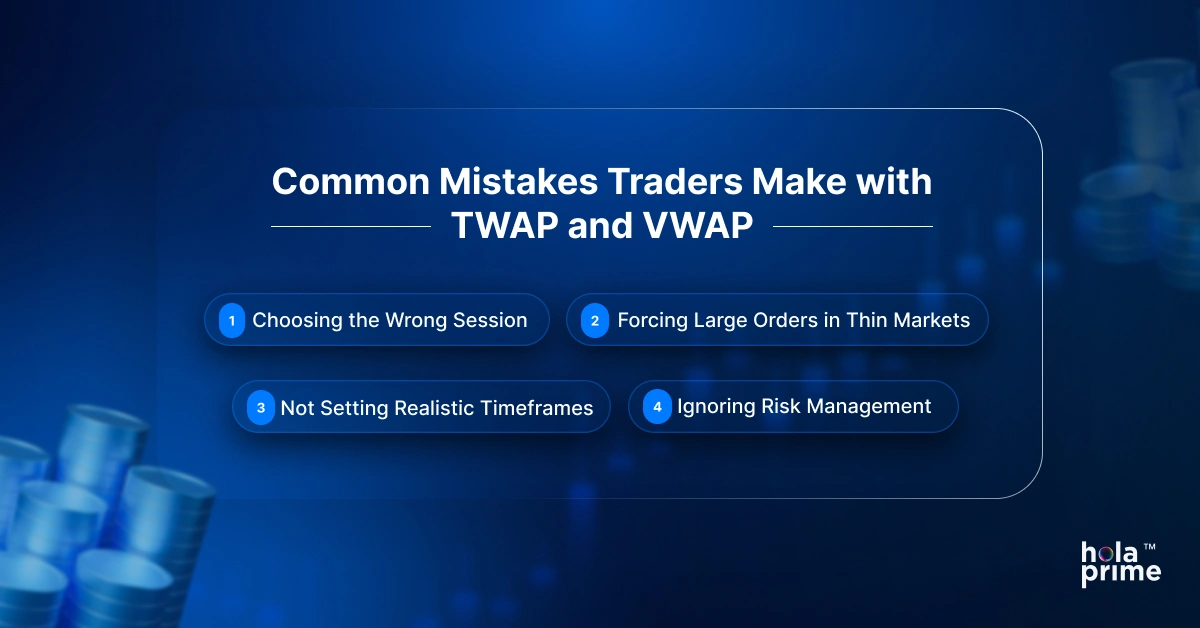
- Choosing the Wrong Session: Running VWAP in a dead Asian session won’t work well - it needs volume.
- Forcing Large Orders in Thin Markets: TWAP helps, but in very illiquid pairs, you’ll still face slippage.
- Not Setting Realistic Timeframes: Expecting VWAP to fill a huge order in one hour during quiet times is unrealistic.
- Ignoring Risk Management: These algorithms handle execution, not risk. Stop-losses and position sizing are still your job.
In short, algorithms are helpers, not magicians. They won’t fix poor trading strategies, but they will make good strategies more efficient.
Risk Management While Using Algorithmic Execution
One of the traps traders fall into is thinking, “I’m using an algorithm, so I’m safe.” That’s not entirely true. TWAP and VWAP reduce execution risks, but market risks are still real.
Here are a few principles to keep in mind:
- Always use stop-losses: Algorithms won’t protect you if the market suddenly breaks out against your position.
- Size appropriately: Don’t rely on VWAP to magically absorb oversized trades in thin markets.
- Understand the market context: News events, session changes, and liquidity shifts still matter.
- Test before using: If your broker offers demo accounts with TWAP/VWAP, practice there first.
Execution is just one piece of the puzzle. Pairing algorithms with good risk control is where the real edge lies.
Advanced Considerations
1. Hybrid TWAP-VWAP Strategies
Not every situation fits neatly into TWAP or VWAP. Many institutional desks actually use hybrid models.
- For example, a trader may start with a TWAP schedule to guarantee steady execution, but overlay a VWAP filter so that larger slices only fire when volume is supportive.
- This ensures they’re not dumping trades in illiquid periods but still maintain the discipline of regular fills.
Think of it as “TWAP for structure, VWAP for flexibility.”
2. Session-Based Adjustments
Forex markets aren’t uniform; liquidity and volatility swing dramatically across the day.
- Asian session: Lower liquidity, narrower flows → TWAP tends to be safer here.
- London session: High volume, explosive moves → VWAP thrives because there’s a lot of natural flow to blend into.
- New York session: Often volatile with news → Hybrid or adaptive models (starting VWAP, switching TWAP around news) can reduce risk.
In practice, large traders will rotate between TWAP and VWAP depending on session conditions.
3. News Event Sensitivity
Neither TWAP nor VWAP is “news smart” by default. Imagine running a VWAP sell order right before Non-Farm Payrolls - it could execute big chunks into a fast-moving market, leaving you exposed.
Some advanced algos now use “pause-on-news” features, temporarily halting execution around major economic releases. Retail traders can mimic this manually - stop the algo, let the dust settle, then resume.
4. Dark Pools and Hidden Liquidity
While less common in retail FX, institutions often blend TWAP/VWAP with dark pool execution - hidden venues where large orders can be filled quietly.
- Example: A bank may use VWAP across public exchanges but divert large slices to dark pools when the opportunity arises.
- This reduces signaling risk even further.
For retail traders, the takeaway is simple: always be aware of market visibility. Even smaller positions can leave footprints in thin markets.
5. Algorithm Tuning and Overrides
The best execution algos aren’t rigid - they allow overrides.
- A trader might manually speed up a TWAP if a breakout is forming.
- Or they might pause a VWAP if spreads suddenly widen.
In practice, TWAP and VWAP should be seen as guidelines, not autopilot. The most skilled traders actively monitor and adjust their execution instead of blindly trusting the algo.
6. Cost-Benefit Analysis
It’s also worth remembering that every execution strategy carries trade-offs.
- TWAP minimizes slippage but can miss liquidity surges.
- VWAP blends well but might delay execution in thin markets.
- Hybrids are powerful but often require more tech and oversight.
The choice boils down to the trader’s priority:
- Do you care more about price certainty? (TWAP)
- Or about liquidity efficiency? (VWAP)
- Or do you need both, at the cost of complexity? (Hybrid)
Common Mistakes to Avoid
1. Treating Algos as Autopilot
One of the biggest traps is assuming TWAP or VWAP will “do the job” without supervision. Markets are alive. Conditions change quickly, and an algo that worked in the morning might be a liability in the afternoon. Blind trust often leads to unnecessary slippage or missed opportunities.
2. Ignoring Spread and Liquidity Shifts
Both TWAP and VWAP assume a certain level of market depth. But spreads can widen dramatically during news releases, rollovers, or thin liquidity hours. If you don’t pause or adjust, you could be filling orders at terrible prices. Always keep an eye on the bid-ask spread while the algo is running.
3. Poor Time Horizon Matching
A common mistake is using TWAP or VWAP on trades that don’t justify it.
- Example: A retail trader splitting a $10,000 EUR/USD order over an hour. In reality, that size is small enough to fill instantly without much impact. Over-engineering execution can waste time and create exposure.
Execution algos shine when order size is large relative to market conditions, not for every click of the button.
4. Over-Slicing Orders
Breaking orders into too many micro-slices can backfire. Instead of hiding your intention, you might actually make your activity more obvious because the market keeps seeing repetitive small orders at regular intervals.
Good algos add randomization to avoid being predictable. If yours doesn’t, consider adjusting manually.
5. Running Through Major News Events
We touched on this earlier, but it’s worth repeating: news is the graveyard of lazy algo execution.
- A VWAP order during NFP could fill aggressively into spikes.
- A TWAP order could keep trading even while spreads blow out.
Either way, your execution cost skyrockets. Always check the economic calendar before hitting “go.”
6. Ignoring Hidden Costs
Even if you think you’re beating the average price, don’t forget about transaction costs. Commission, spread, and financing can eat into perceived gains. An algo isn’t truly successful unless it improves net execution after costs, not just gross prices.
7. Failing to Align Strategy and Execution
Finally, the classic error: using TWAP or VWAP without considering the bigger trading plan.
- If your strategy is based on quick momentum bursts, a slow TWAP might kill your edge.
- If your approach relies on fading intraday ranges, a liquidity-chasing VWAP could execute at exactly the wrong time.
Execution should serve the strategy, not the other way around.
The Future of Algorithmic Execution in Forex
Execution isn’t standing still. Markets are becoming faster, more fragmented, and more data-driven. What used to be the edge, just having a TWAP or VWAP script, is now standard. So, what’s next?
1. AI-Driven Smart Order Routing
Tomorrow’s execution engines won’t just follow a clock (TWAP) or a volume curve (VWAP). They’ll use real-time AI models that analyze order book depth, news headlines, sentiment feeds, and even social media chatter to decide how to slice and place trades. Instead of just “time” or “volume,” execution will be context-aware.
2. Hybrid Execution Models
We’re already seeing hybrid strategies - mixing TWAP, VWAP, and liquidity-seeking tactics. For example, an algo might start with VWAP in the morning, switch to TWAP during quiet hours, then move into dark pool execution when liquidity dries up. These blended approaches mean traders won’t have to choose between one method - they’ll get the best of both worlds automatically.
3. Latency Arms Race
High-frequency traders (HFTs) have long fought for microsecond advantages. In Forex, where milliseconds can decide fills, we’ll likely see a bigger push for ultra-low latency infrastructure. Execution algos will be co-located next to major FX liquidity hubs like London and New York, reducing every possible delay. For retail traders, brokers may start offering access to execution optimization services once reserved for institutions.
4. Adaptive VWAP & TWAP
The basic formulas will evolve. Instead of following static schedules, VWAP and TWAP will become adaptive:
- VWAP could adjust its volume curve in real time if volume surges unexpectedly.
- TWAP could flex its slice size if spreads widen, instead of blindly pushing orders through.
This adaptability will reduce the weaknesses that currently catch traders off guard.
5. Integration with Risk Management
Execution will no longer be just about getting in and out at good prices; it’ll tie into portfolio-level risk controls. For example:
- If volatility spikes mid-execution, the algo might pause to prevent exposure blowouts.
- If correlation risk rises (say EUR/USD and GBP/USD both move together), the algo may rebalance execution speed between them.
Execution will be smarter, acting as a risk partner instead of a dumb order-filler.
6. Democratization for Retail Traders
Perhaps the biggest shift: tools that were once the domain of hedge funds are now moving into retail platforms. Already, brokers are experimenting with giving retail traders access to VWAP-style execution buttons or TWAP plug-ins. In the next few years, expect retail platforms to offer smart execution dashboards, making these strategies mainstream.
7. Regulatory Oversight and Transparency
As algos dominate execution, regulators will push for more transparency. Expect rules around disclosing algo execution types, benchmarks, and impact. This will help level the field so smaller traders aren’t unknowingly disadvantaged by execution games.
The bottom line?
The future of Forex execution is faster, smarter, and more accessible. TWAP and VWAP aren’t disappearing; they’re evolving into more intelligent hybrids that will quietly work in the background while traders focus on strategy.
Conclusion
At the end of the day, TWAP and VWAP aren’t about which one is “better.” They’re tools - each with its own strengths and weaknesses. TWAP is like a steady heartbeat, simple and predictable, best suited for quiet markets or traders who want full control over pacing. VWAP, on the other hand, is more dynamic, moving in rhythm with the market, great for those who want to stay invisible and minimize market impact when liquidity is shifting.
The real secret isn’t in choosing one over the other, but in knowing when to use each. Sometimes, the discipline of TWAP is exactly what a choppy market needs. Other times, the fluidity of VWAP makes execution smoother. For larger, institutional players, the future lies in blending and evolving these methods into adaptive, AI-driven execution engines. For retail traders, the exciting part is that these once-exclusive tools are gradually becoming accessible - bringing smart execution into everyday trading.
Execution may not feel as exciting as calling the right direction of EUR/USD or Bitcoin, but it’s the quiet force that can make the difference between winning and bleeding out on slippage. In trading, getting in and out efficiently is half the battle won.

 EN
EN DE
DE