What is a Futures Contract?
Before we even talk about ticks and values, let’s pause and break down what a futures contract is. At its simplest, a futures contract is just an agreement to buy or sell something - oil, gold, a stock index, or even agricultural goods - at a set price on a future date.
The important part is that these contracts are standardized. That means the exchange decides the details ahead of time - the size of the contract, how much each price movement is worth, and when the contract expires. Traders everywhere work with the same rules, which keep things clear and consistent.
To put that into perspective:
The E-mini S&P 500 (ES) gives you exposure to the S&P 500 index.
A single Crude Oil (CL) contract covers 1,000 barrels of oil.
One Gold (GC) contract represents 100 troy ounces of gold.
So when you’re trading futures, you’re not buying one share of stock or one ounce of gold. You’re entering into a standardized agreement that bundles those units together. That’s why knowing the contract size is critical - it tells you exactly how much of the underlying asset you’re controlling.
What is Contract Size?
The contract size is simply the amount of the underlying asset tied to one futures contract. It’s what defines the scale of your exposure.
Here are a few examples that make it clear:
In Crude Oil futures (CL), one contract = 1,000 barrels. If crude is trading at $80 per barrel, a single contract represents $80,000 worth of oil.
In Gold futures (GC), one contract = 100 troy ounces. If gold trades at $2,000 per ounce, the notional value of one contract is $200,000.
In the E-mini S&P 500 (ES), the contract is worth $50 times the index value. If the index is at 4,500, that works out to $225,000.
These numbers aren’t meant to scare you. You don’t need that much in cash to open a position, because futures only require margin. But the notional value matters - it tells you the real size of the bet you’re making. Without paying attention to it, it’s easy to take on more risk than you realize.
Now you can see why futures can feel intimidating - the notional values are huge. But the beauty of futures is that you don’t need to put up the full notional amount. Instead, you post a margin (a fraction of the value) to control the contract.
This is why understanding contract size is so important. It tells you exactly how much exposure you have when you place a trade. Without this knowledge, you might risk far more than you intended.
What is Tick Value?
Now let’s talk about ticks. A tick is simply the smallest price movement a futures contract can make. Each market has its own defined tick size.
For example:
E-mini S&P 500 (ES) → Tick size = 0.25 points.
Crude Oil (CL) → Tick size = 0.01 per barrel.
Gold (GC) → Tick size = 0.10 per ounce.
But here’s the kicker - the tick size alone doesn’t tell you much. You need to multiply it by the contract’s multiplier or size to find the tick value (the dollar value of one tick move).
Let’s go through this step by step.
How to Calculate Tick Value Step-by-Step
To figure out the tick value, you start with the minimum price movement. This is the smallest amount the contract's price can change, set by the exchanges and unique to each market. Let's take Crude Oil (CL) as an example. Its price moves in $0.01 increments per barrel. One CL contract stands for 1,000 barrels, so a single tick - that $0.01 change - equals $10. While this might not seem like much, a 50-tick market move would result in a $500 difference.
Next comes the contract size. It tells you how big your position really is. Take Gold (GC) futures as an example: one contract equals 100 troy ounces of gold. If the tick size is $0.10 per ounce, a tick is worth $10 because $0.10 × 100 = $10. Now you can easily see how the tick size to the contract size is relevant to each other.
Once you’ve got those two pieces, you multiply them to get the tick value in dollar terms. Exchanges usually provide this number in their contract specs, but knowing how to do it yourself gives you a clearer picture of what’s at risk.
Here’s another practical example: the E-mini S&P 500 (ES). Each tick is 0.25 index points. One point is worth $50, so that quarter-point tick comes out to $12.50. That means if the price moves four ticks, you’ve gained or lost $50, depending on your position.
Understanding tick value in this way helps you see futures trading less as abstract numbers and more as actual dollars moving in and out of your account. And once you start thinking like that, risk management becomes second nature.
Why Tick Value and Contract Size Matter for Traders
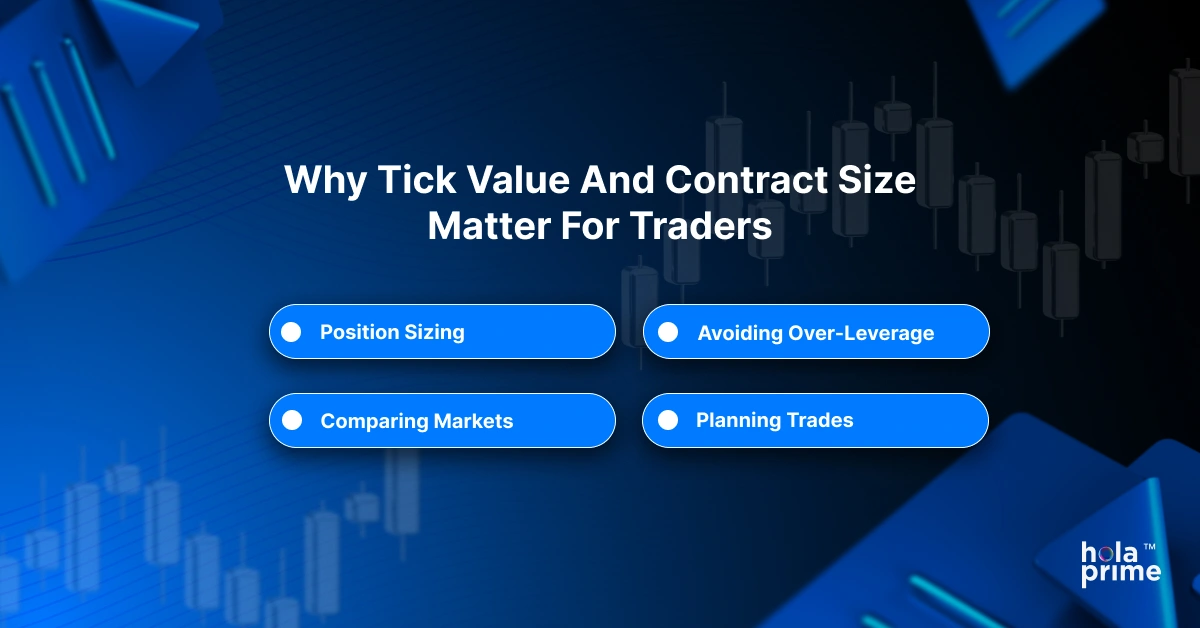
So why does all this math matter? Here’s why:
Knowing tick value helps you calculate how much you’re risking per trade. For example, if your stop loss is 20 ticks in crude oil, that’s $200 per contract. Trading three contracts? That’s $600 risk.
Futures margins can be deceptive. Just because you can open a crude oil position with $5,000 margin doesn’t mean you’re only risking $5,000. If oil swings $2.00 against you (200 ticks), that’s a $2,000 loss per contract.
Once you know tick values and contract sizes, you can compare markets. Maybe you realize crude oil is too volatile for your account size, but the E-mini Dow or Micro contracts fit better.
If you know exactly what each tick is worth, you can set stop losses and profit targets with precision. No guessing, no surprises.
Common Mistakes Traders Make
Even with this knowledge, traders often trip up. Here are a few common mistakes:
Confusing tick size with tick value. Just because the ES tick size is 0.25 doesn’t mean it’s worth $0.25. You have to apply the multiplier.
Ignoring contract size. A small move in price can translate to a big dollar change if the contract size is large.
Trading markets they don’t understand. Jumping into crude oil or natural gas without realizing how volatile they are is a recipe for blown accounts.
Over-trading. Some traders forget that trading multiple contracts multiplies their risk. Two contracts in crude oil doubles your tick value exposure from $10 to $20 per tick.
Practical Tips for Futures Traders
If you’re serious about trading futures, here are a few practical tips:
Use a tick value calculator. Most brokers provide these, so don’t try to memorize every number.
Start with Micro contracts. For example, Micro E-mini S&P 500 (MES) has a tick value of $1.25, which is far more beginner-friendly than the $12.50 ES tick.
Plan your risk. Before entering a trade, multiply tick value × stop loss ticks × number of contracts. If the number feels too big, scale down.
Understand each market. Don’t just trade crude oil because you heard it’s “hot.” Look at the tick value, contract size, and volatility first.
Keep a trading journal. Track not just wins and losses, but how many ticks you risked and gained per trade.
Conclusion:
If you've followed along to this point, you now understand more than most newcomers diving into futures without preparation. The tick value and contract size might appear trivial, but they form the foundation of futures trading. They have an impact on your profits, your losses, and how you handle your risk.
The next time you view a chart, don't just focus on price points. Take a second to ask yourself: What's the tick value in this case? What size is the contract? How much am I putting at risk? When you start to trade with this approach, you'll notice yourself making wiser choices, steering clear of big losses, and gaining the self-assurance that sets apart a well-prepared trader from a careless one.
To sum up, the key is straightforward: get a grip on the essentials - ticks and contract sizes - and the other aspects of futures trading will seem much less daunting.