Prop traders must prove themselves in structured “challenges” before earning a funded account. This is where trading style - systematic or discretionary - becomes crucial.
Why the Systematic vs. Discretionary Debate Matters
In prop trading, your performance isn’t just about profit - it’s about how you achieve it. Systematic trading relies on rule-based algorithms, while discretionary trading depends on human judgment. Each approach has strengths and pitfalls that can make or break your prop challenge success.
How This Decision Impacts Funded Traders
Your trading style shapes everything - from how you plan trades to how you handle stress. Choosing a style aligned with your personality and prop firm rules often determines whether you pass your challenge or hit a drawdown limit.
Basics of Forex Trading Styles
The Evolution of Forex Trading Strategies
Forex trading evolved from manual chart reading to algorithmic precision. Traders today can code complex systems or rely on intuition honed over years of experience.
The Two Pillars: Systematic and Discretionary Trading
- Systematic trading uses predefined rules - no emotions, just logic and automation.
- Discretionary trading relies on the trader’s perception, skill, and gut feeling.
Both can work - but not always in the same environment.
Which Type Do Most Prop Firms Prefer?
Many prop firms lean toward systematic traders for their consistency, but some celebrate discretionary mastery when it’s disciplined. The best firms welcome both - as long as you stay within risk limits.
What Is Systematic Forex Trading?
Systematic Forex trading is like setting up a well-oiled machine that trades for you - calmly, precisely, and without emotions getting in the way. Instead of relying on hunches or split-second decisions, a systematic trader follows a clear set of rules that decide when to buy, when to sell, and how much to risk.
Think of it like putting your trading brain into code. You tell your system exactly what to do, and it does it - over and over, without fear, doubt, or hesitation.
How It Works
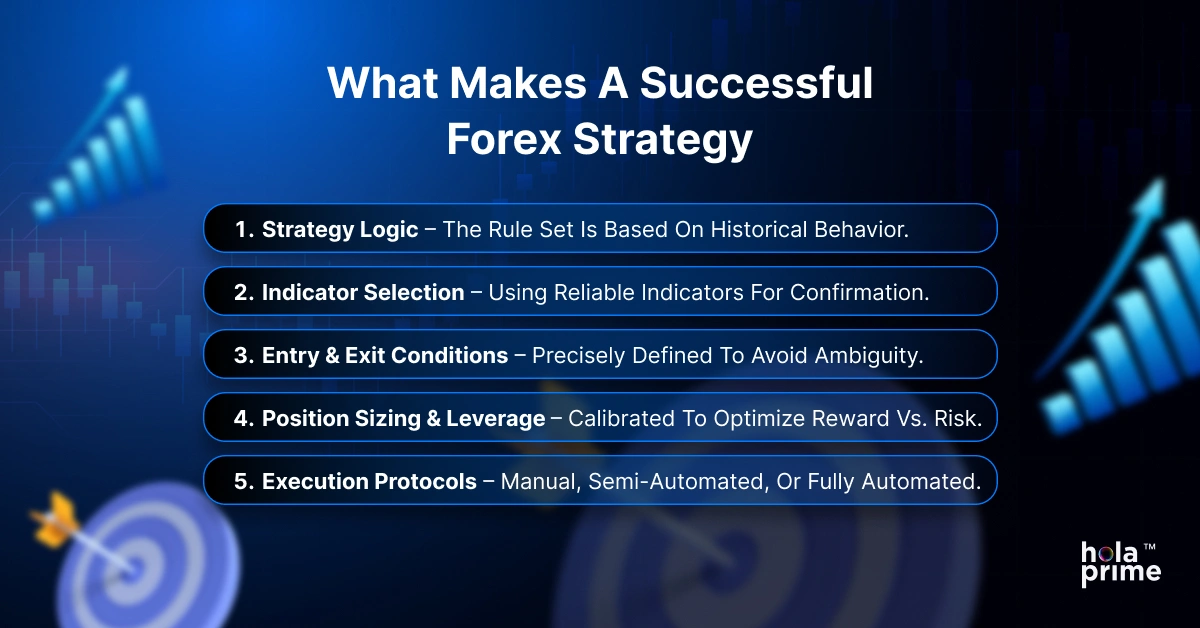
A typical systematic strategy starts with an idea - maybe you’ve noticed that certain currency pairs trend strongly after breaking a key level. You test that idea, build a rule-based plan around it, and feed it into your trading platform or algorithm. From there, it scans the markets and executes trades automatically whenever those conditions appear.
The beauty of this approach is its consistency. It doesn’t panic when the market dips or chase profits when it rallies. It just follows the plan.
A Simple Example
Let’s say your strategy buys EUR/USD when the 20-day moving average crosses above the 50-day moving average, and sells when it crosses back down. Once programmed, the system runs in the background - buying and selling based on those rules, without you needing to lift a finger.
That’s the magic of systematic trading: your emotions take a back seat, and the data does the talking.
The Role of Backtesting
Before a system ever goes live, traders run it through years of historical data to see how it would have performed in different conditions. This process - called backtesting - helps spot weaknesses and gives confidence that the rules actually work.
Some traders take it a step further, layering in advanced algorithms or machine learning tools. But even the simplest systems can work beautifully, as long as they’re logical, tested, and aligned with your risk tolerance.
What Is Discretionary Forex Trading?
If systematic trading is like a machine on autopilot, discretionary trading is like driving a sports car with your hands firmly on the wheel. You feel every turn, sense every shift, and make decisions based on experience, instincts, and what the market is showing you right now.
Discretionary trading is deeply personal - it’s where your skill, mindset, and intuition take center stage.
How It Works
A discretionary trader reads the market like a story. They might see a price level that’s been tested several times and sense that it’s about to break. Or they might notice a sudden shift in sentiment after a big economic announcement and decide to take a position before the crowd jumps in.
There’s no fixed formula - just a balance of technical knowledge, observation, and gut feeling.
A Real Example
Imagine it’s Non-Farm Payroll day - one of those make-or-break moments for USD pairs. The numbers come out much stronger than expected, and the dollar starts surging. A discretionary trader spots this reaction, waits for a small retracement, and jumps in long on USD/JPY before the next leg higher.
An automated system might have missed that subtle timing. But a human trader, tuned in and alert, can capture it.
Why It Works
The power of discretionary trading lies in human adaptability. You can respond instantly to new information - whether that’s breaking news, changing volatility, or unexpected reactions. It’s the ultimate blend of logic and instinct, and it’s something no machine can truly replicate.
The Key Differences Between Systematic and Discretionary Trading
At their core, both approaches aim for the same thing - consistent profits - but they take very different roads to get there.
Here’s how they stack up in plain language:
Aspect | Systematic Trading | Discretionary Trading |
How Trades Are Made | Based on rules and algorithms | Based on human judgment |
Execution | Automatic | Manual |
Emotions | Almost none | Very much involved |
Consistency | High | Depends on mindset and discipline |
Adaptability | Limited by the code | Extremely flexible |
Scalability | Easy to run on many pairs | Harder to manage manually |
Learning Curve | Technical and data-heavy | Experience and intuition-driven |
Why Many Traders Love Systematic Trading
There’s a reason why more and more traders - especially those joining prop firms - are drawn to systematic strategies. It’s not just about automation; it’s about peace of mind.
It Keeps Emotions Out of the Way
When your system follows clear rules, it doesn’t get scared or greedy. It won’t revenge trade after a loss or chase a move that’s already over. That kind of discipline is gold in trading.
It’s Backed by Data, Not Guesswork
Every rule is tested and measured before real money is ever put on the line. That gives traders confidence that their edge is based on evidence, not emotion.
It’s Amazingly Consistent
Once your system is set, it executes trades the same way every single time - no matter how crazy the markets get. That kind of reliability is something most human traders struggle to maintain.
It’s Scalable
A single system can trade multiple pairs across timeframes simultaneously. That’s like having a team of disciplined traders working for you 24 hours a day.
It Fits Prop Challenges Perfectly
Prop firms value one thing above all: consistency. Systematic trading, by nature, aligns perfectly with that. It helps you stay within drawdown limits, follow risk rules, and show the steady results prop firms love to see.
The Drawbacks of Systematic Trading
Of course, even the best systems have their weak spots. Here’s what traders need to watch out for:
It Can Be Over-Optimized
When you test and tweak too much, your system might start fitting perfectly to the past - but fail miserably in the present. It’s a common trap that even experienced traders fall into.
Technology Isn’t Foolproof
All it takes is a glitch, a server issue, or bad data for your system to go off track. And when money’s on the line, that can be stressful.
It Lacks Human Intuition
An algorithm doesn’t know when a central bank governor just hinted at a policy shift, or when traders are reacting emotionally to a news headline. It simply does what it’s told - nothing more, nothing less.
It Can Be Expensive and Complex
Not everyone wants to deal with coding, servers, or statistical testing. Setting up and maintaining an automated strategy takes time and technical know-how.
It Slows Personal Growth
Because the system makes most of the decisions, some traders don’t develop the same market instincts that come from hands-on experience. Over time, that can limit your ability to adapt or evolve.
The Upside of Discretionary Forex Trading
There’s something uniquely satisfying about discretionary trading. It’s not about code or formulas - it’s about you and the market. The connection feels personal. You’re reading price action, feeling the rhythm, and making judgment calls that reflect your own experience and instincts.
Here’s why so many traders love this approach:
You’re in Control
Unlike automated systems that trade on their own, you’re behind the wheel here. Every decision - when to enter, when to hold, when to close - is yours. That kind of control can feel empowering, especially for traders who trust their intuition.
Adaptability Is a Superpower
Markets change - sometimes fast. News breaks, liquidity shifts, sentiment turns on a dime. Discretionary traders can adjust instantly. You can choose to stay out of a choppy market, change your risk mid-session, or ride a strong move longer than planned. That flexibility is priceless.
Experience Sharpens Your Edge
Over time, discretionary traders develop what can only be described as “market feel.” You start noticing the subtle stuff - the way price reacts to certain levels, the tone of traders before news, the rhythm of volatility on different days. That instinct, once honed, becomes one of your biggest advantages.
You See the Story Behind the Chart
While algorithms focus purely on numbers, discretionary traders see why those numbers move. You learn to connect the dots - from macroeconomics to trader psychology - which deepens your understanding of how markets actually work.
The Challenges of Discretionary Forex Trading
Now, as rewarding as discretionary trading can be, it’s not without its challenges and every trader who’s been around for a while knows these all too well.
Emotions Can Take Over
This is the big one. Even the most experienced traders struggle to stay objective after a tough loss or a missed move. Fear can make you hesitate; greed can make you overtrade. The key is learning to stay calm and stick to your plan - easier said than done.
Consistency Is Hard to Maintain
Because discretionary trading depends so much on your mindset, your results can swing. One great week can be followed by a rough one if you’re tired, distracted, or simply not in the zone.
It’s Tough to Scale
There’s only one of you. Unlike a system that can trade 20 pairs at once, you can only focus on so much. Discretionary trading often works best when your attention is sharp and your workload is light.
No Real Backtesting
While you can review charts and journal your trades, it’s hard to test discretionary setups the same way systematic traders can. Every decision is subjective, which makes it tricky to measure the long-term edge statistically.
Still, many traders find the emotional and intellectual satisfaction of discretionary trading totally worth it - as long as they build the mental discipline to handle it.
Why Consistency Is the Golden Rule
Whether you’re trading manually or through an algorithm, one truth always stands tall in prop trading: consistency wins.
Prop firms don’t care if you double an account one week and blow it the next. They’re not looking for fireworks - they’re looking for steady hands.
Systematic Traders Have an Edge Here
Because systems follow fixed rules, their performance tends to be steady. Every trade looks like the last one - same risk, same setup, same logic. That predictability builds trust.
A prop evaluator can look at a systematic trader’s record and see exactly how they manage risk. No wild swings, no emotional decision-making - just consistent execution.
Discretionary Traders Can Be Consistent Too
It just takes a different kind of discipline. For discretionary traders, consistency means developing a routine. That might look like:
- Only trading during specific sessions
- Following one or two setups you know well
- Risking the same percentage per trade
It’s about finding a rhythm and sticking to it, no matter how tempting it is to break your rules.
At the end of the day, consistency isn’t just about profit - it’s about trust. When you show the firm that you can handle risk maturely and stay composed through ups and downs, you’re not just passing a challenge - you’re earning a seat at the table.
Risk Management Strategies for Each Style
If trading is a game, risk management is your defense. It’s what keeps you in the game long enough to let your edge play out.
How Systematic Traders Manage Risk
Systematic traders build risk control directly into their code. Every trade has a predefined stop loss, take profit, and position size. There’s no guessing or improvising - the system manages exposure automatically.
For example:
- 1% risk per trade
- 2:1 reward-to-risk ratio
- Daily drawdown cap of 5%
This structure helps them stay within prop firm limits without needing to think twice.
How Discretionary Traders Handle It
Discretionary traders use their own judgment - which can be a strength or a weakness, depending on their discipline. A good discretionary trader knows when to cut losses early or reduce risk during volatile sessions.
Some common habits include:
- Avoiding trades during high-impact news unless it’s part of the plan
- Adjusting stop losses based on volatility
- Scaling in or out of trades when price action confirms their view
The best discretionary traders treat risk like oxygen - essential, constant, and never ignored.
How Prop Firms See It
When firms analyze risk, they’re not just looking at P&L - they’re watching how you trade. They want to see that your losses are controlled, your position sizes make sense, and your behavior is rational under pressure.
That’s why traders who prioritize risk management - no matter their style - tend to make it to the funded stage faster and stay there longer.
The Psychology Behind Each Trading Style
Trading isn’t just about charts, indicators, or algorithms - it’s also a battle of the mind. Your emotions, habits, and discipline often determine your results more than your actual strategy does.
Let’s look at how the psychology differs between systematic and discretionary traders.
The Systematic Trader’s Mindset
Systematic traders often find comfort in structure. Their peace of mind comes from knowing the plan is already defined - no hesitation, no second-guessing. The system takes care of the decisions, and the trader’s job is to trust the process.
But that trust doesn’t always come easy.
When a system hits a losing streak, the temptation to “tweak” or override it can be strong. That’s where emotional control really matters. A disciplined, systematic trader learns to resist that urge - to let the math and logic play out, even when it feels uncomfortable.
The Discretionary Trader’s Mindset
Discretionary traders, on the other hand, live in a world of constant decision-making. Every move requires judgment, timing, and emotional balance. When things go right, it’s deeply satisfying - you feel in tune with the market.
But when things go wrong, it can get personal fast. A bad trade might feel like a personal failure, which can lead to revenge trading or hesitation. Successful discretionary traders learn to detach their ego from the outcome. They know that one loss doesn’t define them - it’s just part of the game.
Finding Mental Balance
No matter your style, the mental game is universal. The best traders - systematic or discretionary - practice emotional neutrality. They don’t get too high after a win or too low after a loss. They focus on execution, not outcomes.
Choosing the Right Trading Style for You
Let’s be honest - there’s no universal “best” way to trade. What works brilliantly for one trader might feel completely unnatural to another. Choosing between systematic and discretionary trading is about understanding your personality, your goals, and your patience level.
Ask Yourself a Few Honest Questions
- Do you enjoy data, structure, and logic?
→ Then systematic trading might feel like home.
- Do you prefer flexibility, reading the market, and using intuition?
→ Discretionary trading could be your sweet spot.
- Are you someone who enjoys both - having a system but still making judgment calls?
→ You might thrive as a hybrid trader.
Match It to Your Lifestyle
If you have a busy schedule or another job, systematic trading offers freedom - your system can run while you’re away.
But if you love being hands-on and analyzing the market live, discretionary trading gives you that engagement and control.
Play to Your Strengths
The truth is, great traders don’t fight their nature - they build around it.
If patience isn’t your strongest suit, you might need automation. If coding drives you crazy, keep it simple and trade what you see.
Choosing your trading style is like finding your rhythm in the market - once you do, everything starts flowing naturally.
Final Thoughts: The Trader You’re Becoming
At the end of the day, trading isn’t just about profits or passing challenges. It’s about becoming the kind of person who can handle the markets with grace and clarity.
Whether you’re a data-driven thinker who thrives on rules, or an instinctive trader who trusts their gut, your edge lies in knowing yourself.

 EN
EN DE
DE