If you want to be a profitable forex trader, you need to understand what leverage is actually doing, how it is impacting your account, and how to use it wisely. In this article, we will highlight how leverage works, the various reasons it is both an opportunity and a huge risk, and how professional and prop trading take advantage of leverage.
What Is Leverage in Forex Trading?
Leverage in Forex is what allows traders to take positions in the market that are much larger than their account balance. For example, with a 1:100 leveraged position, a trader can open a $100,000 position with $1,000 in the trading account. This results in minor movement in the market being amplified and a major impact on profits and losses alike.
This mechanism is part of what makes forex so accessible. Unlike traditional stock trading, you don’t need a huge amount of capital to start trading meaningfully. However, the same principle that makes leverage attractive also makes it dangerous when not managed properly.
How Leverage Works: The Simple Math
Now let’s keep this simple. Let’s say you have $1,000, and you want to place a trade on EUR/USD at 1:50. So, you will have $50,000 in play. That said, if the price swings in your direction, and heads on up or down, we may say it goes up by 1% for an overall profit of $500, which will give you a profit of 50% of your initial capital.
On the contrary, if the market swings against you, that is the price down if up or up if down, and heads in the direction of the market price. You lose $500 for a drawdown of 50% of your account.
This is why leverage can feel like a two-edged sword and is usually walked like a treadmill. The 2% now in your favor becomes a disaster and drawdowns - as a trader, you get used to losing $. The secret is to keep a proper risk going; poor risk management can vanish your account just as fast.
The Allure of Leverage: Why Traders Love It
There’s no denying that leverage makes forex trading exciting. It gives traders the ability to participate in larger moves, even with small capital. For many, it’s a way to turn modest accounts into something meaningful.
Prop traders, for instance, often use leverage to meet their profit targets efficiently. Since their risk per trade is carefully managed, leverage allows them to scale performance without tying up too much capital.
Leverage also adds flexibility. You don’t need to risk a huge part of your balance to open positions in multiple currency pairs. With smart use of position sizing, you can build a diversified strategy while still keeping exposure balanced.
In other words, leverage isn’t the villain - it’s the misuse of leverage that gets traders in trouble.
The Hidden Risks of Leverage
Leverage allows you to maximize your potential earnings, but is just as capable of maximizing losses. New traders overlook how fast an over-leveraged position can get out of hand.
The most dangerous aspect of leverage is margin calls. When you have a trade that goes against you and the equity in your account drops below a certain level, the broker will automatically close your positions to avoid even more losses. This usually happens so quickly that you barely have time to respond.
The other issue is psychological. High leverage frequently gives traders a false sense of empowerment. The concept of controlling large positions breeds overconfidence, impulsive trading, and revenge trading after suffering a loss. Many traders end up chasing big wins when they could easily manage small wins effectively and consistently.
That’s why successful traders - especially those in prop firms - treat leverage as a tool, not a shortcut. They use it strategically and always combine it with strict risk management rules.
Margin and Leverage: The Connection You Need to Know
To understand leverage better, you also need to know how margin works. Margin is the amount of money your broker requires you to deposit to open and maintain a leveraged position.
Let’s say you have 1:100 leverage. For every $100,000 trade, your margin requirement generally is 1%, or $1,000, though it varies from broker to broker. That margin acts as a security deposit. If your trade goes well, you earn profits on the full $100,000 position. If it goes wrong, your loss is deducted from your $1,000 deposit.
Understanding margin levels helps you avoid overexposure. When your margin level drops too low, it means you’re risking too much relative to your capital. Keeping enough free margin is essential to survive volatile moves - especially during major news releases like the FOMC or CPI data.
How Professional Traders Use Leverage
The most successful traders do not employ the maximum leverage available to them - they employ the rational amount of leverage to suit the market conditions.
For example, in a quiet market characterized by low volatility, they may increase leverage somewhat to take advantage of smaller moves. However, in uncertain conditions - of a major economic announcement or geopolitical events - they will scale back their measures, reduce position sizes, or hedge and distribute risk across major pairs.
Professional traders will also combine leverage with bijective risk limits. Many prop firms impose daily or overall drawdown limits. To remain within the limits, traders will proactively plan their position sizes and often do not exceed even a 0.5% to 1% risk for any particular trade.
This approach ensures they can still use leverage efficiently while protecting their capital during losing streaks.
Smart Ways to Manage Leverage
Leverage becomes dangerous only when it’s uncontrolled. Here are some practical ways to manage it safely:
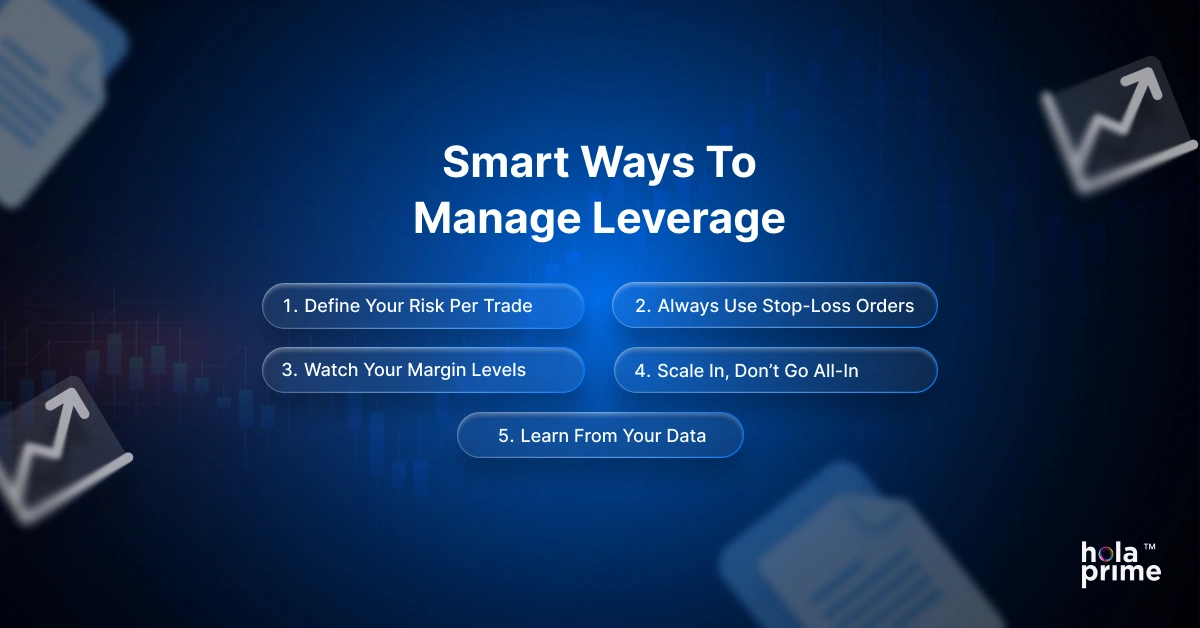
1. Define your risk per trade.
Before you enter a position, decide how much of your account you’re willing to lose if the trade goes wrong - usually no more than 1–2%. Adjust your position size and leverage to fit that limit.
2. Always use stop-loss orders.
Never trade without one. A well-placed stop-loss prevents small mistakes from turning into large losses, especially when you’re trading with leverage.
3. Watch your margin levels.
Keep enough free margin to handle unexpected volatility. If your margin level drops below 100%, you risk a margin call that could close all open trades.
4. Scale in, don’t go all-in.
Instead of opening one large position, build it gradually as the market confirms your bias. This helps manage risk while still using leverage effectively.
5. Learn from your data.
Track your trades and see how leverage affects your performance. Over time, you’ll notice the sweet spot that gives you strong returns without exposing you to unnecessary risk.
Leverage in Prop Trading: A Balanced Perspective
In the world of prop trading, leverage is both an opportunity and a test. Firms provide access to large capital, but with strict risk limits. This teaches traders to respect leverage rather than abuse it.
Passing a prop challenge often requires balancing consistency and aggression - knowing when to scale up and when to stay defensive. The traders who succeed are those who use leverage as an amplifier for skill, not emotion.
They understand that the goal isn’t to take massive positions but to build steady, risk-adjusted returns.
Final Thoughts
Leverage is one of the most powerful tools in forex trading - but like any tool, it depends on how you use it. It can turn a good strategy into a great one or wipe out your account in a single bad trade.
The key is balance. Treat leverage as a way to enhance performance, not to chase quick profits. Combine it with solid risk management, realistic expectations, and emotional control.
In the end, successful traders don’t just know how to use leverage - they know when not to use it. That’s the real edge that separates professionals from gamblers in the forex market.


 EN
EN DE
DE