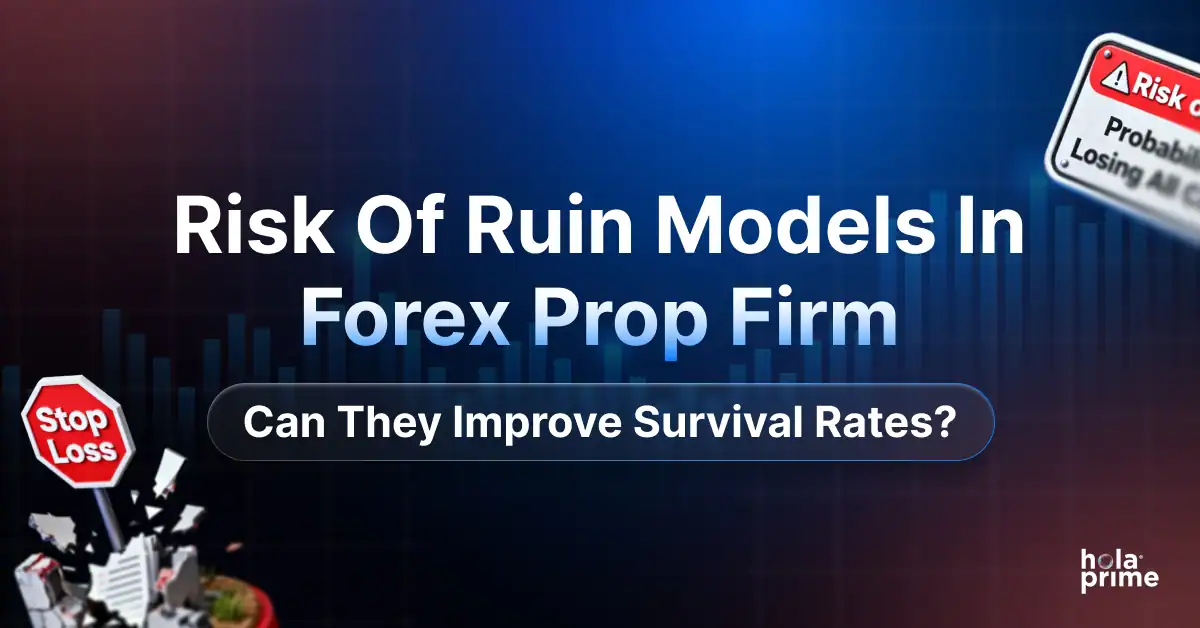
Every trader who enters a prop challenge wishes to pass it, scale up and eventually trade with larger capital with confidence. Yet one thing many traders do not realise early on is that the biggest threat to their journey is not a bad strategy or a string of losing trades. It is the mathematical possibility of wiping out the account simply because the risk per trade is too high for the size of the account. This is where risk of ruin models step in. These models help traders understand how close they are to blowing the account based on win rate, risk per trade and average reward. If you can quantify the risk of ruin, you can build habits that help you survive longer in a challenge, especially when you combine these insights with the rules of a prop firm like Hola Prime.
What Is Risk of Ruin in Trading?
Risk of ruin refers to the probability of losing enough trades in a row that the account reaches a level where it can no longer continue. In a prop trading context, ruin does not necessarily mean zero balance. It often means hitting the drawdown limit that ends the challenge. If your maximum loss for the challenge is ten percent, then mathematically, ruin occurs when your equity touches that limit. Even traders with solid strategies can face ruin if their risk per trade is too large for the account size. Understanding this probability is the first step toward surviving long enough to let your edge play out.
Why It Matters for Prop Traders?
Prop traders operate with rules that limit how much they can lose. These rules turn the risk of ruin into a very real boundary. You might have an excellent strategy with strong long term expectancy. However, if you risk too much per position, even a normal losing streak can knock you out before the edge has time to show results. This is why traders who understand ruin models tend to last longer in evaluations. They know exactly how many losses they can absorb before danger appears, which forces them to respect position sizing and avoid emotional decisions after a bad day.
How Risk of Ruin Is Calculated in Simple Terms?
You do not need to be a mathematician to understand the idea. The model combines three ingredients: your win rate, your average reward relative to risk and the percentage of the account you risk per trade. When the risk per trade is high or the win rate is inconsistent, the probability of ruin moves up very quickly. Small changes in risk can have a surprisingly large effect. For example, risking two percent per trade with a moderate win rate can still create a high ruin probability, while risking half a percent with the same strategy can reduce the likelihood dramatically. This gap is why some traders pass evaluations with ease while others keep failing even though they use similar strategies.
Example for Better Clarity
Imagine a trader who risks two percent per position on a $100K prop account. If this trader loses five trades in a row, the account is already down ten percent, which usually breaks the rules. A trader with the same strategy who risks only half a percent can survive the same losing streak and remain well inside the drawdown limits. The strategy did not change. The risk model changed everything.
Linking Risk of Ruin to Prop Evaluation Rules
Most prop firms, including Hola Prime, focus strongly on account protection. Daily drawdown limits, overall loss limits and consistency requirements all exist to teach traders how to manage downside risk. What traders often forget is that these rules can be used to their advantage. If you calculate your ruin probability based on these limits, you will know exactly what risk level keeps you safe. The goal is not to avoid losing trades. The goal is to make sure losing spells do not violate the rules. When you treat the drawdown limit as part of your risk model instead of a restriction, your survival rate improves instantly.
Adjusting Risk Positioning for Better Outcomes
One of the most useful ways to work with ruin models is to adjust your risk dynamically instead of sticking to a fixed number. If you notice the account moving closer to the danger zone, reducing your risk per trade helps protect the remaining capital. In stronger performing phases, you can return to your preferred levels. This flexible approach is something many funded traders quietly use to remain consistent over long periods.
The Psychology Behind Survival
Risk of ruin is more than numbers. It shapes the mindset of a trader. When you understand how close you are to blowing the account, you naturally avoid revenge trading or oversized positions that tempt you during frustration. You begin to think like a risk manager rather than a gambler. Since prop trading is not about single trades but about survival, passing the challenge becomes less stressful because each position carries a controlled and predictable danger.
Why Traders Ignore This Model?
Many traders avoid thinking about ruin probabilities because it feels uncomfortable to face the chance of blowing the account. They focus on entries and setups but never on the survival aspect. However, the truth is that a trader who understands their risk boundaries has a far better chance of turning a prop account into long-term income.
Can Risk of Ruin Models Improve Survival Rates?
Yes, and in a very direct way. When you know how changes in risk per trade affect the probability of failure, you make smarter decisions automatically. You do not need to guess whether risking two percent is too aggressive. The model will show you. You do not need to assume your strategy can survive ten losses in a row. The numbers will tell you. When you apply these insights consistently, survival rates increase because your approach becomes structured rather than emotional.
Final Thoughts
Prop trading challenges reward traders who can protect capital as much as they reward performance. Understanding risk of ruin models gives you an upper hand because you work with probabilities that many traders ignore. You stop thinking about passing quickly and shift toward lasting long enough to let your edge unfold. With good risk discipline and a model that shows your danger zones, you place yourself in a stronger position to succeed with a prop firm like Hola Prime where consistency and risk management truly matter.

 EN
EN DE
DE