If there’s one market that can humble even the most confident trader, it’s the E-mini Nasdaq 100 (NQ). This futures contract behaves like a caffeinated squirrel - fast, unpredictable, and capable of jumping far beyond where you expect it to land. One minute, you’re comfortably in profit; the next, you’re wondering why your stop-loss feels like it wasn’t even there.
That volatility is exactly why so many traders love it. And it’s also why risk management isn’t just “helpful” in NQ trading - it’s survival.
Whether you’re already neck-deep in Nasdaq futures or planning to take your first shot, this guide breaks down the practical, real-life risk rules that can help you stay in the game long enough to actually grow.
First, Why Does the E-mini Nasdaq 100 Require Special Attention?
The Nasdaq 100 reacts to almost everything:
- Big tech earnings
- Federal Reserve speeches
- Inflation data
- Even a rumor about Apple working on a new gadget
Each tick in the E-mini Nasdaq 100 is worth $5, and it can easily move 200–400 points in a volatile session. That means a single contract can swing $1,000–$2,000 in minutes.
Let that sink in.
Fast markets are great - only if you’re positioned correctly.
Tips to Manage Risks When Trading E-mini NASDAQ 100
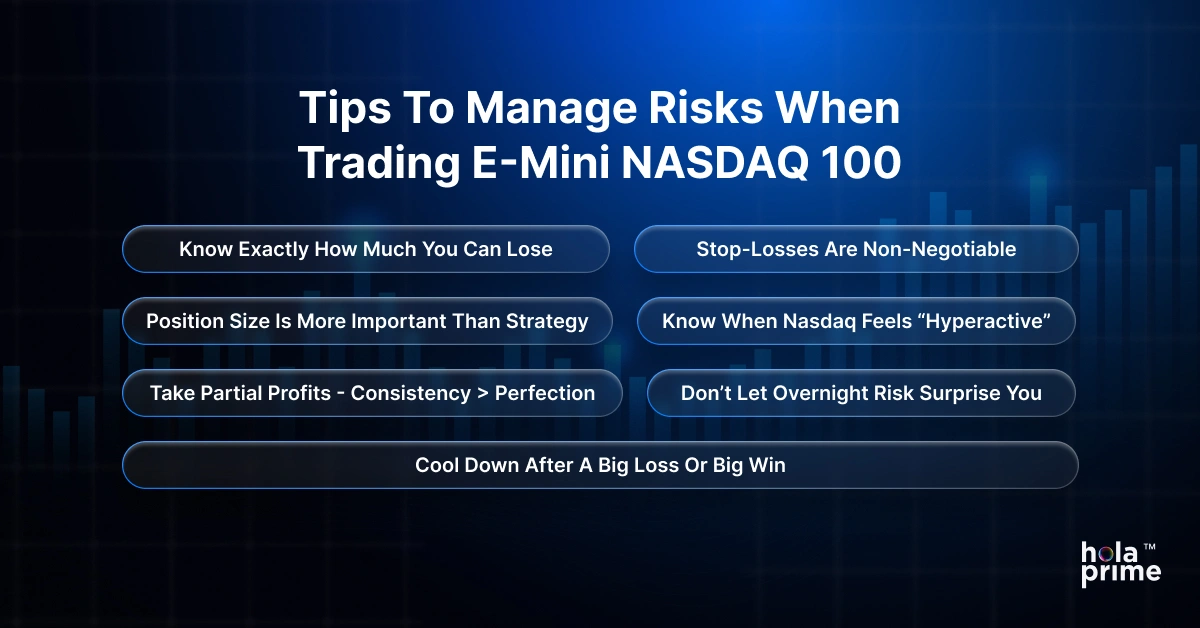
Rule #1: Know Exactly How Much You Can Lose - Before You Click Buy
Most traders focus on “how much they could make.” Nasdaq futures don’t care about your dreams. The first question you should ask is:
“How much am I willing to lose if this goes wrong?”
Here’s a simple, practical rule grounded in sanity:
Risk no more than 1-2% of your account balance on a single NQ trade.
If you have:
- $10,000 → max risk per trade = $100–$200
- $50,000 → max risk per trade = $500–$1,000
You’re not being conservative. You’re being realistic. The ones who ignore this rule aren’t just risking money - they’re risking their ability to keep trading at all.
Rule #2: Stop-Losses Are Non-Negotiable (and They Need Room)
Some traders set tight stops like they’re protecting a rare family recipe. NQ doesn’t care. It will chew through tight stops with no remorse.
The solution is not to set stops based on fear, but on market structure.
Better stop-loss locations
Set stops below/above:
- A swing high/low
- A key support/resistance level
- A meaningful moving average
- A volume cluster or VWAP area
In other words - place stops where the market must be wrong for you to be wrong.
Bad stop example:
“This looks fine. I’ll just put a 10-point stop.”
Good stop example:
“If price breaks below this 30-minute support level, my trade thesis is invalid.”
Let the chart decide - not your emotions.
Rule #3: Position Size Is More Important Than Strategy
You can have the most brilliant Nasdaq strategy in the world, but if your size is too big, one trade can wipe out weeks of work. Position sizing for NQ should revolve around two numbers:
A. Your stop distance
Let’s say your stop is 20 points →
20 points × $5 per point = $100 risk
B. Your risk per trade
If your acceptable risk is $300, then you can trade 3 contracts.
Here’s a quick cheat guide:
Stop Size | Risk per Contract | Max Contracts for $400 Risk |
10 points | $50 | 8 contracts (too aggressive) |
20 points | $100 | 4 contracts (still risky) |
40 points | $200 | 2 contracts (safer) |
Wider stops + smaller size = more survival and less panic.
Rule #4: Know When Nasdaq Feels “Hyperactive”
The E-mini Nasdaq 100 isn’t wild all day. There are hours when it behaves like a toddler after three cups of cola. These tend to be:
High-risk volatile periods:
- First 15–45 minutes after market open
- Fed meeting days (FOMC days are chaos)
- CPI, Jobs Data, PCE announcements
- Big tech earnings releases (Apple, Microsoft, Tesla)
During these times, volatility doubles (sometimes triples). Your usual stops and targets might be useless.
Smart approach:
- Reduce size
- Widen stops slightly
- Scale into positions instead of entering all at once
Trading NQ during news without a plan isn’t “brave.” It’s expensive.
Rule #5: Take Partial Profits - Consistency > Perfection
Nasdaq can give you profit and snatch it back like a kid teasing with candy. One way to avoid that?
Take partial profits.
If your trade is up 20–40 points with solid momentum:
- Close part of your position
- Move stop-loss to breakeven or trailing stop
This protects your gains without fully giving up on the bigger move.
Remember: Profit booked is growth in future trading power. Unrealized profit is just an idea.
Rule #6: Don’t Let Overnight Risk Surprise You
Most new traders overlook overnight exposure. The E-mini Nasdaq trades almost 24 hours, but liquidity dries up and spreads widen drastically outside the U.S. session. That means:
- Stop levels can gap through your order
- You may take a bigger loss than expected
- It’s harder to get filled where you want
Night Trading Rule:
Only hold overnight if it’s part of a well-defined swing trade, not because you “hope it’ll come back.”
Hope is not a strategy. Hope is a leak in your account.
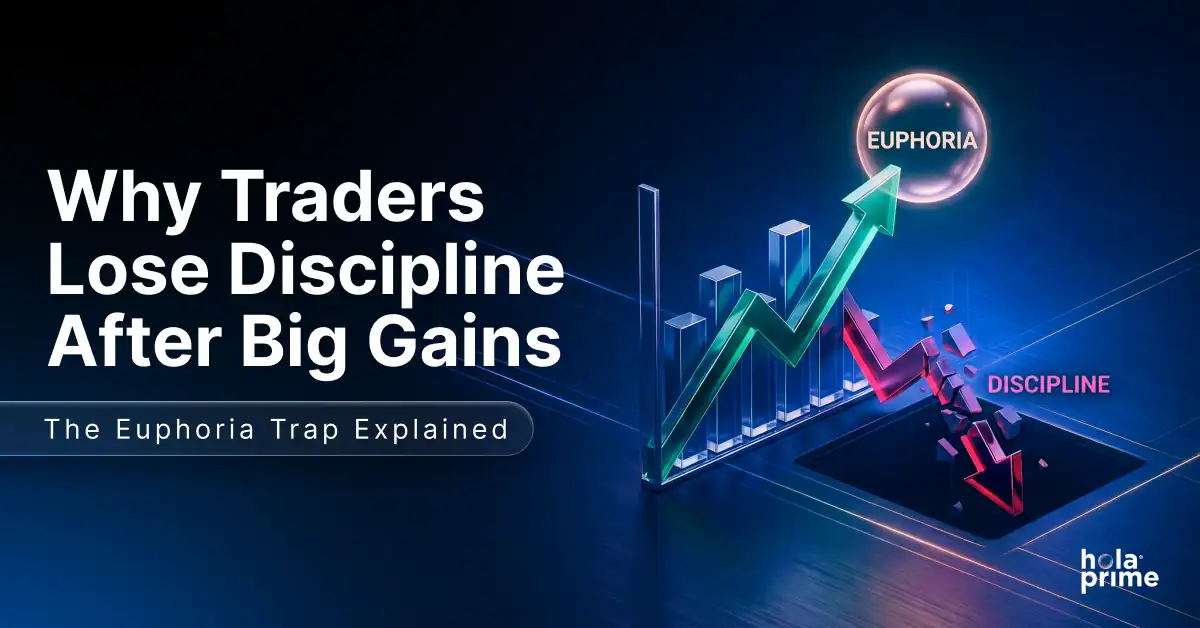
Rule #7: Cool Down After a Big Loss or Big Win
Sounds odd, but both winning and losing cloud judgment.
- After a win → overconfidence kicks in
- After a loss → revenge trading tries to rescue your pride
Neither state of mind respects risk.
Smart rule:
After a win or loss that’s larger than your average, step away for 10-20 minutes.
Your brain needs a reset. Trading with emotion isn’t trading - it’s gambling with better graphics.
Rule #8: Create a Personal Trading Playbook (This Is Your Safety Net)
Trading platforms don’t save you. Brokers definitely don’t. A written personal risk policy does.
Your playbook should clearly state:
- Max contracts per trade
- Max risk per day (e.g., 2–3 losing trades and you stop)
- Minimum stop size
- Rules for entries & exits
- News you avoid trading
- Pre-market checklist
This isn’t bureaucracy - it’s habit building. The market is chaotic. Your playbook brings stability.
Conclusion: Risk Management Is Not Limiting You - It’s Protecting Your Freedom
Every trader is attracted to the E-mini Nasdaq 100 for a reason. It moves. It pays fast. It challenges you. But the real money doesn’t go to the fastest trader or the bravest trader. It goes to the trader who can stay in the game long enough to learn how to win consistently.
Risk management isn’t there to hold you back. It’s there so you can show up tomorrow - calm, funded, and ready.
Trade smart, not loud. Protect your account like you plan to trade for years, not minutes. That's how real progress and real profits grow.

 EN
EN DE
DE