In this blog, we'll go through some legitimate risk management models that traders use when managing a leveraged futures contract exposure. We will discuss what the models are, how they work, why they are important, and how to incorporate them into your trading. No matter if you trade an equity index, commodities, or currencies, if you become familiar with these models, you set yourself up to outlast and have greater comfort with your risk in trading.
Why Risk Management Matters More with Leverage?
Leverage will allow you to control a larger position using a relatively small amount of risk capital. For instance, consider a $100,000 notional futures contract where you need only put up $5,000 to meet margin requirements. If the price moves in your favor one percent in a given day, that would be a $1,000 gain (or loss), which is equivalent to 20 percent of your margin in a day. This is usually necessary to have risk control when trading leveraged products.
Trading futures is very different from spot trading. In spot trading, a loss is limited to your initial investment. In futures trading, as an example, you could lose more than your original $5,000 margin amount if the market reverses in your favor. A relatively small or manageable move against you could wipe out days or weeks of gains if your size is too large. Creating structured models to manage your risk involves a decision on how much to risk per trade, a way of allocating that risk capital across multiple positions, and taking the judgment (and emotion) out of the equation when things get volatile.
Different Risk Management Models:
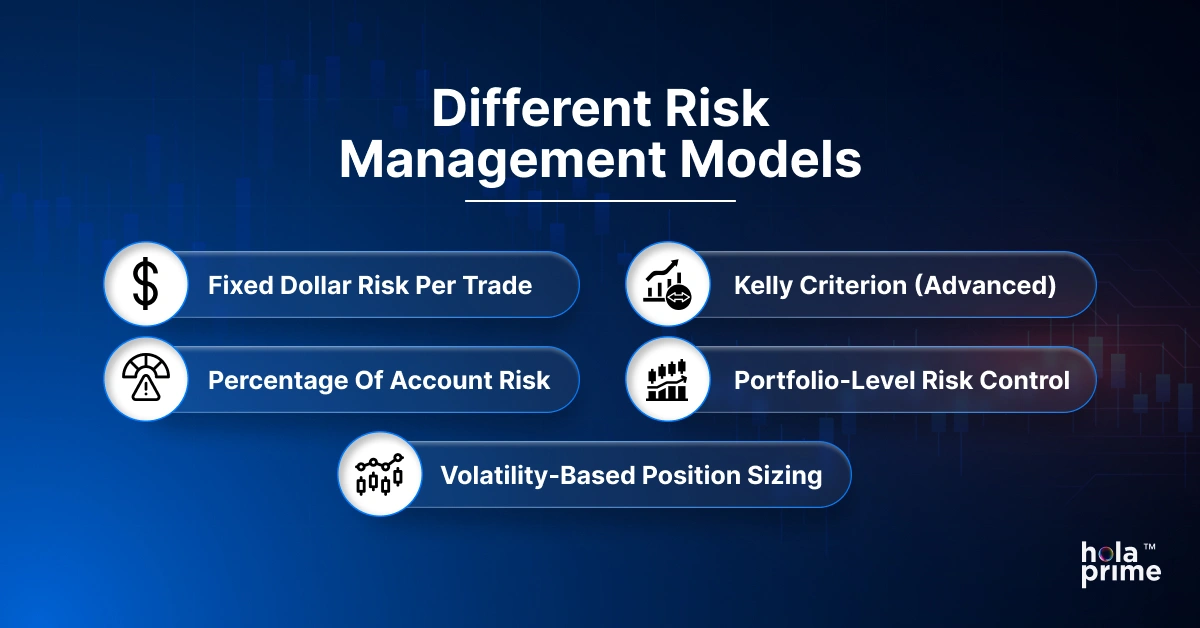
Model 1: Fixed Dollar Risk Per Trade
This is one of the simplest and most popular approaches. Here, you decide in advance how much money you’re willing to lose on a single trade, and you size your position accordingly. For example, let’s say you’re trading crude oil futures and you set your risk per trade at $500. If your stop loss is $0.50 away from entry and each tick is worth $10, then you can trade one contract because 50 ticks × $10 = $500.
This model is easy to apply and keeps your losses consistent regardless of the market volatility. It works well for traders who want straightforward risk control without complex calculations. The key is to stick to the predefined amount no matter how confident you are in a trade. Over time, this consistency builds discipline and protects your capital during losing streaks.
Model 2: Percentage of Account Risk
This model involves risking a fixed percentage of your account per trade. For example, with a $25,000 account risking two percent, your maximum loss per trade would be $500. You would then determine your position size based on the distance between your entry and stop loss. The wider your stop, the smaller your position size would be, and the tighter your stop, the larger your position size would be.
This approach naturally adjusts your trade size as your account grows or shrinks. When you’re on a winning streak and your account increases, your risk amount also increases slightly, allowing for compounding. When you hit a losing streak, your risk amount decreases, helping you preserve capital. Many professional traders prefer this model because it balances growth with protection in a systematic way.
Model 3: Volatility-Based Position Sizing
Volatility-based models use market volatility to help in the determination of position size, thus allowing these models to be more flexible or adaptive than fixed dollar or fixed percentage models. A common measure used for calculating volatility is called the Average True Range (ATR), which measures a market's average daily movement over a specified number of periods. The idea is to determine your position size so that your stop loss is below or above the typical market movement.
For example, if you’re trading gold futures and the ATR is $20, placing a stop just $5 away from entry may not make sense because normal daily swings can easily hit it. Instead, you might set your stop one ATR away and size your position so that the dollar risk matches your acceptable loss. This model prevents stops from being placed too close in volatile markets and gives trades more breathing room.
Model 4: Kelly Criterion (Advanced)
The Kelly Criterion is a method for determining how much capital to risk on each trade based on one's edge. It uses the win probability and average reward-risk ratio to help traders decide how much risk is optimum for capital growth. For example, if a system has a 60 percent win probability and a reward-risk ratio of 1:1, the optimal risk might be 20 percent of total capital.
The model can theoretically maximize returns, but it is quite aggressive and can result in larger drawdowns if the assumptions are wrong. In practice, most traders only risk a fractional Kelly or maybe a quarter of Kelly, which is more suitable for traders who have tracked an edge and an established statistical edge and time than it is for rookies testing a new system.
Model 5: Portfolio-Level Risk Control
Many traders think about risk only on a per-trade basis, but if you hold multiple positions at once, your total exposure can quickly add up. Portfolio-level models consider the combined risk across all open trades. For example, you might set a rule that your total open risk should never exceed five percent of your account. If you already have trades open risking four percent combined, your next trade can only risk one percent.
This approach is essential when trading correlated markets. If you’re long crude oil and also long heating oil, you’re essentially doubling your exposure to the energy sector. A sudden move in oil prices could hit both positions at once. By managing risk at the portfolio level, you avoid situations where multiple trades go against you simultaneously and cause larger-than-expected losses.
Incorporating Margin Requirements into Risk Models
Futures contracts have specific margin requirements that can change depending on market volatility. It’s important to integrate these requirements into your risk model. If margin levels rise due to increased volatility, your available capital for new trades might shrink. Ignoring this can lead to over-leveraging without realizing it.
For example, during periods of high volatility in gold or oil, exchanges often increase margin requirements to control systemic risk. If you’re trading near your maximum allowable size and margins increase, you might get a margin call or be forced to reduce your positions at a bad time. Regularly checking margin levels and adjusting your position sizes accordingly is a key part of effective risk management.
Setting Maximum Daily and Weekly Loss Limits
In addition to per-trade risk models, it is wise to implement daily and weekly loss limits. This is critical for leveraged futures traders, as one bad day's performance can have long-lasting effects. For instance, you may devise a rule that, if the day's loss exceeds 2% of your account equity, you will not trade for the remainder of the day. Likewise, if the loss for the week exceeds 5% of your account equity, you will not trade for the remainder of the week. Essentially, these guidelines act as circuit breakers to managing emotional overtrading followed by compounding mistakes.
By setting daily and weekly loss limits, you will exhibit a risk control strategy similar to what prop firms use to exert risk controls. With guidelines regarding your daily and weekly loss limits, you have time to reset mentally, use some discretion, and determine what went wrong, while not trying to force a comeback in the same session from your previous performance. This simple step can prevent a small losing streak from developing into a substantial drawdown.
Combining Models for More Robust Risk Management
Most traders combine features of different models to create a risk plan that fits their personality. For example, a trader uses percentage risk per trade in order to size their individual positions, volatility-based stops to create their logical exit levels, and portfolio-level rules that provide some type of overview assessment of overall exposure. This multifaceted approach allows the trader flexibility in their risk plan while giving them clearly defined guardrails.
There is no one model that is good in all conditions. Markets are not static and neither is your account size, and your strategy will shift between hot and cold periods of execution. By combining models, you are developing a framework that allows for some changes, which is much different than relying on one static rule to regulate risk.
Final Thoughts
Risk management probably isn’t the most exciting part of trading, but it is what allows traders to remain in the game long enough for their styles and strategies to work. Leveraged futures have a natural tendency to amplify gains and losses, so using some structured risk models is not optional, but essential. The goal is not to eliminate risk, but to take a risk that is appropriate for your trading plan's growth objective and your account size.
Whether you choose a simple fixed dollar model or a more advanced volatility-based or portfolio approach, what matters most is consistency. Once your risk model is set, the discipline to follow it trade after trade is what builds longevity. Over time, this discipline becomes a competitive advantage.

 EN
EN DE
DE