Play DUNK Trade & Get 15% OFF
Play Now
Hola PrimeLogin/Register

Pip Value and Lot Size in Forex: A Complete Guide for Beginners

Oct 8, 2025
Pip Value and Lot Size in Forex: A Complete Guide for Beginners

As a novice in forex trading, you might find all the terminology quite overwhelming. Words such as "pips," "lots," and "pip value" are used assuming that every trader already knows what they mean. However, these are really the cornerstones of forex, and without some knowledge of these terms, you will find it hard to trade comfortably.

One Time

20% discount

on all accounts
Get Funded

Think of it this way: if forex is like driving a car, then pips are the distance markers on the road, and lot sizes are the type of car you’re driving. A misunderstanding here doesn’t just cause confusion - it can cost you money. That’s why in this guide, we’ll slow things down, break everything into plain language, and give you real-world examples so you know exactly how pip value and lot size fit into your trading.

By the end, you’ll not only understand how to calculate pip values but also know how to use lot sizes to manage risk properly.

What is a Pip in Forex?

The term "pip" stands for percentage in point, also known as a price interest point. This is the minimum amount that a price changes in forex trading. Pips allow traders to determine how much a currency pair has moved.

In most currency pairs, a pip is based on the fourth decimal place. For example:

If EUR/USD goes from 1.1000 to 1.1001, this is a one-pip move.

If GBP/USD increased from 1.2500 to 1.2510, that is a ten-pip move.

There are certain cases where pip identification is different. For currency pairs that include the Japanese Yen, such as USD/JPY, the second decimal place is a pip. For example, going from 145.50 to 145.51 represents one pip.

Real-World Example of Pips

Imagine you’re trading EUR/USD. You enter a long trade at 1.1000, and after an hour, the price rises to 1.1020. That’s a 20-pip gain. Now, whether those 20 pips translate into $20, $200, or $2,000 depends entirely on your lot size - and this is where most beginners either thrive or burn out.

What is a Lot in Forex?

In forex, trades are executed in lots, which represent standardized contract sizes. Lot size determines how much each pip movement is worth in your account.
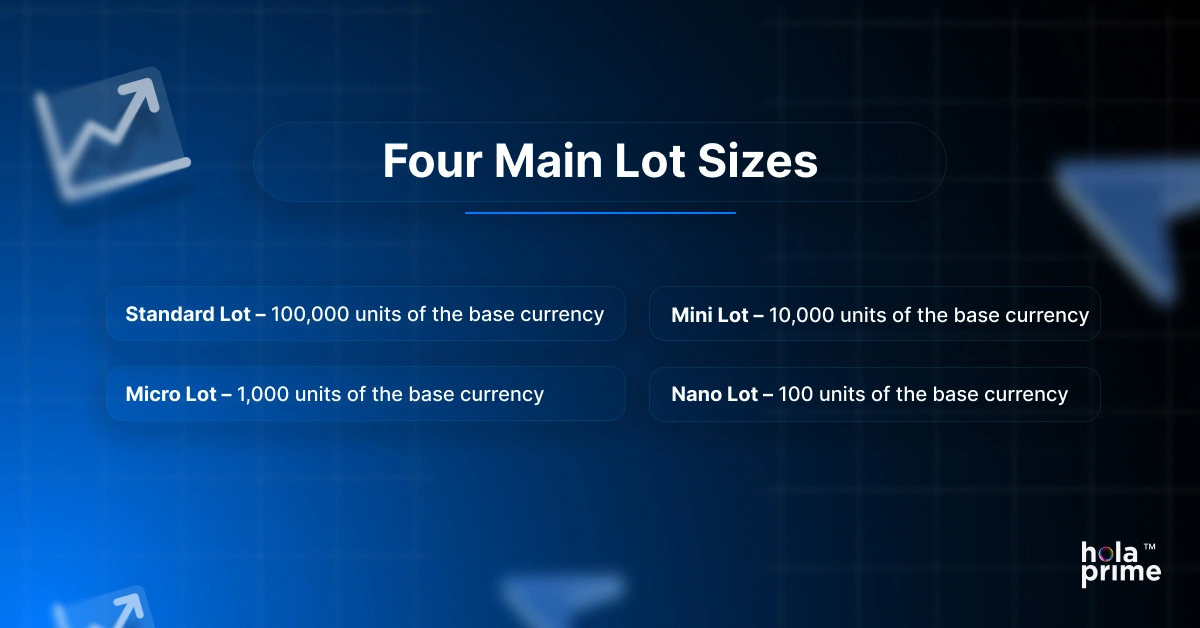
Infographic with 4 mail lot sizes, namely, standard lot, mini lot, micro lot, and nano lot.

Example: Trading With Different Lot Sizes

If you trade 1 standard lot of EUR/USD, each pip is usually worth $10.

If you trade 1 mini lot, each pip is worth about $1.

With 1 micro lot, each pip equals $0.10.

So, in the earlier EUR/USD example, where the pair moved 20 pips in your favor:

With a standard lot, you’d earn $200.

With a mini lot, it’s $20.

With a micro lot, it’s just $2.

This is why lot size is so crucial - it directly affects the amount of risk and potential profit you’re dealing with.

Pip Value Explained: Why It Matters

Pip value is simply the monetary worth of a pip for a given trade. It depends on three things:

The currency pair you’re trading

The lot size you choose

The exchange rate (especially if your account is not in USD)

Without knowing your pip value, you’re essentially trading blind. You might think, “Oh, it’s just a 50-pip stop loss, that’s not much,” but if you’re trading a standard lot, that’s a $500 risk. On a micro lot, it’s only $5. Same distance, completely different financial impact.

How to Calculate Pip Value

Don't worry - working out pip value isn't as tricky as you might think. The basic formula is pretty simple:

Pip Value = (One Pip ÷ Exchange Rate) × Lot Size

What does all this mean when it comes to your trade? For most currency pairs, a pip is equal to 0.0001, with the exception of yen pairs like USD/JPY, which use 0.01. The exchange rate is simply the current market price of the currency pair you are trading. The lot size is the amount of the base currency you are trading. 

Let's take a look at two examples. You are trading EUR/USD at an exchange rate of 1.1000, and so you open a standard lot (100,000 units). Plugging the values of the pip value into the equation gives us 

(0.0001 ÷ 1.1000) × 100,000 = approximately $9.09. 

In real-world terms, this is about $10 per pip on a standard lot for the pair EUR/USD. This means for every 10 pip move in your favor, you have made approximately $100 in the profit column; but conversely, for every 10 pip move against you, you have taken a hit of $100 in loss. 

Now, let's say you were instead trading a yen pair such as USD/JPY at 145.50, and you open a mini lot (10,000 units). Since the pip is 0.01 for yen pairs, we plug the values of the pip value into the investment equation below. 

(0.01 ÷ 145.50) × 10,000 = approximately $0.69.

That means each pip is worth about 70 cents. You can already see the contrast — trading a mini lot on USD/JPY exposes you to much smaller swings compared to a standard lot on EUR/USD.

But what if you don’t want to crunch numbers every time? A quick shortcut helps. For most non-JPY pairs, you can assume:

On a standard lot, one pip is close to $10.

On a mini lot, it’s about $1.

On a micro lot, it’s just 10 cents.

For yen pairs, the values come in a little lower, as the USD/JPY example showed. Once you practice a bit, you’ll get used to these rough figures, and they’ll become second nature when planning trades.

Relationship Between Pip Value and Risk Management

Here’s where most new traders mess up. They understand pips and lot sizes separately but fail to connect them with risk per trade.

A simple rule: never risk more than 1–2% of your account on a single trade.

Example:

You have a $1,000 trading account. You decide to risk 2%, which is $20.

If your stop loss is 50 pips, then your pip value should be $0.40.

That means you should trade a micro lot, not a mini or standard lot.

This kind of calculation keeps you in the game long enough to learn and grow, instead of blowing up your account in a few trades.

Common Mistakes Beginners Make With Pip Value and Lot Size

  1. Ignoring Pip Value – Many beginners place trades without checking how much each pip is worth. This often leads to oversized risks.
  2. Over-leveraging – Choosing a standard lot when their account size can barely handle a micro lot.
  3. Not Adjusting for Account Currency – If your account isn’t in USD, pip values change depending on the exchange rate.
  4. Setting Random Stop Losses – Using 100 pips as a stop without checking whether that equals $100 or $1,000 in risk.
  5. Chasing Big Wins Too Early – Focusing on high lot sizes for “fast profits” instead of building consistency.

Putting It All Together: A Practical Example

Let’s say you’re trading GBP/USD.

Your account balance = $5,000

You decide to risk 2% ($100)

Your stop loss = 50 pips

Now, to calculate lot size:

$100 ÷ 50 pips = $2 per pip.

So you need a position where each pip is worth $2. That means you should trade 0.2 lots (20,000 units).

If you had chosen 1 standard lot by mistake, your risk would jump to $500 instead of $100 - way above your comfort zone.

Tips for Mastering Pip Value and Lot Sizes

Always calculate before entering a trade. Guessing is the fastest way to lose money.

Start small. Use micro lots until you’re consistent, then scale up.

Use calculators. Many brokers provide pip and lot size calculators for free - take advantage of them.

Think in risk, not in pips. Don’t say, “I’m risking 30 pips.” Instead, say, “I’m risking $15,” so you know exactly what’s at stake.

Practice on demo account. Use a demo account to get a feel for how pip values impact your trades before going live.

Conclusion:

If you’ve ever felt like forex trading is just about chasing charts and guessing where the market goes next, now you know there’s much more beneath the surface. Pip value and lot size are not just technical details - they are the foundation of smart risk management.

When you understand how pips translate into actual money and how lot sizes determine your exposure, you stop trading blindly. Instead, you start trading with purpose, with numbers that make sense for your account size.

So the next time you open a trade, don’t just think about whether the market is going up or down. Take a moment to calculate how much each pip will cost you - and whether that risk feels comfortable. That little calculation might be the difference between lasting years in the market or burning out in weeks.
About the Author: Sam Saleh

Sam Saleh, a London-based trader, began his trading journey at 19 while studying Business at the University of Bedfordshire. With expertise in trading and a background in marketing, he now coaches at Hola Prime, where he develops educational content aimed at building trader confidence, consistency, and financial literacy.

FAQs

Still Have Questions?

Feel free to get in touch with us today!

Book a MeetingArrow
A pip is the smallest unit of price movement in most currency pairs. For most pairs, it’s the fourth decimal place (0.0001), while for Japanese yen pairs, it’s the second decimal place (0.01).
Pip value tells you how much money each pip movement is worth for your trade. Without knowing it, you can’t properly measure your risk or potential reward.
Lot size directly impacts pip value. A standard lot makes each pip worth around $10, a mini lot about $1, and a micro lot just $0.10.
Micro lot = 1,000 units of the base currency Mini lot = 10,000 units Standard lot = 100,000 units Your choice determines the size of your risk and reward per pip.
The formula is: Pip Value = (One Pip ÷ Exchange Rate) × Lot Size. For example, on EUR/USD at 1.1000, trading a standard lot, each pip is worth roughly $10.
Yes. Pip values differ between pairs, especially when the Japanese yen is involved. Non-USD account currencies also require conversion.
They let you control exactly how much you risk on a trade. By adjusting your lot size, you can ensure your risk stays within 1–2% of your account balance.
It’s not recommended. Standard lots carry large risk per pip. Beginners usually start with micro or mini lots to protect their accounts while learning.
It depends on your account size, risk tolerance, and stop loss distance. The goal is to choose a lot size where your maximum risk per trade is manageable.
Yes. Most brokers, including prop firms like Hola Prime, offer free calculators that quickly determine pip values and lot sizes for you.

Disclaimer

All information provided on this site is for educational purposes only, related to trading in financial markets. It is not intended as financial advice, business or investment recommendation, or as an opportunity or recommendation to trade any investment instruments. Hola Prime only provides an educational environment to traders, including tools, materials and simulated trading platforms which have data feed provided by Liquidity Providers. The information on this site is not directed at residents in any country or jurisdiction where such distribution or use would be contrary to local laws or regulations.

Our Community

Join our discord server to connect with our community of active traders.

Join Discord

24/7 Customer Support

Our support staff is available to you 24/7.

About: Simulated trading operations are managed by Hola Prime Limited, a company registered at L1, Shaw House, 201 Wan Po Road, Tseung Kwan O, Hong Kong.
Holaprime Limited a company registered in Cyprus having registration number HE 454359 is a 100% subsidiary of Holaprime Limited Hong Kong.
For MT4 And MT5: Hola Prime Limited, with Company registration number 220248, and registered office at 4th Floor, Docks 4, The Docks, Caudan, Port Louis, Mauritius, is authorized and regulated by the Financial Services Commission (FSC) of Mauritius as an Investment Dealer (Full Service Dealer, excluding underwriting) under license number GB24203729.
For DXTrade, cTrader and MatchTrader: Gooey Trade, GT Tech LLC 6800 Broken Sound Parkway Northwest Suite 150 Boca Raton, FL 33487 US

RISK DISCLOSURE:
All of the information provided on this website and by Hola Prime Ltd, or its affiliates, is intended solely for Educational purposes. Nothing on this website is to be construed as investment advice, nor an offer or invitation to buy or sell any financial instrument, nor does it endorse, recommend, or sponsor any financial product, company, or fund. Testimonials on the Company’s website may not be reflective of the experience of other clients or customers and should not be considered as an assurance of future performance or success. Hola Prime only provides services of simulated trading and educational tools for skill assessment and enhancement of traders. Hola Prime does not act as a broker and does not accept any deposits. Any purchases made should not be regarded as deposits. There are no promises of rewards or returns. Trading in financial markets is inherently high-risk and speculative. The content and information provided on this website are not intended for distribution to, or use by, any person or entity in any jurisdiction or country where such distribution or use would be contrary to local law or regulation.

HYPOTHETICAL PERFORMANCE DISCLOSURE:
ACFTC Rule 4.4-Hypothetical performance results have many inherent limitations, some of which are described below. No representation is being made that any account will or is likely to achieve profits or losses similar to those shown. In fact, there are frequently sharp differences between hypothetical performance results and the actual results subsequently achieved by any particular trading program. One of the limitations of hypothetical performance results is that they are generally prepared with the benefit of hindsight. In addition, hypothetical trading does not involve financial risk, and no hypothetical trading record can completely account for the impact of financial risk of actual trading. For example, the ability to withstand losses or to adhere to a particular trading program in spite of trading losses is material points, which can also adversely affect actual trading results. There are numerous other factors related to the markets in general or to the implementation of any specific trading program, which cannot be fully accounted for in the preparation of hypothetical performance results and all of which can adversely affect trading results. Testimonials appearing on this website may not be representative of other clients or customers and are not a guarantee of future performance or success.

EVALUATION DISCLOSURE:
The customer pass rate of the Challenge/Evaluation program was 35% between 10th November, 2024 – 29th May, 2025, who traded at least one evaluation and obtained a Hola Prime Account during this time period. The Challenge and Hola Prime Accounts are meant to be a realistic simulation of trading under actual market conditions, including commissions, to mimic real market conditions, as much as possible. The evaluation is difficult to pass even for experienced traders. The Evaluation is not suggested for individuals with little to no trading experience.

CUSTOMER COMPENSATION DISCLOSURE:
All trades presented for compensation to customers should be considered hypothetical and should not be expected to be replicated in a live trading account. Hola Prime Accounts may represent simulated accounts or live or copied accounts. Hola Prime does not provide services to the residents of certain countries including – Afghanistan, Belarus, Burundi, China, Cuba, Congo, Sudan, Sri Lanka, North Korea (Democratic People’s Republic of Korea) and Yemen.

This is the only website for Hola Prime. We are not using any third party websites or links. Any link, outside of this website that claims to be ours, could be fraudulent and users are advised to not use it.