When you step into the world of futures trading, you quickly realize that charts alone don’t always tell the full story. Price patterns and indicators give you an overview of what’s happening, but if you really want to understand why prices move, you need to dig deeper. That’s where order flow and the Depth of Market (DOM) come in. These tools help traders see what’s happening behind the scenes — showing how buyers and sellers interact in real time.
For prop traders, mastering order flow and DOM can make all the difference between reactive trading and proactive decision-making. Let’s explore how they work and how you can use them effectively.
What is Order Flow in Futures Trading?
Order flow is simply the stream of buy and sell orders entering the market. It helps you see who’s in control — buyers pushing prices up or sellers driving them down. When you analyze order flow, you’re not guessing direction based on past data; you’re watching current market activity unfold.
For instance, if you notice a surge in buy market orders hitting the ask, it usually means traders are aggressively entering long positions. On the other hand, an increase in sell market orders hitting the bid suggests growing selling pressure. This kind of real-time insight can help you confirm trade setups or avoid entering weak trades.
Many prop traders use order flow to gauge momentum and conviction in price movement, rather than relying only on lagging indicators.
Understanding the Depth of Market (DOM)
The DOM, or Depth of Market, is a window that displays all pending limit orders at various price levels. It shows how much liquidity is sitting on the bid and ask sides — giving traders a live look at market interest and supply-demand dynamics.
For example, if the DOM shows a large cluster of buy orders below the current price, it could act as short-term support. Similarly, a heavy wall of sell orders above might signal resistance. DOM reading is not about predicting; it’s about interpreting intent. When paired with order flow, it can reveal whether those large orders are genuine or being used as bait to mislead traders.
Why Prop Traders Rely on Order Flow and DOM
Prop traders operate with strict risk parameters and performance goals. Every trade needs high probability, supported by evidence — not emotions. Order flow and DOM provide that evidence.
Instead of reacting to a sudden candle on a chart, a prop trader can look at the DOM and see if large orders are absorbing price movements or if momentum is accelerating. This helps refine entries, tighten stops, and manage positions more confidently.
For example, during high-impact events like the Non-Farm Payrolls or FOMC releases, the DOM often lights up with activity. Traders using these tools can spot liquidity shifts or fading interest before it becomes obvious on a price chart.
Core Order Flow Strategies for Futures Traders
To make order flow work for you, it’s important to apply structured strategies. Here are some of the most effective ones used by prop traders:
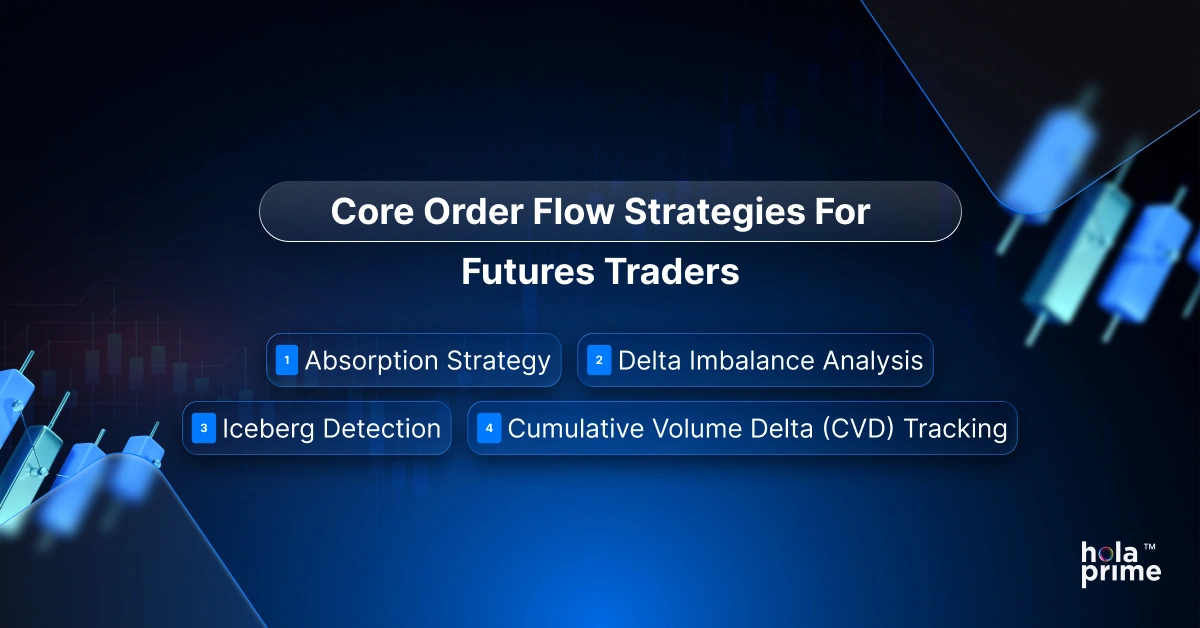
1. Absorption Strategy
This happens when large resting orders absorb aggressive market orders without moving the price much. For example, if sellers keep hitting the bid but the price isn’t falling, a big buyer may be accumulating quietly. Spotting absorption early can help you position in the direction of hidden strength.
2. Delta Imbalance Analysis
Delta measures the difference between market buys and sells. When delta spikes in one direction but price doesn’t follow, it could indicate exhaustion. Prop traders watch for these moments to anticipate reversals or short-term pullbacks.
3. Iceberg Detection
An iceberg order is a large hidden order that only partially shows in the DOM. Specialized software can help detect these orders based on repetitive execution patterns. Recognizing iceberg activity gives traders a sense of where large institutions are positioning.
4. Cumulative Volume Delta (CVD) Tracking
CVD adds up buy and sell pressure over time. A rising CVD during a sideways market hints that buyers are building up, while a falling one shows selling pressure accumulating. It’s a powerful tool for understanding underlying momentum.
DOM-Based Strategies for Futures Prop Traders
Order flow gives you context, but DOM helps you execute. Here are a few DOM-focused strategies:
1. Liquidity Zone Identification
By monitoring where most limit orders are clustered, you can identify potential turning points. When liquidity gets pulled right before a move, it often signals that smart money is preparing for a breakout.
2. Spoofing Awareness
Sometimes, large orders appear in the DOM only to vanish moments later. These fake orders are designed to manipulate perception. Recognizing spoofing prevents traders from being trapped by false signals.
3. Scalping with DOM
Scalpers often rely on the DOM for split-second decisions. They look for quick imbalances between bid and ask sizes to enter trades for small, consistent profits. This approach requires focus, speed, and a clear understanding of order book dynamics.
4. Tracking Order Book Shifts
Watching how liquidity moves — whether large orders are being added, canceled, or moved — can reveal sentiment shifts. For example, if you see heavy buy liquidity suddenly disappear before a drop, it may signal weakening demand.
Combining Order Flow and DOM in Your Trading Routine
The best results often come when order flow and DOM are used together. Order flow tells you what’s happening in terms of transactions, while DOM shows where the action is likely to unfold.
Here’s how a prop trader might combine both:
- Watch for large buy imbalances on the order flow chart.
- Confirm if the DOM supports it — for example, by showing liquidity thinning above current price.
- Time your entry as momentum starts building, and use DOM levels to manage exits or set stop-losses.
This layered approach adds clarity and control to your trading. Instead of reacting to price spikes, you’re anticipating them based on the market’s internal behavior.
Practical Tips for Prop Traders Learning Order Flow
1. Start with Simulation –
Practice in a simulated environment to build speed and pattern recognition without risking capital.
2. Focus on One Market –
Each futures contract behaves differently. Master one before expanding.
3. Use Clean Data –
Reliable data feeds are essential. Even minor lags can distort your view.
4. Avoid Over-Interpreting –
Not every order flow shift means something. Learn to distinguish between noise and meaningful moves.
5. Stay Calm Under Pressure –
DOM trading can be fast-paced. Emotional control is key to staying consistent.
Final Thoughts
Order flow and DOM aren’t magic indicators — they’re windows into how the market truly operates. For prop traders, these tools offer transparency, structure, and confidence in execution. When you understand the intent behind each order, you’re no longer guessing where the market will go; you’re reading it in real time.
It takes patience and practice, but once mastered, these methods can transform the way you trade futures — from reactive to deliberate, and from uncertain to strategic.

 EN
EN DE
DE