As you start exploring the trading world, you'll soon discover numerous strategies to increase your profits. Momentum trading and mean reversion trading stand out as two of the most common approaches. These methods can work well based on market conditions, how much risk you're comfortable with, and your preferred way of handling trades. But what do these strategies mean? And how can you tell when to apply each one? This blog will explain what momentum and mean reversion trading are, and help you determine which approach fits your trading style the best.
What is Momentum Trading?
Momentum trading is the buying and selling of financial instruments based on their price action momentum. If the price is going up, momentum traders assume that the trend will continue the same way for some time. Picture a surfer catching a wave - you aim to jump in when the market shows strong movement and continue riding that wave until the trend begins to weaken. Let's say oil prices have risen because of growing demand, and you spot increasing trading volume. A momentum trader would open a long position expecting the price to keep climbing.
A crucial part of momentum trading involves spotting trends and riding them as long as possible. The strategy is simple: purchase when the market rises and sell when it falls. Yet, the challenge lies in deciding when to exit - it's almost impossible to pinpoint the peak or trough of a trend. Take stocks that are skyrocketing, for instance. A momentum trader might eye a stock like Tesla, known for its big price swings. If Tesla's stock begins to gain steam due to news about a new product launch or a robust earnings report, the trader would buy in, expecting the price to keep climbing.
Key Indicators for Momentum Trading
To identify and capitalize on strong trends, momentum traders rely on a few important technical tools. Moving averages (MAs) are used to gauge whether the price is rising or falling. If the price is above the moving average, this indicates an uptrend, and if the price is below the moving average, this indicates a downtrend. The Relative Strength Index (RSI) is also a useful indicator. An RSI of 70 or above means the asset may be overbought and due for a pullback, while an RSI of 30 or below means it may be oversold and ready for a bounce. Many momentum traders utilize MACD (Moving Average Convergence Divergence). This trend-following momentum indicator can help traders identify a change in the strength of a trend, its direction, and its duration.
Advantages of Momentum Trading
The main advantage of momentum trading lies in its potential to generate substantial gains. Jumping on a trend might allow you to ride it for quite a while. This approach proves effective when markets show strong trends, such as when a stock's price breaks through a major resistance point or a currency pair surges due to positive economic reports. Momentum trading also offers clear guidance for executing trades. With the trend already set, you don't have to overanalyze your decisions.
However, momentum trading has its own set of risks. At times, trends change very quickly, and a sudden change in the market sentiment can put you from green to red. To manage the risk efficiently, it is important to have a plan for your exits. For this, depending on your trading strategy, you can use stop-loss or trailing stops. So that if the market happens to move the other way around, you can stay safe.
What Is Mean Reversion Trading?
Mean reversion trading is fundamentally different: instead of propping up the trend, you will wager that the price will revert to its average or "mean" level after it has moved too far in one direction. You can think of this like watching a pendulum sway: when a pendulum swings too far to one side, it will always come back. A common example of this strategy is when a stock rallies due to a one-time news event or overreaction. A mean reversion trader would short the stock based on the expectation that its price would revert back to a more normal price level in a reasonable timeframe.
Let's say a stock like Amazon sees a sudden price jump after a good earnings report, pushing it well above its usual price range. A mean reversion trader would view this as a chance to sell, betting the stock will soon return to its historical average. This strategy works best in markets that stay within a certain range or experience short-term overreactions.
Key Indicators for Mean Reversion Trading
Mean reversion traders often rely on tools like Bollinger Bands to spot when prices have strayed too far from their average. These bands show up two standard deviations from a moving average. When prices hit the upper band, it hints at an overbought market. The lower band, on the other hand, points to an oversold situation. RSI serves as another way to catch potential turnarounds. Readings above 70 or below 30 can signal that the market has gone too far one way and might soon swing back. The moving average itself comes in handy too. If prices wander far from this average, mean reversion traders tend to expect a return to it.
Advantages of Mean Reversion Trading
Mean reversion trading tends to be a more controlled method, particularly in a choppy or sideways market. You can profit from overbought or oversold situations, without having to wait for a stronger move in one direction or the other. The main benefit of mean reversion trading is that you are usually betting the price is going to move a small amount - back toward its mean - rather than betting it is going to make a large directional move. As such, this can create a feeling of less risk in the strategy, as when you are betting price is going to correlate to its mean, the expected price change a trader is expecting is usually a small mean reversion and not a large directional move. For instance, if you are buying a currency pair after the price has dropped a lot due to market panic, the mean reversion style of trade could bet that once panic is settled, the currency will recover the drop in price.
Moreover, mean reversion strategies often allow you to set your stop losses a bit better as you are placing trades based upon extremes in price. With appropriate risk management, mean reversion can also be an effective and low-risk trading style.
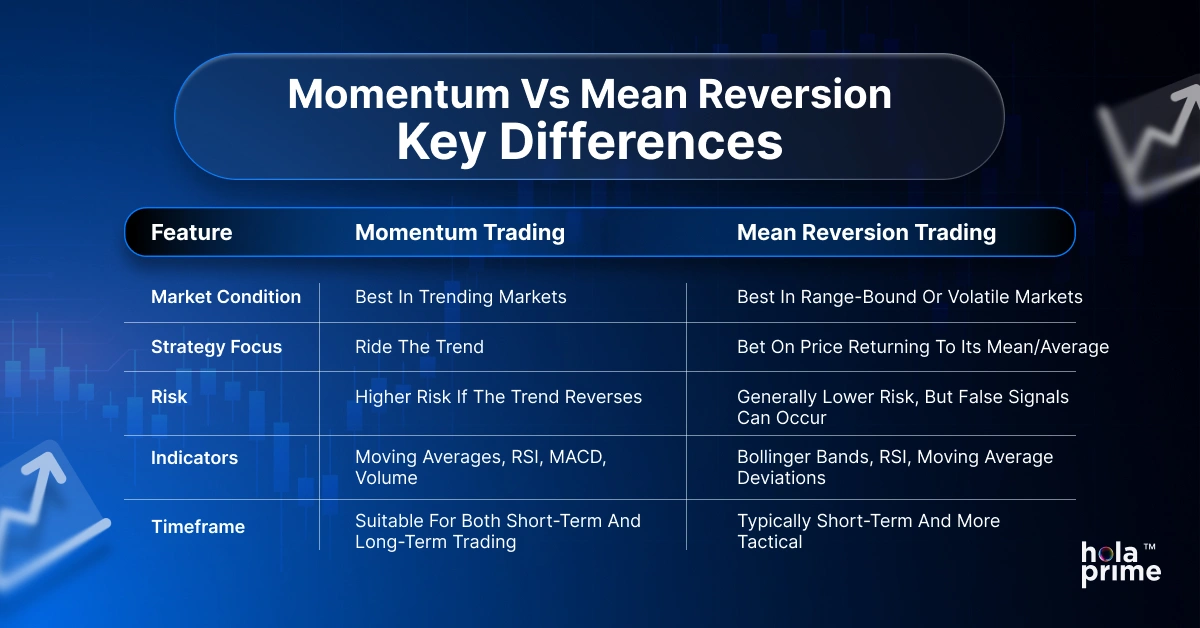
Momentum vs Mean Reversion: Key Differences
When to Use Momentum vs Mean Reversion
The decision regarding which strategy to use and when will largely depend on many factors. If the asset you are trading, like gold, is very much trending in a bull market, or if you are trading a stock that makes an overall trend of higher highs at the first hint of momentum, you will have a good chance that the momentum trade is going to be the better way to trade. If the market is more choppy, or range-bound - a forex pair that is consolidating, for example - that's more amenable to adhering to a mean reversion strategy.
You may consider using both the momentum strategy and the mean reversion strategy at different times as well. If you're in a strong uptrend, for example, you may use the momentum strategy. But if the market reaches an extreme level of overbought conditions, these conditions could lead to mean reversion considerations, and so you may switch gears and start looking for opportunities to short that position.
Real-World Example of Momentum and Mean Reversion in Action
Suppose the price of Bitcoin has been on an upward trend as a result of positive news surrounding institutional adoption. A momentum trader would likely buy the trend and continue to ride it until the price began to trail off. A mean reversion trader, however, may note the recent spike and short the market, anticipating that the price of Bitcoin will revert back to its average price range.
The momentum trader's success relies on the market continuing the upward trend, and a mean reversion trader's success relies on the price pulling back toward the average price. Both traders are working with the same asset; however, they rely on two very different assumptions about the price action.
Conclusion
Both momentum trading strategies and mean-reversion trading strategies have their strengths and weaknesses, but can work together effectively if implemented in the correct manner. Momentum trading suits traders who look to capture long-lasting trends in a strong market. Mean-reversion is more suitable for markets that tend to respond to overreactions or if a market is simply consolidating. Regardless, whichever strategy you choose, you want to ensure it corresponds with your risk tolerance, trading plan, or market conditions.

 EN
EN DE
DE