In this blog post, we will explain mini and micro contracts in a practical way by discussing how they function, where they diverge, and which contract may be better for small account traders. By the end, you will understand how to use each contract type in your trading plan without the use of conjecture or marketing hype.
Quick Recap: What Are Futures Contracts?
A futures contract is an agreement to buy or sell a specific asset at a set price on a future date. Traders don’t usually wait until the contract expires; they buy and sell these contracts for speculation or hedging. Unlike spot or CFD markets, futures trade on centralized exchanges with standardized contract sizes and fixed tick values.
This structure makes futures more transparent and often more cost-efficient. However, it also means traders must understand the capital required to control each contract. Whether it’s a mini or a micro, each futures contract represents a defined amount of the underlying asset, which directly impacts the margin you need and the potential gains or losses.
What Are Mini Futures Contracts?
Mini futures contracts are smaller variants of standard futures contracts created to give access to futures trading in a more user-friendly way, while still offering substantial exposure. A popular example of a mini future would be the E-mini S&P 500, which is equal to one-fifth the size of the regular S&P 500 futures contract. Mini futures are often more accessible to a larger number of traders than their counterpart standard futures contracts due to the smaller contract size, but still have equivalent liquidity.
Let’s say you’re trading the E-mini S&P 500. One tick is worth $50, and the initial margin requirement is usually several thousand dollars. For active day traders with a reasonable account, minis offer a balance between exposure and affordability. Many institutional players and professional retail traders use minis as their core instruments because they combine liquidity, tight spreads, and decent tick values that make them efficient for short-term and swing strategies.
What Are Micro Futures Contracts?
Micro futures contracts are even smaller, typically one-tenth the size of their mini version. Micro futures were put in place in order to give traders with smaller accounts extra flexibility and better risk controls. An example of a micro future would be the Micro E-mini S&P 500, which equals one-tenth of a regular E-mini. The point value is now worth only $5, as opposed to the $50 value of the E-mini. They also possess a much smaller margin requirement that can be as low as a few hundred dollars, thereby truly opening the door for new or smaller traders to participate.
For new or smaller traders with an account size in the $3,000 to $5,000 range, trading a micro contract allows them to feel comfortable in the pace of the trading environment without the pressure of having large volatility swings. They are also useful in order to test out strategies without risking too much capital in a live environment.
Mini vs Micro Futures: Key Differences
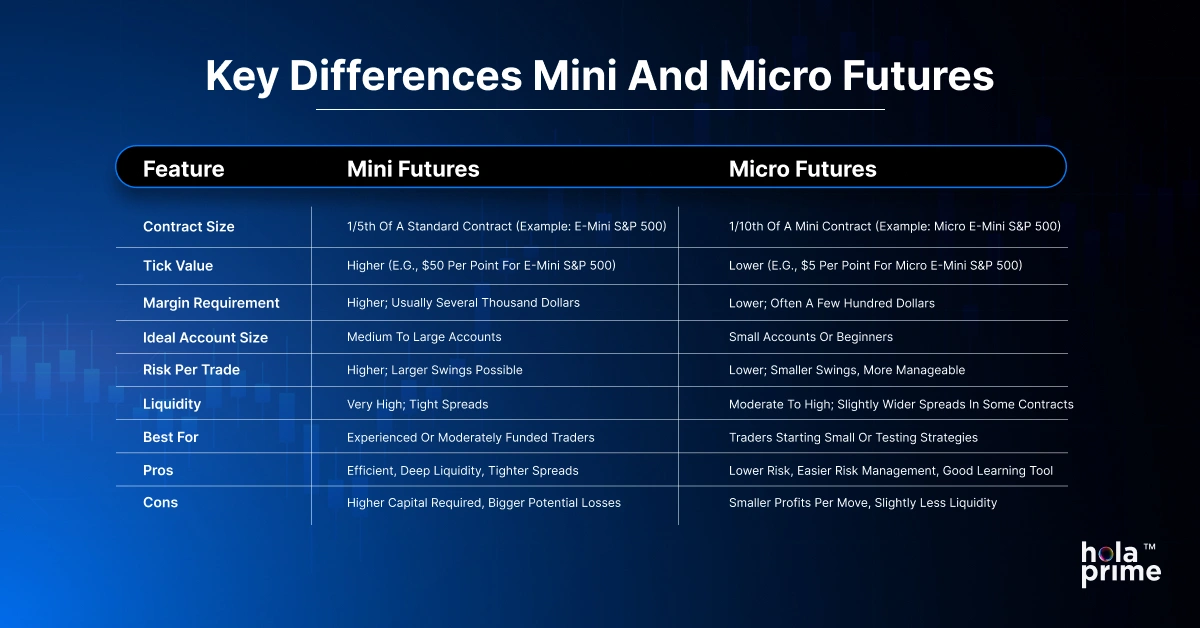
The main differences between mini and micro futures come down to size, margin, tick value, liquidity, and suitability. Minis are larger, which means higher potential profits but also larger potential losses. Micros have smaller tick values, so price movements impact your P&L more gently.
For example, a change of 10 points on the E-mini S&P 500 represents a dollar value of $500, but a 10-point change on a micro represents a dollar value of $50. That's a huge difference in terms of risk exposure. Margin requirements follow this other's pattern. Minis will often have several thousand dollars in margin requirements to hold a position, while micros can be traded with a fraction of that.
Another major point of consideration is liquidity. Minis tend to have tighter spreads and deeper order books, which translates to more seamless execution and less slippage. It's important to note that micros have certainly come a long way since they were first created, but in various contracts, they may still lag slightly in volume. For traders who are executing trades using high-frequency trading strategies or larger trade sizes, minis may seem to fit their efficiency needs more efficiently. For traders who are working on control and learning the process, micros may be a better fit.
Pros and Cons of Mini Futures
Mini futures offer a mix of size and liquidity that appeals to active traders. One of the biggest advantages is the deep liquidity. Because so many institutional traders use minis, spreads are tight, execution is smooth, and large positions can be entered or exited quickly. For strategies that rely on efficiency, like scalping or active intraday trading, this liquidity matters.
The downside is the capital required. With bigger tick values, a small mistake or unexpected volatility can lead to quick losses. Traders with smaller accounts can find themselves over-leveraged if they’re not careful. For example, if you’re trading with $5,000 and holding a mini during a volatile session, a few adverse moves can wipe out a large portion of your account. Minis work best when you have enough capital to absorb normal market swings without emotional pressure.
Pros and Cons of Micro Futures
Micro futures give traders more room to grow into the market. The smaller tick size makes it easier to manage risk and experiment with strategies in real conditions. For instance, if a market moves against you by 10 points, the loss on a micro contract is much easier to handle than on a mini. This can make a big difference for newer traders who are still learning to control their emotions during live trading.
On the other hand, some micro contracts don’t have the same level of liquidity as minis. This can lead to slightly wider spreads or occasional slippage during fast-moving markets. For longer-term traders or those managing modest size, this usually isn’t a big issue, but active scalpers might feel the difference. Micros also generate smaller profits per move, which means you either need to scale into multiple contracts or accept smaller returns until your account grows.
Which is Better for Small Traders?
There isn't a definitive answer that applies to everyone, but for most small traders, starting with micros is a better option. With a small account, let's say anywhere between $3,000 and $7,000, trading minis can be challenging after such large moves, and you may end up making it even harder to recover. Micros offer some breathing room so you can trade actual markets without compromising your entire account.
Let's say, for example, you had a $5,000 account and you are trading one E-mini S&P 500 contract. If you had a 20-point move against you, that would mean a $1,000 loss, which is 20% of your account. That is a substantial hit to recover from. In comparison, with a micro, that same move would only represent $100 or so. That is much more manageable in terms of risk. The goal is to allow your account to grow to eventually be able to trade multiple micros or transition into trading minis when you are more comfortable trading larger swings.
Practical Tips for Transitioning
If you start with micros, you don’t have to stick with them forever. Many traders use them as a training ground, building consistency before moving to minis. One approach is to scale up the number of micro contracts as your skills improve. For example, trading four micros is roughly equivalent in exposure to half a mini. This allows you to increase size gradually while maintaining flexibility.
When transitioning to minis, pay attention to execution differences. Minis tend to fill faster due to higher volume, so your trades might feel different compared to micros. Also, make sure your capital has grown enough to handle the larger tick size comfortably. Jumping to minis too early can undo months of progress if your risk management isn’t adjusted properly.
Common Mistakes Traders Make When Choosing Contract Sizes
Many small traders get excited by the profit potential of minis without fully appreciating the risk. Over-leveraging is one of the most common mistakes. A single mini contract can be too big for a small account, making it hard to withstand normal volatility. Others ignore liquidity differences and try to scalp illiquid micro contracts, leading to unexpected slippage.
Another common error is the lack of awareness of how tick size impacts psychology. Losing $50 on a micro contract isn't extremely stressful. However, losing $500 on a mini contract is hard to ignore and can trigger impulsive decisions. Some traders bounce back and forth between mini contracts and micro contracts without a plan, which diminishes their execution consistency. Being intentional about your contract choice and understanding how it falls into your overall strategy is helpful.
Final Thoughts
Mini and micro futures both have their place in a trader’s toolkit. Minis offer efficiency and liquidity for those with enough capital and experience. Micros provide flexibility, risk control, and a safer path for smaller traders to gain live market experience. There’s no rule that says you must choose one and stick with it forever. Many traders start with micros, build consistency, and then transition to minis as their capital and confidence grow.
The key is to match your contract size with your trading style, capital, and risk tolerance. For small traders, micros are often the smarter choice early on because they allow you to learn without putting too much on the line. As your account grows, minis can become a natural next step.