For traders who are already comfortable with CFDs, leveraged positions, and technical analysis, MCL presents a chance to broaden our market exposure while staying in a familiar trading environment. By understanding the unique characteristics of these micro contracts, you can tap into one of the world’s most traded commodities and apply strategies that you’ve already honed in forex and indices markets.
Why Energy Markets Matter
Energy is a cornerstone of the global economy. Crude oil, in particular, affects all parts of the economy, from transportation to manufacturing costs. Changes in oil prices will affect firms and economies as a whole. For example, increases in crude prices will harm oil-importing countries, effectively weakening their currencies, and will strengthen the currency of oil-exporting countries, eventually strengthening their overall economy. There are traders in forex who already understand this, especially when looking at pairs such as USD/CAD, and can empathize firsthand what a close correlation crude prices and currency movements have.
Grasping these relationships is important since oil prices are often the first market to move and will subsequently affect the rest of the market. Even stock indices will feel the effects when the price of oil rises or falls drastically. For the trader who wants to diversify their trading portfolio, oil provides a diverse transaction option and exposure to the macroeconomic environment. There is a connection between the economy, oil markets, and trading strategies. Simply put, when you learn how to trade oil well, you're opening a door to other layers of global market analysis.
What Are Micro Crude Oil Futures (MCL)?
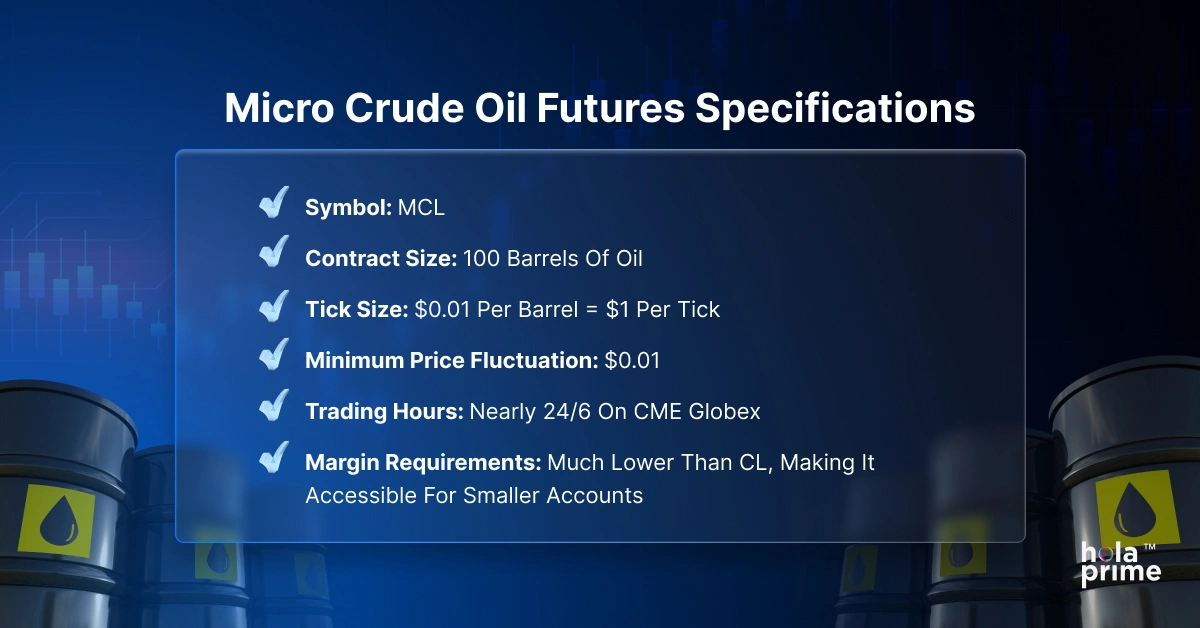
The Micro Crude Oil Futures contract (MCL) was designed by CME Group to help make oil trading accessible to smaller accounts. While the standard crude oil contract (CL) represents 1,000 barrels, the micro contract represents 100 barrels. The smaller size means less access to capital and exposure to price movements, while keeping consistency for traders to leverage the market moves. Micro Oil Futures contracts are suited for beginner traders and intermediate traders seeking to diversify their portfolio.
For traders who are already comfortable with leveraged products in forex or indices, the transition to MCL can feel very natural. You don’t have to adjust to a completely new market structure; you simply scale down your position size while still using the same technical and risk management strategies. MCL allows traders to gain practical experience in energy markets without the intimidation of large, high-risk contracts.
To put that into perspective, if crude oil costs $80 dollars a barrel, one MCL contract is worth $8,000, compared to $80,000 for a standard CL contract. This is an important distinction for traders who want to invest in oil futures but don't have the financial flexibility of a full CL contract. You can buy an MCL contract to learn the market, back test your strategies, and scale as you become comfortable, all while managing your risk more effectively.
Why MCL Is Great for Forex and Index Traders
Traders who are familiar with forex or indices will find MCL appealing for several reasons. First, the lower capital requirement allows you to test strategies without risking an excessive portion of your account. Second, it provides portfolio diversification, letting you trade commodities while still applying your technical and macroeconomic analysis skills. Third, oil markets are inherently volatile, which can create trading opportunities similar to what you might encounter with forex news releases or index gaps.
Additionally, MCL trades almost 24/6, which allows traders to take their positions at a time that suits their trading schedule. This almost continuous trading practice is similar to trading forex markets and is a good way for traders to adjust their time and strategies. Although forex and index traders are used to reviewing trends, breakouts, and reversals, MCL offers a familiar way to react to market price changes with the energy market influences.
How MCL Differs From CL and CFDs
It’s essential to understand how Micro Crude Oil differs from other trading instruments.
- Compared to CL: The micro contract is simply a tenth of the size of the standard contract. Pricing and behavior are identical, so strategies that work on CL can be scaled down to MCL.
- Compared to CFDs: Many forex brokers offer crude oil CFDs, which are flexible and accessible but aren’t exchange-traded. MCL contracts trade on CME, offering regulation, transparency, and standardized pricing.
For traders already knowledgeable in CFDs, MCL combines the familiarity of leverage and technical analysis with the established structure and credibility of an exchange-traded product. This is a good option for traders looking to participate in commodities without changing their trading style.
Key Trading Considerations
Before trading MCL, it is important to consider a few key points. Firstly, the economic calendar is important. Oil is impacted by the EIA’s weekly inventory report, OPEC meetings, and geopolitical developments. Secondly, understand the expiry and rollover of contracts: futures contracts have an expiry, and if you want to hold through expiry, you will have to roll your position into the next contract month.
Liquidity is also important. While MCL is highly liquid, the standard CL contract still has more volume. For most traders, though, MCL provides sufficient liquidity to enter and exit positions with minimal slippage. Finally, manage leverage carefully. Even though MCL is smaller than CL, leverage amplifies gains and losses, so traders transitioning from forex should continue applying strict risk management rules.
Strategy Adaptation: From Forex to Oil
Many forex or indices trading systems can be modified just slightly and applied to MCL. Techniques related to technical analysis, such as trendlines, support/resistance, and moving averages, are also effective for the analysis of oil charts. Breakout strategies often used in currency trading around news releases can also be implemented in oil trading, especially when there are inventory reports and geopolitical pressures affecting price movements.
Range trading is another common technique utilized in currency trading. During periods of a lack of volatility, oil can trade sideways, which creates additional opportunities to engage in the scalping strategy. Additionally, traders can use correlations, for example, long CAD plus long MCL, in their strategies in order to improve results. Ultimately, position sizing and stop loss have to be adjusted to accommodate a smaller contract size without overleveraging.
A Real-World Example
Suppose crude oil trades at $80 per barrel. You anticipate that geopolitical tensions will push prices higher in the coming days.
- Entry: Buy 1 MCL contract at $80
- Stop Loss: $79.50 (risking $50)
- Take Profit: $81 (reward $100)
This setup mirrors the risk-reward management familiar to forex traders. Each tick in MCL represents $1, making it easy to calculate potential gains or losses. By applying your existing trading discipline, technical analysis, and risk control, you can trade MCL in a very familiar way while gaining exposure to oil.
Risk Management and Common Mistakes
Trading in oil has its own unique risks associated with it. Not accounting for expiration and rollover of contracts, trading with too much leverage, and buying the latest news event are frequent errors in trading oil futures, especially for beginners. Even though Micro Crude Oil Futures (MCL) have lower capital at risk than trading with WTI, they are still leveraged products, which only magnify losses. Furthermore, you can expect price action to move quickly when high-impact economic releases or geopolitical events are taking place. As always, risk management (position sizing, stop losses, and defining reward-to-risk ratios) should be a priority in your trading.
Conclusion
Micro Crude Oil Futures (MCL) can lead the trader who is comfortable trading forex and indices into energy markets and commodities in a simple and manageable format, while remaining familiar with the trading mechanics. These products provide exposure to one of the most traded goods in the world, while implementing trading strategies that you already know, and respect the inherent volatility of oil. MCL can be used to diversify your portfolio, take advantage of trading opportunities, and improve your understanding of the commodity trading world.
For those who are looking to scale trade strategies they have used in foreign exchange and indices, or to simply try new markets, MCL is a reasonable starting point into commodities with a lower barrier to entry, with acceptable risk.


 EN
EN DE
DE