Most traders don’t lose because they lack strategies. They lose because they keep using the same approach even when the market has clearly changed its tone. A setup that works beautifully in a clean trend can fall apart the moment price starts moving sideways. The market did not break. The environment changed.
This is where the idea of market regimes comes in. Once you understand whether the market is trending, stuck in a range, or somewhere in between, a lot of confusion disappears. You stop forcing trades, you stop blaming your system, and you start matching your decisions to what price is actually doing.
What Is a Market Regime?
A market regime is simply a way to describe how price is behaving right now. Is it moving with purpose, or is it going nowhere? Are buyers clearly in control, or are both sides pushing and pulling without much progress?
Think of it less like a rule and more like a condition. Markets go through phases where direction is clear, phases where price is boxed in, and phases where it is transitioning from one state to another. None of these phases is rare. In fact, markets cycle through them constantly.
One important thing many traders miss is that regimes depend on the timeframe you trade. A chart can look messy on a five-minute view but clean and directional on a four-hour chart. That’s why regime awareness only works when it’s tied to your execution timeframe. Ignoring this often leads to overtrading and frustration.
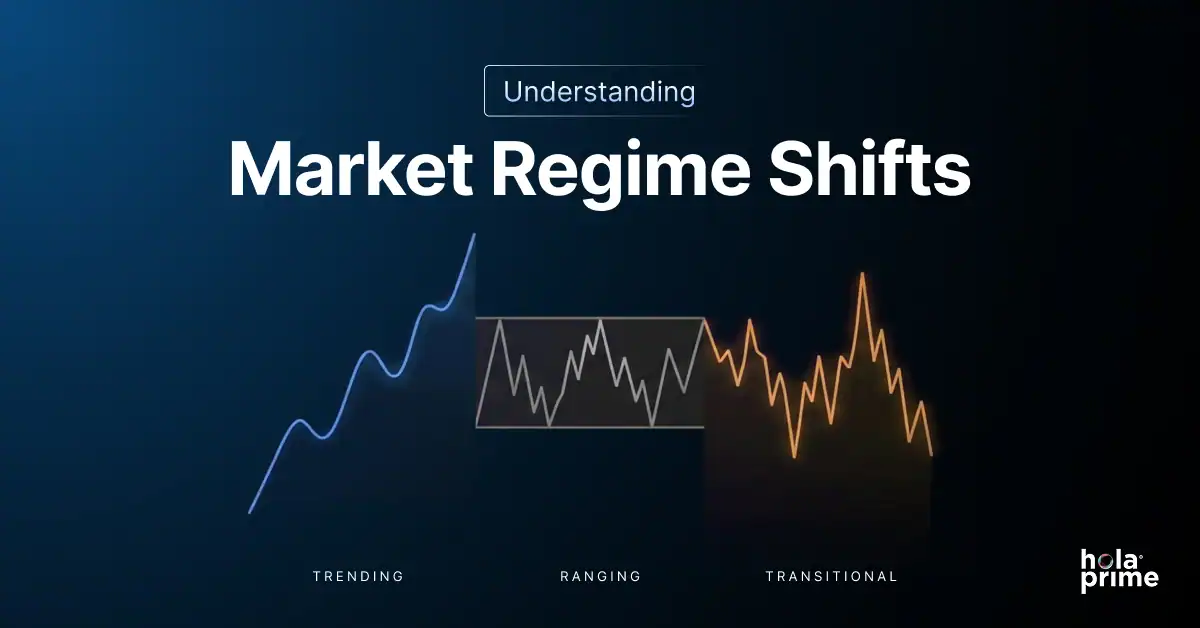
At a high level, most price action falls into three categories: trending markets, ranging markets, and transitional phases between the two.
Trending Markets: When Direction Is Clear
A trending market is usually the easiest to spot after the fact, but not always easy to trade in real time. In this phase, price consistently pushes higher or lower, forming a clear sequence of higher highs and higher lows, or the opposite in a downtrend.
Trends often begin quietly. A level breaks, pullbacks stay shallow, and the price keeps moving in the same direction. As confidence builds, more traders join in. That’s when trends start to feel obvious, even though the best entries often came much earlier.
Why Trends Start
Strong trends usually appear when one side of the market gains a real advantage. This can come from changes in interest rates, macro data, policy decisions, or a shift in overall sentiment. In futures and forex markets, these moves often tie back to central bank actions or long-term economic expectations.
As price starts moving, breakout traders jump in. Pullback traders follow. Stops from the losing side get triggered. All of this adds fuel to the same move, which is why trends can last longer than most traders expect.
How Trending Markets Behave
In a healthy trend, pullbacks tend to be controlled rather than chaotic. Price often respects previous structure or commonly watched levels. Volatility expands when price pushes in the trend direction and cools off during retracements.
One thing that stands out in strong trends is how often reversal attempts fail. Traders keep trying to pick tops or bottoms, only to get stopped out repeatedly. The trend doesn’t care about how extended it looks.
Trends reward patience. Traders who wait for pullbacks usually fare better than those who chase price after large moves.
Common Mistakes in Trending Markets
One of the biggest mistakes traders make in trends is overcomplicating entries. They look for perfect reversals instead of accepting continuation setups. Another mistake is taking profits too early because the move already “feels big.” In strong trends, price can stay overextended longer than logic suggests.
Fighting the trend with counter-trend trades may work occasionally, but it usually leads to a series of small wins followed by one large loss.
Ranging Markets: Where Patience Beats Prediction
Ranging markets occur when the price moves sideways between clear support and resistance levels. There is no sustained directional control, and both buyers and sellers are active within defined boundaries.
Why Markets Range
Ranges form when there is balance. Neither side has enough conviction to push the price into a sustained move. This often happens during periods of uncertainty, ahead of major economic events, or after a strong trend where participants pause to reassess value.
Institutions may be accumulating or distributing positions quietly during ranges, which is why breakouts from ranges can be sharp and aggressive.
Key Characteristics of Ranging Markets
In a range, price repeatedly returns to the middle. Breakouts often fail. Indicators that work well in trends tend to give false signals here. Volatility is usually lower, and candles overlap more frequently.
Support and resistance levels become more important than trendlines. Mean reversion strategies often perform better, where traders fade moves into extremes instead of chasing momentum.
Common Mistakes in Ranging Markets
The most common mistake is trying to force trends where none exist. Traders buy breakouts only to watch price snap back into the range. Others overtrade the middle of the range, where risk-reward is poor.
Another issue is impatience. Ranging markets test discipline because they offer fewer clean setups. Many traders lose money simply because they feel the need to trade every small move.
Transitional Phases: The Most Dangerous Market Environment
Transitional markets sit between trends and ranges. This is where most traders struggle, not because the market is unpredictable, but because expectations are misaligned with reality.
What Is a Transitional Market?
A transitional phase occurs when a market is shifting from a trend into a range, from a range into a trend, or changing trend direction entirely. During this phase, price behaviour becomes messy. Old rules stop working, but new ones are not yet clear.
False breakouts, failed reversals, and sudden volatility spikes are common. The market is essentially deciding what it wants to do next.
Signs a Market Is Transitioning
You may notice that trends stop making clean higher highs or lower lows. Pullbacks become deeper. Volatility increases without follow-through. Key levels break and then immediately reclaim.
Indicators often contradict each other during transitions. Trend indicators lag, while oscillators flip rapidly between overbought and oversold.
Why Transitional Phases Are So Risky
Transitional markets punish certainty. Traders who are too confident in one direction tend to get chopped. Systems that rely on a clean structure suffer because the structure is being redefined.
This phase often produces emotional trading. Losses feel random, which pushes traders to revenge trade or abandon risk rules. In reality, the market is simply changing regimes.
How to Adapt Your Trading to Each Regime
The goal is not to predict regime changes perfectly. The goal is to recognise them early and adjust behaviour accordingly.
Adjusting Strategy Selection
In trends, focus on continuation setups, pullbacks, and momentum alignment. In ranges, prioritise fading extremes and taking profits quickly. In transitional phases, trade smaller or step aside until clarity improves.
Many professional traders reduce the size or stop trading entirely during transitions. Sitting out is also a position.
Managing Risk Across Regimes
Risk should expand and contract with clarity. Trending markets allow for slightly larger risk because the structure is clearer. Ranging markets require tighter stops and quicker exits. Transitional phases demand the smallest risk, if any.
Drawdowns often occur when traders keep the same position size across all regimes, ignoring the changing probability environment.
Using Timeframes for Confirmation
Multiple timeframe analysis helps identify regimes. A market may appear choppy on a lower timeframe but clearly trending on a higher one. Aligning your trading timeframe with the dominant regime improves consistency.
Lower timeframe noise increases during transitions. Zooming out often restores perspective.
Why Most Traders Fail to Respect Market Regimes
Many traders become emotionally attached to a single strategy. When it stops working, they blame execution instead of context. Others trade based on indicators without understanding what the price is actually doing.
Another issue is overconfidence after strong trending periods. Success in one regime creates a false belief that the trader has mastered the market, only to be humbled when conditions change.
Markets evolve. Traders who survive are the ones who evolve with them.
Final Thoughts: Trade the Market You Have, Not the One You Want
Market regime awareness is not about being clever or predictive. It is about being honest with what price is showing you right now. Trends, ranges, and transitions are natural phases of market behaviour. None of them is good or bad on their own. They simply require different responses.
When traders stop forcing trades and start adapting to regimes, consistency improves naturally. Losses make more sense. Drawdowns shorten. Confidence becomes calmer instead of emotional.
The market is always speaking. Understanding its regime is how you learn to listen.

 EN
EN DE
DE