Now, these aren’t mysterious forces out to get you. They’re just part of how the market works when real money is involved. And the sooner you start seeing them as natural events rather than “bad luck,” the sooner you’ll stop getting shaken out by them.
What Are Liquidity Gaps in Forex Trading?
Think of liquidity as the crowd at an auction. When the room is packed and bids are flying, the price moves in small, controlled steps. But when the room is half empty and nobody wants to raise their paddle, the price can jump suddenly from one level to the next. That’s what we call a liquidity gap in forex - the absence of enough buyers or sellers between two prices, which forces the market to leap over the empty space.
On your chart, it shows up as candles that don’t quite “connect,” almost like the market teleported from one level to another. You’ll often notice this on Monday opens, when sentiment has shifted over the weekend, or during quiet hours like the early Asian session. News events can do it too, because many traders pull their orders before an announcement, leaving the book thin.
It’s jarring when you first see it - price jumping as if it skipped a beat - but once you know why it happens, you stop taking it personally. It isn’t the market malfunctioning; it’s just the reality of trading when there’s no one on the other side of your order.
These gaps often occur during times of low participation: after the Friday close when the market reopens on Sunday, during the Asian session when fewer banks are active, or around unexpected news releases when traders pull orders to avoid risk. On the chart, they look like empty spaces where candles don’t connect smoothly.
What Are Stop Runs and Why Do They Happen
If liquidity gaps are about missing orders, stop runs are about hunting existing orders. A stop run happens when the market deliberately pushes toward obvious stop-loss levels, clears them out, and then often reverses.
Why does this happen? Large institutions and liquidity providers need counterparties for their big positions. Retail traders often cluster their stops in obvious places - right below recent lows, above recent highs, or at round numbers. For a big player, these stops represent liquidity. By pushing the price just far enough to trigger them, institutions get the orders they need to enter or exit at better prices.
If you’ve ever seen your stop-loss hit by a sharp spike only for the market to reverse and go in your direction, you’ve experienced a stop run firsthand. It’s not personal; it’s how the market balances liquidity.
How Liquidity Gaps and Stop Runs Affect Forex Traders
Both liquidity gaps and stop runs can feel like traps. They lead to slippage, where your trade executes at a worse price than expected. They create sudden volatility, which can shake you out of otherwise good trades. And they can mess with your psychology, making you hesitant or overly aggressive.
Several times, the emotional side is the toughest part. A stop run happens, and traders feel robbed and jump back into a trade, and do so without due diligence. A liquidity gap occurs, and they chase the price, only to enter the market just before the market cools down. It is essential to note that all of these instances are normal, technical events caused by the technical structure - not bad luck. When you recognize that these normal events can cause these reactions, you will be better prepared to respond with patience instead of frustration.
How to Identify Liquidity Gaps on Charts
Liquidity gaps are not random; they tend to occur in predictable conditions:
Time of Day:
The Asian session, particularly before Tokyo opens, often has thinner liquidity. This is when sudden jumps or odd gaps can occur. Weekends are another classic example - markets close Friday and reopen Sunday, and if sentiment shifts in between, you see an opening gap.
Candlestick Clues:
Liquidity gaps often show as candles with long wicks or sudden spaces between price closes and opens. If you see an abnormally large candle in a low-volume session, it might signal a thin order book.
News Releases:
Before high-impact news, many traders pull orders to avoid risk. That absence of orders creates temporary illiquidity, so when the release hits, the price can gap or spike erratically.
By combining time awareness with chart observation, you can anticipate when the market is vulnerable to gaps and avoid being caught off guard.
How to Spot Potential Stop Runs Before They Happen
Stop runs often target areas where traders bunch up. Think of the market as a predator looking for the weakest herd. Common stop - hunting zones include:
Round Numbers:
Levels like 1.2000 or 1.3000 are magnets for stops. Traders love neat numbers, and institutions know it.
Swing Highs and Lows:
If a recent high looks obvious, chances are many traders placed stops just above it. The same applies to recent lows.
Support and Resistance Levels:
Breakouts often begin with a stop run. The market will test a support or resistance level, sweep the stops behind it, and then either reverse or genuinely break out.
By watching these areas, you can start thinking like a bigger player. Instead of setting your stops where everyone else does, consider placing them in less obvious zones or waiting for the sweep before entering.
Strategies to Trade Around Liquidity Gaps and Stop Runs
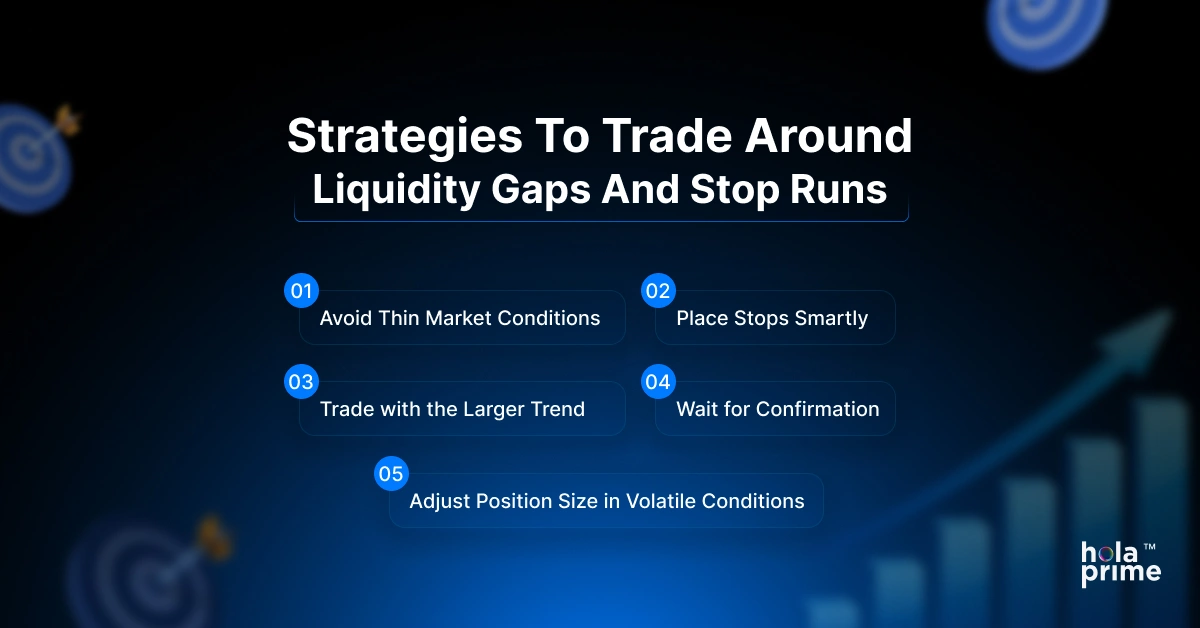
1. Avoid Thin Market Conditions
If you know liquidity is low - say it’s late Friday, early Asian session, or right before a big news release - consider sitting out. These are prime times for erratic moves that don’t follow normal patterns.
2. Place Stops Smartly
Avoid putting stops at obvious levels, like exactly at swing highs/lows or round numbers. Instead, give your trade some breathing room. A slightly wider stop may feel uncomfortable, but it saves you from being taken out by routine liquidity hunts.
3. Trade with the Larger Trend
Stop runs often happen against the prevailing trend to grab liquidity. Once they’re over, the market usually resumes its bigger move. By aligning with the trend, you increase the chance of being on the right side after the noise.
4. Wait for Confirmation
Instead of entering before a level breaks, wait to see what happens after. If the market sweeps a low and then quickly bounces, that’s a sign the stop run is over and liquidity has been collected. That’s often the safer entry point.
5. Adjust Position Size in Volatile Conditions
If you know you’re trading around potential gaps or stop runs, consider reducing your lot size. This way, even if slippage or spikes occur, the impact on your account is limited.
Common Mistakes Traders Make with Liquidity Gaps and Stop Runs
Many traders lose money not because they misread direction, but because they don’t account for how the market behaves around liquidity. Common errors include:
- Entering trades during extremely thin liquidity sessions.
- Using tight stops in obvious areas.
- Over-leveraging when volatility is high, turning small whipsaws into big losses.
- Chasing price after a gap or spike instead of waiting for the market to settle.
- Avoiding these mistakes can instantly improve your survival in the market.
Practical Example: Trading After a Stop Run
Let’s say EUR/USD has been trending upward. It forms a clear swing high at 1.1050, then pulls back. Many traders place stops just above that high, expecting resistance to hold.
The market then spikes to 1.1060, sweeping all those stops. Retail traders get stopped out of their shorts, while big players use the liquidity to add to their long positions. Soon after, the price reverses back down to 1.1040, leaving traders confused.
If you had waited for the sweep, you could have entered long right after the liquidity grab, riding the trend with the institutions. This simple patience - waiting for the stop run to complete - can make a huge difference.
Conclusion
Both liquidity gaps and stop runs are simply part of the forex environment. It is easier to deal with them if you think of them not as unfair tactics but as simply relationships between buyers and sellers reaching an equilibrium. Once you understand not only when they happen, but also how to recognize them and how to trade around them, you will stop being the trader who gets shaken out and start being the trader who can anticipate the shakeout.
Your best assets are patience, context, and a rational approach to risk. Next time you see a market spiking or a gap that seems unusual, instead of responding emotionally, step back and ask yourself: Is this a liquidity grab? Just that simple level of thought can enhance how you think about the market.


 EN
EN DE
DE