Understanding the Basics of Trading Before You Dive In
Understand what trading is before you even think about charts, brokers, or strategies. Trading is simply buying and selling financial instruments - currencies, stocks, commodities, even crypto - with the purpose of making a profit from the price changes. It seems simple, yet it involves a combination of skill, patience, and risk management.
There are also different “styles” of trading. Some people trade stocks long-term, holding positions for weeks or months. Others prefer forex, where trades can last just minutes. Futures and crypto markets add even more variety. The important thing as a beginner is to first grasp that all trading is a balance of risk and reward. You’re not just trying to make money; you’re trying to manage risk so that you don’t lose it all in one go.
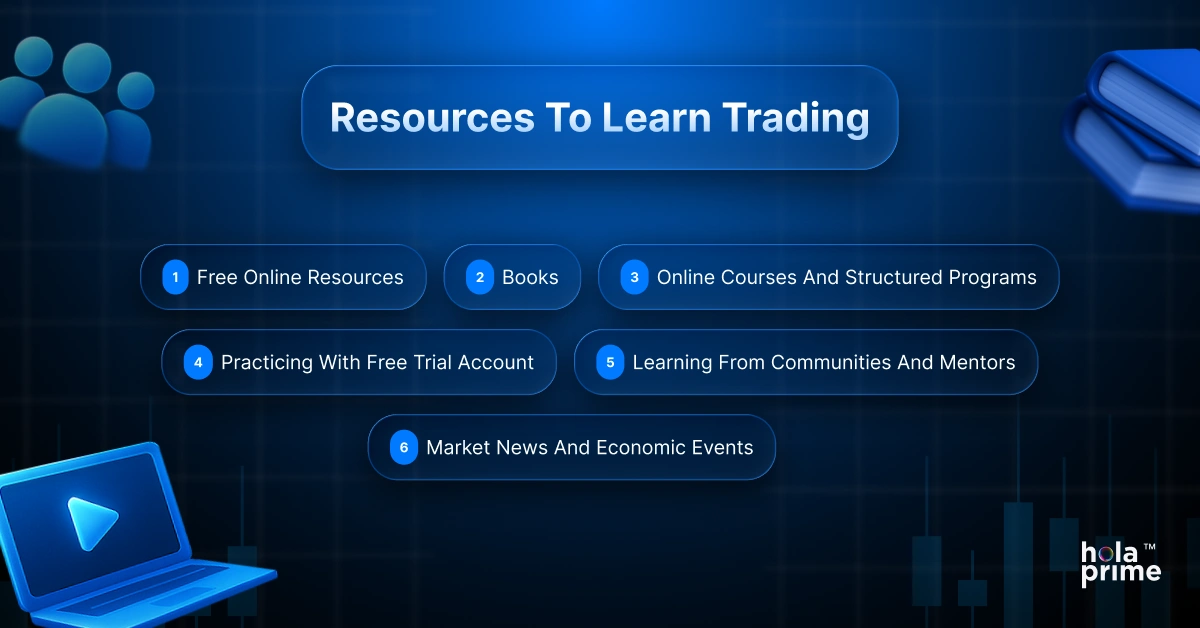
Different Resources to Learn Trading:
Learning Through Free Online Resources
When most beginners start, they head straight to Google or YouTube. And honestly, that’s not a bad place to begin. Free resources give you exposure to the basics without you spending a single dollar. There are hundreds of blogs, websites, podcasts, and explainer videos that can introduce you to trading concepts.
But here’s the catch: not all free resources are created equal. Some are outdated, and others are created by people more interested in clicks than in actually teaching. If you’re using free resources, try to stick with platforms that are trusted - like Investopedia for definitions, or well-known trading educators on YouTube who break things down with real examples instead of hype. Free resources are great for building your foundation, but at some point, you’ll want to go deeper.
Books Every Beginner Trader Should Explore
Books might sound old-school, but they remain one of the best ways to build a strong base in trading. Unlike random blog posts or videos, books are usually structured and give you a complete view of a topic. A good starting point is Trading for a Living by Dr. Alexander Elder, which covers psychology, technical analysis, and risk management in a practical way. If forex is your focus, Currency Trading for Dummies is another beginner-friendly pick that breaks down the market without overwhelming you.
The real benefit of books is that they slow you down. In a world where trading often looks fast-paced, taking time to read forces you to digest concepts properly. Think of books as your reference material. You don’t need to memorize everything, but having them on hand will help you revisit key ideas when you’re stuck.
Using Online Courses and Structured Programs
Once you’ve gone through free resources and maybe a book or two, structured courses can help you connect the dots. The benefit of courses is that they’re organized - someone has already put together a learning path for you. That means less time wondering, “What should I learn next?”
There are both free and paid courses out there. Free ones are good for basics, but paid ones usually dive into strategies and give you practical tools. The key is to avoid flashy courses that promise overnight riches. A good course should teach you how to analyze markets, manage risk, and build discipline, not just how to place one “winning” trade.
Practicing with Free Trial Account
Reading and watching videos will only take you so far. At some point, you need to start practicing, and that’s where demo accounts or free trails come in. Almost every broker or prop firm offers a demo or free trail account where you can trade with virtual money in real market conditions.
This stage is critical because it lets you test what you’ve learned without risking real money. You’ll quickly see how fast the market moves, how spreads affect your trades, and why risk management is more than just a theory. Even prop firms use demo stages to test traders before giving them their simulated funded accounts l. Don’t skip this step - paper trading builds muscle memory and confidence before you put your own money at stake.
Learning from Communities and Mentors
It can be lonely when you start your trading learning journey. That's why community matters. Getting involved in a trading community can really be a game-changer, instead of relying only on yourself to navigate the ocean of trading. Forums, Discord, and Telegram groups give you visibility in so many forms to traders who are going through the same evolution as you.
Sometimes, just by being able to put your eyes and ears on someone else's experience is enough to get you to avoid rookie mistakes along your journey.
Mentorship is also a very powerful tool. A mentor that you trust and has traded through different market cycles will likely be a credible resource to help guide you on this evolution of a trader and possibly offer you insights that you won't find anywhere else.
But a warning note - don't get roped into just anyone who offers "trading signals" and hopes to just copy their trades. If you are copying their trades without understanding the why, then you are not progressing as a trader, and what ultimately matters in the long run. Lean into your community and mentors to learn, not to shortcut your learning for your career.
Following Market News and Economic Events
Markets don’t move randomly, they are moved by news, economic data, and political events. For example, when the U.S. Federal Reserve announces interest rate decisions, it can shake the entire forex market in moments. In a similar situation, company earnings releases will impact their stock price, and oil supply data will move commodity prices.
As a beginner trader, you do not have to pay attention to each and every piece of news. You can start gradually and follow an economic calendar, and begin to learn what these major announcements reflect. As you continue a part of your analysis, you will notice patterns - what unemployment numbers do to currency pairs or how the reports on inflation shift indices. Staying up to speed on the current market does not mean running after the headlines, but does mean you should have the awareness to see the large picture.
Common Mistakes Beginners Make While Learning
Most traders make the same mistakes when they start. That’s good to know beforehand since it will save you some headaches. One is information overload, where you try to learn everything at once and confuse the hell out of yourself. Another is skipping the practice part and instead going directly into a live environment with real money, only to blow up an account immediately.
There’s also the trap of focusing only on profits while ignoring risk management. A single bad trade can wipe out weeks of progress if you don’t control your position size. As you learn, remind yourself: trading is a long game. You don’t need to master everything in a month, but you do need to avoid mistakes that set you back.
Creating a Personal Learning Plan That Actually Works
Here's something that most beginners tend to ignore - the fact that you need to create a study plan for yourself. Without a plan, it is very easy, (actually incredibly easy), to continuously jump from topic to topic and not actually keep much of it in your brain while you're doing it. A plan could be something as simple, as your first month learning just the basic concepts, your second month then practicing on demo accounts, and then gradually starting to trade with small amounts of real money.
While you're setting up that plan, set little milestones as well. Such as mastering candlestick charts one week, understanding your risk to reward ratios the next. The idea is to progress without burning yourself out. Trading is a skill. And like any skill, it's important to be consistent instead of going hard once a week.
Conclusion:
Getting the hang of trading is not about finding some secret road to success: it's about building a solid platform layer by layer. Start with free resources, then add books, courses and practice, then slowly transition to live markets. As you develop your trading skill set, you should also surround yourself with the communities and people that can help you, and never stop paying attention to what's happening in the world around you - transactions are literally reacting to the things happening in real life all the time.
Trading is a journey. You will get better at your trading method as long as you look at risk and value before making decisions. Take it one step at a time. If you are looking to get real coaching, you should consider joining Hola Prime’s Discord channel where you can talk directly to top trading coaches and even book 1-on-1 coaching sessions with coaches.

 EN
EN DE
DE