Understanding the Real Difference

 ENEN
ENEN DE
DE
Understanding the Real Difference
If you’ve been trading indices for a while - or even just window-shopping platforms - you’ve probably noticed something:
every broker seems to offer either Index CFDs or Index Futures… and sometimes both.
And that’s usually when the confusion kicks in.
Both products let you trade big global indices like the S&P 500, Nasdaq 100, DAX 40, and FTSE 100.
But the way they behave, the risks you take, and the costs involved can feel very different once you’re actually in a trade.
So if you’ve ever asked yourself…
…this guide will clear that up without burying you under boring textbook jargon.
Let’s break it down in a simple, human way.
Index CFDs - Contracts for Difference - are basically an agreement between you and your broker.
You’re not buying the index itself.
You're simply trading the price movement of the index.
Think of it like saying:
“If the Nasdaq 100 goes up, I make money. If it goes down, I lose.”
That’s… pretty much it. No expiry dates. No contract months. No exchange fees.
This is why CFDs feel easy for many traders - they behave like regular spot trading, just with leverage baked in.
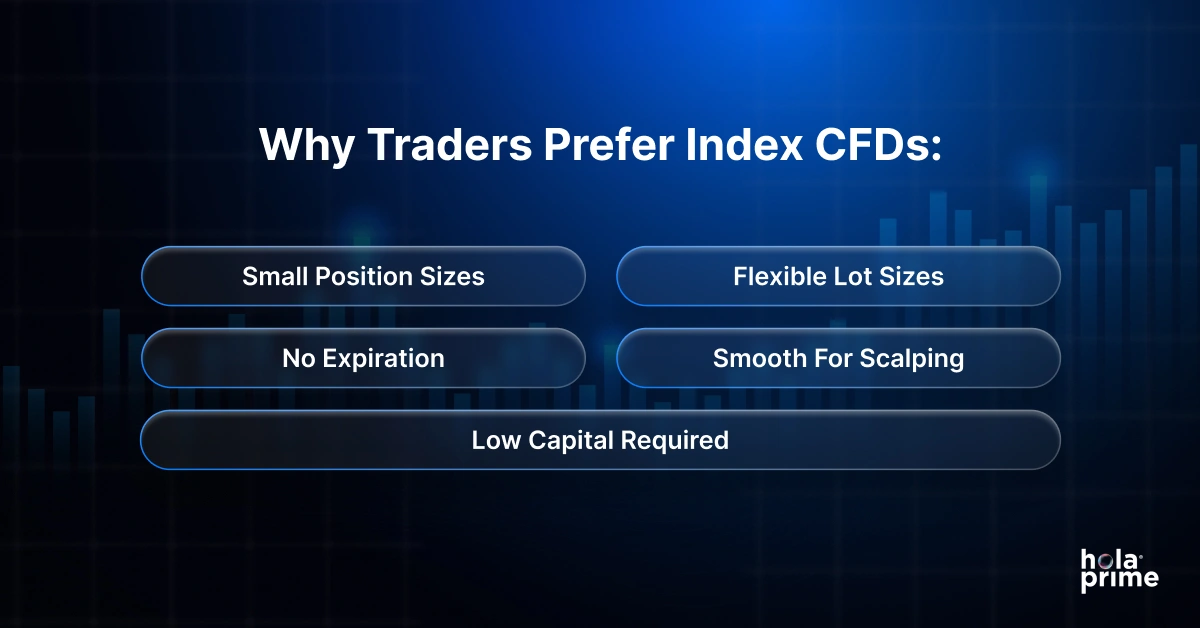
They’re built for convenience, not complexity.
Index futures, on the other hand, are exchange-traded contracts.
When you trade futures, you’re dealing with standardized products that expire every quarter (March, June, September, December).
These contracts move fast, carry high leverage, and are cleared through actual futures exchanges like the CME.
They’re built for speed, liquidity, and long hours of trading.
Why futures attract serious traders:
It’s a more professional-grade environment… but that can be both good and intimidating.
Here’s the comparison you actually need - no fluff.
CFDs = small, flexible.
Futures = bigger, standardized.
CFDs = no stress
Futures = more management
Short-term traders feel the difference.
Futures feel “smoother” during volatile hours.
Futures feel more “real,” while CFDs feel more “accessible.”
For news traders and scalpers, this is a big deal.
Index CFDs are a great match for you if:
CFDs feel light and nimble. You can take $0.50/pip trades, test strategies, and build confidence without stressing about blowing up.
CFDs are basically the “beginner-friendly” gateway into index markets.
Futures tend to suit you better if:
Futures reward discipline. They move fast, they demand precision, and they’re not as forgiving as CFDs.
Traders who move into futures usually do it because they’re ready for more structure and more liquidity.
Let’s be real - this is what most traders actually want to know.
If you're scalping with a small account, CFDs feel easier.
If you're day trading with size, futures feel smoother.
Swing traders usually benefit from futures because there are no overnight financing charges.
But if you're trading with a small account or testing a new system, CFDs are totally fine.
One isn’t universally cheaper - it depends on your trading style.
If you still feel torn, here’s the simplest way to decide.
Choose Index CFDs if you want:
Choose Index Futures if you want:
There's no “best.”
There’s only “best for your style.”
Many traders start with CFDs because they’re simple and flexible.
As skills and account size - grow, they naturally move into futures.
There’s no right or wrong sequence.
The important part is understanding how each product behaves, so when you place a trade… you know exactly what you’re dealing with.
If you’ve been thinking about making the switch (or maybe trading both), this comparison should help you decide with a clear head instead of guesswork.
Sam Saleh, a London-based trader, began his trading journey at 19 while studying Business at the University of Bedfordshire. With expertise in trading and a background in marketing, he now coaches at Hola Prime, where he develops educational content aimed at building trader confidence, consistency, and financial literacy.
Still Have Questions?
Feel free to get in touch with us today!

All information provided on this site is for educational purposes only, related to trading in financial markets. It is not intended as financial advice, business or investment recommendation, or as an opportunity or recommendation to trade any investment instruments. Hola Prime only provides an educational environment to traders, including tools, materials and simulated trading platforms which have data feed provided by Liquidity Providers. The information on this site is not directed at residents in any country or jurisdiction where such distribution or use would be contrary to local laws or regulations.
ISO 9001:2015
Quality Management System - QMS
ISO 22301:2019
Business Continuity
Management System - BCMS
ISO/IEC 27001:2022
Information Security
Management System - ISMS
About: Simulated trading operations are managed by Hola Prime Limited, a company registered at L1, Shaw House, 201 Wan Po Road, Tseung Kwan O, Hong Kong.
Holaprime Limited a company registered in Cyprus having registration number HE 454359 is a 100% subsidiary of Holaprime Limited Hong Kong.
For MT4 And MT5: Hola Prime Limited, with Company registration number 220248, and registered office at 4th Floor, Docks 4, The Docks, Caudan, Port Louis, Mauritius, is authorized and regulated by the Financial Services Commission (FSC) of Mauritius as an Investment Dealer (Full Service Dealer, excluding underwriting) under license number GB24203729.
For DXTrade, cTrader and MatchTrader: Gooey Trade, GT Tech LLC 6800 Broken Sound Parkway Northwest Suite 150 Boca Raton, FL 33487 US
RISK DISCLOSURE:
All of the information provided on this website and by Hola Prime Ltd, or its affiliates, is intended solely for Educational purposes. Nothing on this website is to be construed as investment advice, nor an offer or invitation to buy or sell any financial instrument, nor does it endorse, recommend, or sponsor any financial product, company, or fund. Testimonials on the Company’s website may not be reflective of the experience of other clients or customers and should not be considered as an assurance of future performance or success. Hola Prime only provides services of simulated trading and educational tools for skill assessment and enhancement of traders. Hola Prime does not act as a broker and does not accept any deposits. Any purchases made should not be regarded as deposits. There are no promises of rewards or returns. Trading in financial markets is inherently high-risk and speculative. The content and information provided on this website are not intended for distribution to, or use by, any person or entity in any jurisdiction or country where such distribution or use would be contrary to local law or regulation.
HYPOTHETICAL PERFORMANCE DISCLOSURE:
ACFTC Rule 4.4-Hypothetical performance results have many inherent limitations, some of which are described below. No representation is being made that any account will or is likely to achieve profits or losses similar to those shown. In fact, there are frequently sharp differences between hypothetical performance results and the actual results subsequently achieved by any particular trading program. One of the limitations of hypothetical performance results is that they are generally prepared with the benefit of hindsight. In addition, hypothetical trading does not involve financial risk, and no hypothetical trading record can completely account for the impact of financial risk of actual trading. For example, the ability to withstand losses or to adhere to a particular trading program in spite of trading losses is material points, which can also adversely affect actual trading results. There are numerous other factors related to the markets in general or to the implementation of any specific trading program, which cannot be fully accounted for in the preparation of hypothetical performance results and all of which can adversely affect trading results. Testimonials appearing on this website may not be representative of other clients or customers and are not a guarantee of future performance or success.
EVALUATION DISCLOSURE:
The customer pass rate of the Challenge/Evaluation program was 35% between 10th November, 2024 – 29th May, 2025, who traded at least one evaluation and obtained a Hola Prime Account during this time period. The Challenge and Hola Prime Accounts are meant to be a realistic simulation of trading under actual market conditions, including commissions, to mimic real market conditions, as much as possible. The evaluation is difficult to pass even for experienced traders. The Evaluation is not suggested for individuals with little to no trading experience.
CUSTOMER COMPENSATION DISCLOSURE:
All trades presented for compensation to customers should be considered hypothetical and should not be expected to be replicated in a live trading account. Hola Prime Accounts may represent simulated accounts or live or copied accounts. Hola Prime does not provide services to the residents of certain countries including – Afghanistan, Belarus, Burundi, China, Cuba, Congo, Sudan, Sri Lanka, North Korea (Democratic People’s Republic of Korea) and Yemen.
This is the only website for Hola Prime. We are not using any third party websites or links. Any link, outside of this website that claims to be ours, could be fraudulent and users are advised to not use it.
© 2026 Hola Prime All rights reserved.