If you’ve been trading E-mini futures for a while, you know how important entries are. A good entry can make the difference between a trade that works smoothly in your favor and one that immediately puts you under pressure. The challenge for most traders is finding those levels where the market is most likely to respond. That’s where Volume Profile comes in.
Unlike traditional indicators that follow price, Volume Profile shows you where trading activity actually took place. In this blog, we’ll break down what Volume Profile is, why it’s so effective in E-mini futures, and how you can use it to improve your entries.
What is Volume Profile?
Volume Profile is a charting tool that shows the amount of volume traded at each price level. Instead of measuring volume over time (like the usual volume bars you see at the bottom of your chart), it tells you where traders were most active.
Think of it as a horizontal histogram plotted along the price axis. The thicker the bar, the more contracts were traded at that price. This gives you insight into whether the market accepted or rejected certain levels.
For futures traders, this is gold. While candlesticks tell you what happened, Volume Profile gives you a peek into why it happened.
Key Concepts in Volume Profile
Before we get into strategies, let’s get comfortable with the main terms:
- Point of Control (POC): The price level with the highest traded volume. This often acts like a magnet, pulling price back for retests.
- High Volume Nodes (HVNs): Areas of heavy trading. These zones usually act as strong support or resistance, where the market spent time consolidating.
- Low Volume Nodes (LVNs): Areas where very little trading happened. These often behave like rejection points, where price tends to bounce off quickly.
- Value Area: The range where about 70% of trading volume occurred. Price action inside this zone is considered fair value, while moves outside suggest potential imbalance.
Once you get familiar with these, you’ll start seeing structure in the market that others overlook.
Why Volume Profile Works Well in E-mini Futures
The E-mini S&P 500 futures (often called ES) are among the most liquid instruments in the world. That means massive institutional participation, with thousands of contracts changing hands every second.
Volume Profile works so well here because it highlights exactly where big players are doing business. Instead of guessing support or resistance levels, you’re identifying price zones where institutions either built positions or avoided trading altogether.
This makes your trading decisions more objective and grounded in actual market activity.
How to Use Volume Profile for Better Entries
Now, let’s get practical. Here are a few ways to use Volume Profile in your E-mini futures trading:
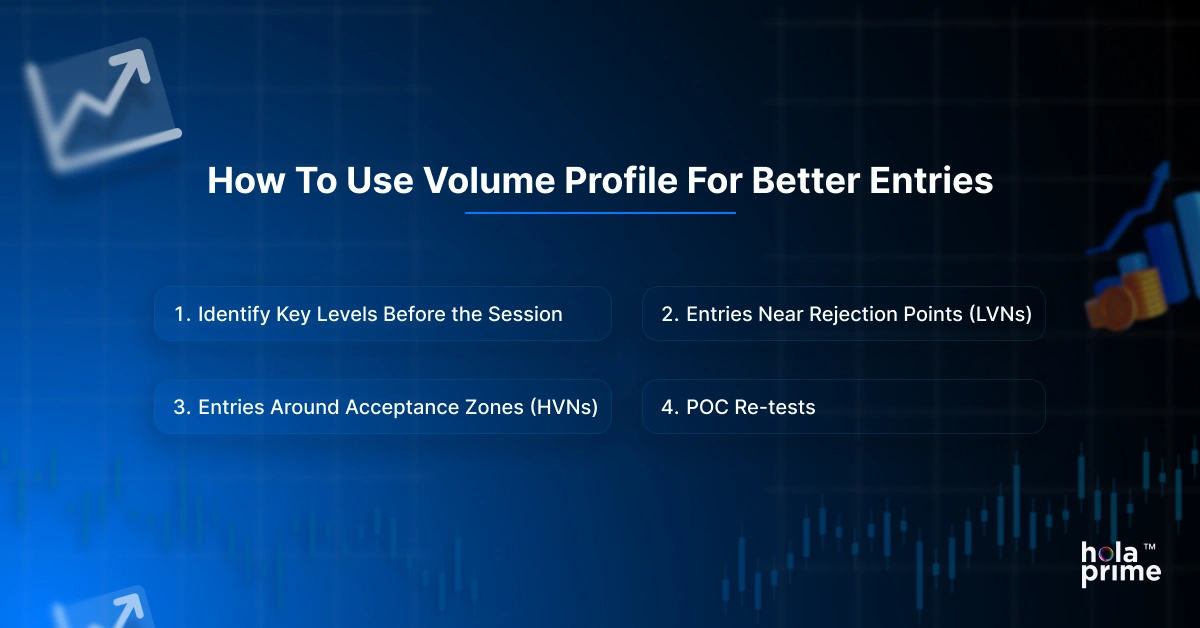
1. Identify Key Levels Before the Session
Start your day by marking the POC, HVNs, and LVNs from the previous session. These levels often carry forward, and the price has a tendency to react to them.
2. Entries Near Rejection Points (LVNs)
When price approaches a low-volume node, watch closely. If the market rejects that area, it often results in a sharp reversal. This can give you a precise entry with tight risk.
3. Entries Around Acceptance Zones (HVNs)
High-volume nodes are areas where the market previously spent time consolidating. If price revisits them, you can look for continuation setups or pullbacks to enter in the direction of the trend.
4. POC Re-tests
When price moves away from the POC and then comes back to test it, that retest often offers a high-probability entry. Institutions tend to defend these levels.
Example:
For example, if the previous day’s POC is at 4500 on the ES and the market rallies to 4520 and later dips back toward 4500, you can look for long setups at or near that level, provided the market shows signs of holding.
Common Mistakes to Avoid
Volume profile is a useful tool, but only if you use it with caution and skill. Many traders end up committing mistakes and losing on the trade. Below are the common mistakes that you have to avoid.
- Over-relying on Volume Profile alone: Always confirm with price action or order flow before entering.
- Ignoring higher timeframes: A level may look important on a 5-minute chart but could be irrelevant on the daily. Always align your setups with bigger picture context.
- Neglecting risk management: Even the best entries can fail. Make sure your stop-loss placement is logical and you’re not risking more than you should.
Putting It All Together: A Simple Trading Process
Here’s a step-by-step way to incorporate Volume Profile into your trading:
- Pre-market prep: Mark previous day’s POC, HVNs, and LVNs.
- During live session: Watch how price reacts as it approaches these levels.
- Look for confirmation: Use candlestick patterns, order flow, or momentum indicators to confirm the setup.
- Take the trade: Enter with a stop just beyond the level you’re trading against.
- Manage the trade: Aim for logical targets such as the next LVN, HVN, or POC.
This process helps you avoid random entries and keeps your trading disciplined.
Conclusion
Volume Profile isn't just another indicator—it offers a glimpse into market behavior. In E-mini futures, where you see high liquidity and institutional dominance, it can help you spot levels where the market tends to react.
When you zero in on POC, HVNs, and LVNs, you give yourself a clear method to find better entry points, tighter stop losses, and setups with higher odds of success. No matter if you're new to trading or a seasoned pro, adding Volume Profile to your arsenal can make your choices more data-driven and your outcomes steadier.
Keep in mind, good entries don't involve predicting what's ahead - they involve tilting the odds to your advantage. And Volume Profile stands out as one of the top tools to do just that.


 EN
EN DE
DE