Volatility is something every futures trader deals with, and if you trade in a prop firm environment, it becomes even more important to understand how to navigate these sharp swings. You have clear rules to follow, strict limits to respect, and a funded account to protect, so knowing how to trade around high-impact events can make a noticeable difference in your performance. When you learn how volatility behaves before, during, and after major market releases, you start reading the market with more confidence rather than guessing what could happen next. This helps you stay consistent, avoid unnecessary losses, and trade with a clearer plan.
Understanding What Creates Volatility
High-impact events can trigger large moves because they force traders to adjust their expectations very quickly. This can push liquidity to thin out and prices to jump faster than usual. When you understand the source of volatility, you naturally handle it better.
Economic releases that move futures markets
Events like the Federal Reserve rate decision, inflation numbers, unemployment data, and GDP reports often cause significant spikes. Traders across the world wait for these numbers, so you see a rapid burst of activity as soon as they are released. This makes the market more unpredictable if you are not prepared for the move.
Unexpected events and market shocks
News related to geopolitics, central bank comments, or sudden market sentiment shifts can change price direction in a matter of seconds. These surprise events are harder to plan for, but you can learn to reduce the impact by controlling your exposure and keeping your position sizes flexible.
Company earnings and sector-wide moves
Index futures like the E-mini Nasdaq or E mini S and P react strongly during major earnings seasons. If a large technology company releases strong or weak results, the entire index can adjust sharply, and this creates a chain reaction across related instruments.
How Volatility Affects Prop Firm Traders
Trading with a funded account changes the way you approach volatile conditions. You are not just thinking about personal capital. You are working within defined rules, and those rules shape your approach.
Drawdown limits become your biggest constraint
Large swings can hit your daily or overall drawdown faster than you expect. Even small positions can produce outsized moves during these moments. This is why planning ahead becomes essential.
Execution quality matters more
When spreads widen or price jumps quickly, your order may not fill where you expect. This can push you into losses without giving you time to react. Traders inside prop firms must be extra aware of these conditions, especially around scheduled news.
Emotional pressure increases
Volatility can pull you into trades too early, shake you out of good setups, or tempt you to chase large candles. In a prop trading environment, emotional stability becomes a core part of your survival because mistakes during these moments carry more weight.
How to Prepare Before High-Impact Events
Preparation is one of the most reliable ways to stay consistent. When you have a clear plan, volatility becomes an opportunity rather than a threat.
Check the economic calendar daily
Before you place your first trade of the day, you should know which events are lined up. Focus on the ones marked as high impact because these are the moments where markets tend to move the most. Once you know the schedule, you can adjust your trading windows and be more thoughtful about risk.
Reduce position sizes before the event
This makes your trading safer without stepping away completely. It gives you space to handle any unexpected jumps and protects your prop account from sudden losses.
Set clear levels and scenarios
Mapping out potential support and resistance zones helps you understand where the market might react. You can prepare different outcomes and decide how you want to respond depending on the move.
How to Trade During High Impact Volatility
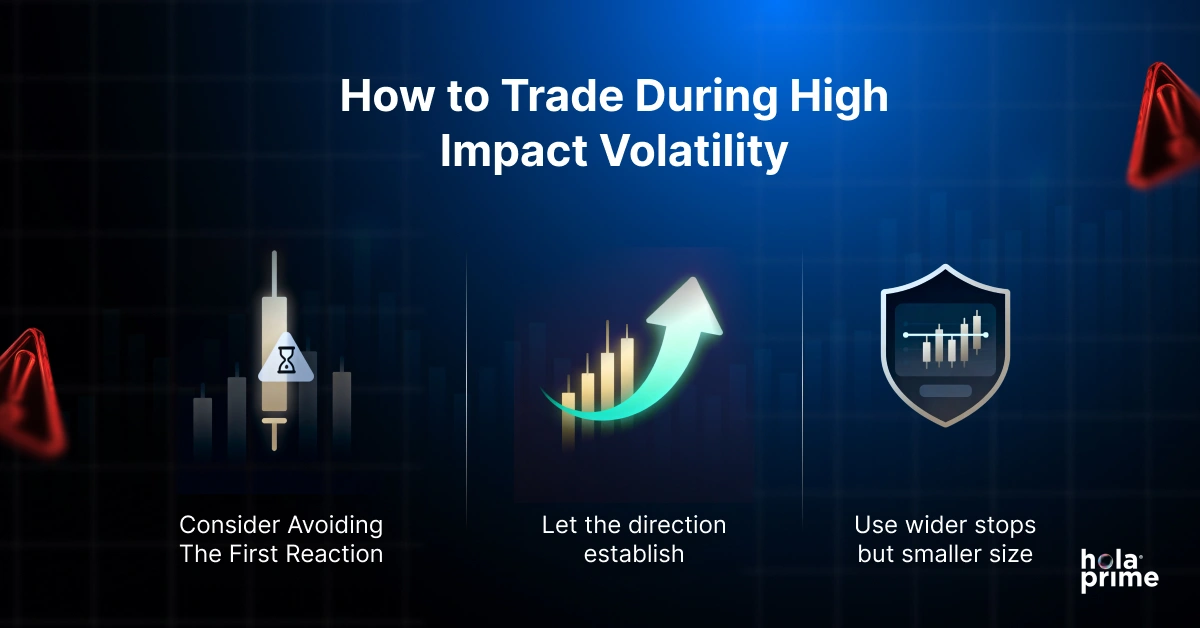
You will often feel the strongest temptation to trade during major events because the candles look exciting and the moves are fast. However, this is also the moment when traders make their worst decisions.
Consider avoiding the first reaction
The initial spike usually contains the most unpredictable movement. Many traders choose to wait for the dust to settle because the early move does not provide enough structure or reliability.
Let the direction be established
Once the first few minutes pass, the market begins to form a clearer direction. This is where patient traders see better opportunities instead of trying to catch the first candle.
Use wider stops but a smaller size
Volatility requires extra breathing room. You can offset this by using smaller positions so your overall risk stays under control.
How to Trade After the Event
The most reliable setups often come after the event is finished. By this time, liquidity improves and price structure becomes clearer.
Look for trend continuation or reversal patterns
Once the market has absorbed the news, you start seeing clean pullbacks, breakouts, and retests. These are easier to read than the chaotic reaction that happens right at release time.
Adjust position sizing back to normal levels gradually
Do not jump from minimal risk to full size immediately. Let the market stabilise and slowly increase your size as conditions return to normal.
Review your decisions
Post-event analysis helps you understand how your strategy behaves under fast conditions. When you measure your performance, you start spotting mistakes that you can easily fix for the next event.
A Practical Example for Prop Traders
Imagine you are trading the E-mini Nasdaq and the Federal Reserve is about to release its interest rate decision. The minutes leading up to the announcement may look slow, but this is usually the calm before the storm. The moment the numbers are released, prices can swing rapidly in both directions. If you try to jump in too early, you may get caught in the chop. Instead, you wait for the first move to finish and watch where the price finds direction. Once it pulls back and holds structure, you take a smaller size trade with a wider stop. Even a small move can generate a strong profit because volatility adds energy to the trend. This approach respects prop rules and keeps your account safe.
Final Thoughts
Volatility can be your friend when you understand how to handle it. In a prop firm environment, trading around high-impact events becomes easier when you plan ahead, stay patient, and manage your risk with clarity. You do not need to chase every spike to succeed. You only need to choose the moments that align with your strategy and respect the rules that protect your funded account. When you bring discipline into volatile conditions, you trade with more confidence and consistency, which is exactly what helps you grow within a prop trading journey.

 EN
EN DE
DE