Forex trading might look like the wild west, where people just click buy or sell and hope for the best - but trust me, it’s far from that.

 ENEN
ENEN DE
DE
Forex trading might look like the wild west, where people just click buy or sell and hope for the best - but trust me, it’s far from that.
There are rules everywhere. Some are official, set by regulators and brokers. Others are more like unwritten laws that experienced traders follow because they know ignoring them ends badly.
Think about it like going to the gym. Sure, the gym has rules - no dropping weights, wipe down the equipment, don’t hog the machines. But then there are the unspoken ones - like not curling in the squat rack. Break those and you’ll annoy people fast.
Trading works the same way. There are the big rules that keep markets fair, and then there are the smaller “survival rules” that keep you from blowing your account.
Prop trading feels like a dream setup: you get access to a big pile of money that isn’t yours, and if you win, you get a cut of the profits. Sounds amazing, right?
But here’s the catch. Prop firms don’t hand you that money without strings attached. Their contracts are full of rules, restrictions, and little conditions tucked away in the fine print. Miss one of those, and boom - you could lose your funded account overnight.
Ever met a trader who smashed the profit target but still failed? Usually, it’s because of one of those sneaky hidden rules - like hitting a daily loss limit or not trading “consistently” enough.
That’s why learning the rules of forex trading and, more importantly, the fine print in prop trading, isn’t just good practice. It’s survival.
At its simplest, forex is just exchanging one currency for another. But the market isn’t a casino, even if it sometimes feels like one. There are rules in place to keep it fair and stop people from blowing up accounts too quickly.
The “official” rules come from regulators. In the U.S., for example, the NFA sets limits on how much leverage you can use - because, let’s be real, if beginners had unlimited leverage, 99% would blow up in a week. In the UK, the FCA keeps brokers honest, making sure they don’t run shady practices.
Then there are the “trader’s rules.” These aren’t written in law but are passed down like wisdom:
Following these rules isn’t about being boring - it’s about staying in the game long enough to actually win.
Here’s where it gets interesting. Forex isn’t regulated the same way everywhere.
In the U.S., traders face strict limits - like a max of 50:1 leverage for major pairs. That means if you want to trade bigger, you need a lot more capital. Canada is similar, with regulators like IIROC keeping a close eye.
But in places like Cyprus or offshore jurisdictions, brokers sometimes offer 500:1 or even 1000:1 leverage. Sounds tempting, right? But there’s a reason regulators in stricter countries ban it - it’s risky business.
The point? Where you trade affects the rules you play by. That’s why “forex trading rules and regulations” aren’t one-size-fits-all - they shift depending on the country, broker, and platform.
If you’re wondering, “Why so many rules?” - think about this. Without rules, forex would be the wild west. Scams would run rampant, brokers could rig prices, and traders would have no safety net.
The rules exist for two big reasons:
Imagine if a football game had no referees, no lines, no time limits. It wouldn’t be a game - it would be chaos. Forex without rules would be the same.
Here are a few myths I hear all the time:
Most traders only learn this after breaking the rules and paying the price. Better to understand them upfront.
Day trading is fast-paced. You’re in and out of trades within the same day, sometimes within minutes. Sounds exciting, right? But here’s the reality - without rules, day trading can chew you up and spit you out.
Forex day trading rules are basically your safety net. They cover things like how much leverage you can use, how much you’re allowed to lose in a day, and whether you can hold trades overnight.
Think of it like a rollercoaster. You strap in, you’ve got safety harnesses, and the track has limits. Without those, you’d fly off at the first turn. Day trading rules keep you strapped in when the market gets wild.
Leverage is both a blessing and a curse. It’s what allows traders with small accounts to make meaningful profits, but it’s also what wipes out beginners faster than you can say “margin call.”
Most regulators cap leverage to protect traders. In the U.S., it’s 50:1 on major pairs. In the EU, it’s even lower - 30:1. But if you head to offshore brokers, you’ll see 500:1 or even 1000:1.
Here’s the truth: just because you can use high leverage doesn’t mean you should. It’s like driving a Ferrari at 200 km/h down a narrow street. Sure, the car can handle it, but can you?
Rule of thumb: use leverage wisely, and never max it out just because it’s available.
Margin is like the deposit you leave with your broker to open a trade. The higher your leverage, the lower your margin requirement. But there’s a catch - if your trade goes against you, margin calls can happen fast.
Picture this: You’re renting an apartment. The landlord asks for a deposit. If you trash the place, you lose the deposit. In forex, margin works the same way - blow your account, and your “deposit” vanishes.
Good traders respect margin rules. They don’t open trades so big that one bad move can wipe them out.
A lot size in forex is simply how big your trade is. Standard lot = 100,000 units, mini lot = 10,000, micro lot = 1,000. Sounds boring? Not really - because this directly affects your risk.
Here’s why lot sizes matter in the rulebook: prop firms and brokers often restrict how big you can go. You can’t just throw on a 50-lot trade and hope for the best. They’ll limit you to keep the risk manageable.
Smart traders see lot sizes as part of their strategy, not just a number. Get it right, and you stay in the game longer. Get it wrong, and even a tiny move against you could wreck your account.
Day trading isn’t just about what you trade; it’s also about when. Some firms don’t allow you to hold trades overnight. Others set rules around high-volatility events like major news releases.
It’s like working a shift job. You clock in, you clock out, and if you stay past your hours, you’re breaking the rules.
Many beginners ignore timeframes, holding trades longer than they should. That’s where trouble starts. Stick to the timeframe rules, and you’ll avoid unnecessary headaches.
If you’re trading without a stop-loss, let’s be honest - you’re gambling, not trading.
Stop-loss rules are the market’s way of forcing discipline. They cap your losses on a single trade, so one mistake doesn’t snowball into disaster. Prop firms take this seriously. Some even auto-close trades that don’t have stop losses.8
One of the most underrated rules is how much you size each position. Too big, and you’re risking your account. Too small, and you’re spinning your wheels with no meaningful profit.
Most smart traders risk 1-2% of their account per trade. Prop firms often enforce this by limiting max exposure. Why? Position sizing is the difference between surviving a losing streak and blowing up in three trades.
It’s not about how much you can make in one trade but how many trades you can survive.
This one catches a lot of new traders off guard. Not every broker or prop firm lets you hold trades overnight. Why? Because overnight trading carries more risk - low liquidity, spreads widening, and unexpected news can mess you up.
Imagine leaving your car parked on a sketchy street overnight. Sure, it might be fine in the morning, but there’s always that chance it won’t be there when you come back. That’s how overnight positions feel in forex.
If your firm says “no overnight holds,” it’s not them being mean - it’s them managing risk. And trust me, it’s better to know this upfront than to learn the hard way.
When you join a prop firm, you’re not just trading - you’re borrowing someone else’s money. And when you play with other people’s money, the rules get stricter.
Prop trading rules are the guardrails that protect the firm’s capital. They’re designed to filter out reckless traders and make sure only disciplined ones get funded.
Think of it like renting a sports car. The rental company doesn’t want you doing donuts in the parking lot, so they slap on conditions: no racing, no stunts, bring it back in one piece. Prop firms are the same - they give you the keys to a big account, but only if you follow their rules.
Here’s the difference:
It’s like comparing playing poker with your own cash vs. playing with someone else’s. If it’s your own money, no one cares how you play. But if it’s theirs, you can bet they’re going to watch you closely.
Most prop firms don’t just hand you money. They first put you through an evaluation challenge - a test account where you have to hit profit targets under strict rules.
Sounds fair, right? But here’s the catch: many of these challenges hide little conditions in the fine print. Things like:
It’s like an exam where you’re told to “get at least 70%,” but later you find out you also had to show your work and finish within 30 minutes.
Profit targets are straightforward on paper - you need to make X% profit before moving on. Usually, it’s around 8-10% in the evaluation stage.
But here’s what trips traders up: the target isn’t the only goal. You could hit 10% in a week but fail because you didn’t respect consistency rules (more on that soon).
It’s like being told to run a marathon and then being disqualified because you ran too fast in the first half. Strange, but that’s how many prop firms operate.
Drawdown is how much you can lose before your account is shut down. There are two types you’ll see in the fine print:
Relative drawdown is the tricky one. You might grow your account to $110,000, and then suddenly your “max loss” level shifts upward with it. Traders who don’t notice this often get caught out.
Prop firms live and die by risk management. That’s why they often set rules like:
These rules aren’t personal - they’re just the firm’s way of keeping you in check. They’d rather you trade small and consistently than go for a big “all or nothing” win.
This is probably the most painful rule for traders. Daily loss limits mean you can’t lose more than a set percentage (say 4–5%) in a single day.
Here’s the kicker: you might still be profitable overall, but if you hit that limit even once, your account is gone.
It’s like being in a soccer match where you’re winning 4-2, but if you foul once too hard, the referee ejects you from the tournament. Brutal - but that’s how daily loss limits work.
Ever thought, “If I just open a massive trade, I can hit the target in one go”? Well, prop firms thought of that too.
That’s why they set lot size and exposure limits. For example, you may not be allowed to risk more than 5 lots per position or more than 10 lots total across all trades.
These rules force you to trade responsibly. They’re basically saying, “Slow and steady wins the race.”
Here’s a sneaky one many traders miss: some firms ban holding trades over the weekend or during high-impact news events (like NFP or Fed rate decisions).
Why? Spreads can go crazy and prices can gap, creating big risks for the firm.
Imagine locking your shop for the weekend and returning Monday to find the front door kicked in. That’s the risk of weekend trades, and that’s why firms try to avoid it.
Not all instruments are treated equally. Some firms only allow forex pairs, while others let you trade indices, commodities, or even crypto. But each comes with its own restrictions.
For example, some firms limit how many trades you can place on volatile assets like gold or NASDAQ because of the high swings.
Think of it like a buffet: sure, you can fill your plate with anything, but if you pile on too much spicy food, don’t be surprised if your stomach revolts.
Finally, the golden question: when can I get paid?
Prop firms often advertise big profit splits - 70%, 80%, even 90%. But the withdrawal rules are where reality kicks in. Some firms only allow payouts after a certain number of trading days. Others require you to hit a minimum withdrawal amount.
And of course, if you broke a rule along the way, your profits might not even be valid.
It’s like winning a game show, only to find out the prize money comes in installments over 12 months.
Here’s the truth: most traders don’t actually read the fine print when they sign up with a prop firm. They skim through the flashy stuff - profit splits, leverage, scaling plans - and skip the boring legal text.
But buried in that text are the rules that can cost you your account. Things like “no holding over weekends,” “must place trades on X number of days,” or “restricted strategies.”
It’s kind of like signing up for a gym membership because the ad said “unlimited access,” only to discover later that the pool is closed on weekends, the sauna costs extra, and you have to book classes two weeks in advance.
The fine print isn’t exciting, but ignoring it can be expensive.
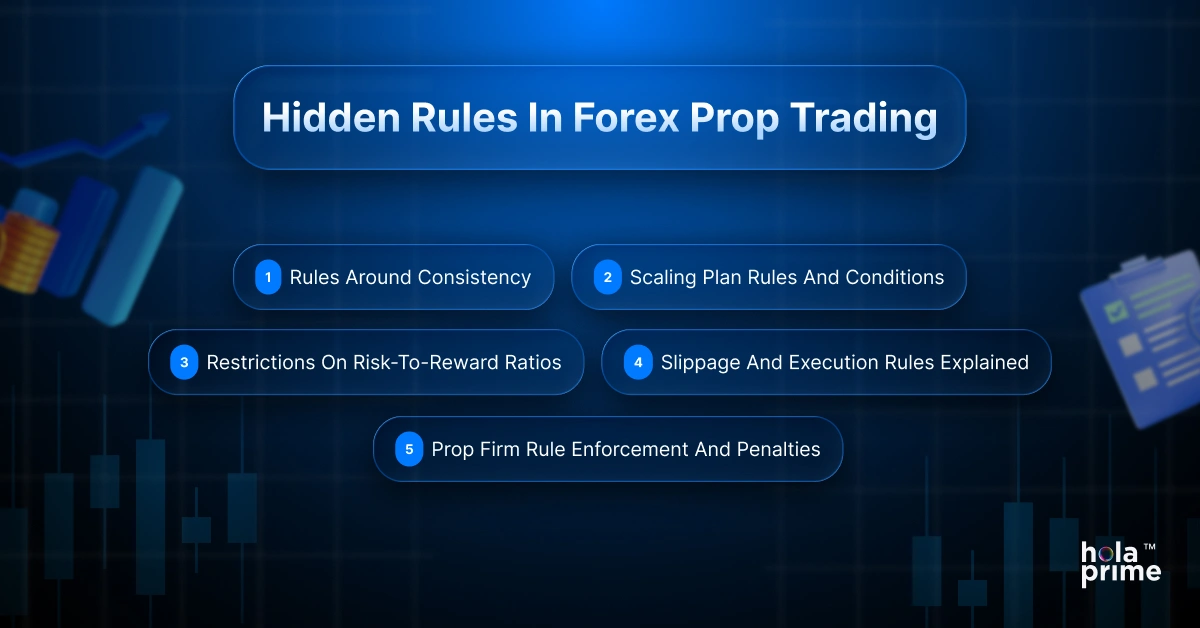
One of the sneakiest rules prop firms enforce is consistency. It’s not always obvious, but it shows up in different ways:
So even if you smash the profit target, if you did it with one giant trade and tiny trades everywhere else, you might get disqualified.
Imagine being told you need to “run 10 miles total.” You sprint 9 miles on day one, jog 1 mile on day two, and then get told you failed because your pace wasn’t “consistent.” Frustrating? Yes. But that’s how many firms operate.
Scaling plans sound amazing: “Trade well and we’ll increase your account size.” Who doesn’t want that?
But look closer. The conditions are often strict. You might need to:
It’s like getting a promotion at work. The offer sounds great, but the path to earning it is often full of hurdles that most people don’t realize until they’re in the middle of it.
Some prop firms don’t openly say it, but they don’t like traders with “lopsided” risk-to-reward ratios.
For example, if you consistently risk $500 to make $50, that’s a red flag. Even if you’re profitable for a while, the firm knows one bad streak could wipe you out.
So while you technically can trade like that, you might find your account suddenly flagged or even terminated.
Think of it like a casino. They don’t mind people winning small amounts. But if you’re using a strategy that could bankrupt the house, they’ll show you the door.
Here’s one traders rarely think about: slippage - the difference between the price you wanted and the price you actually got.
Prop firms often have rules or disclaimers around execution. They might say, “We’re not responsible for slippage” or “Extreme market moves may void trades.”
That means in fast markets, your stop-loss might not trigger exactly where you placed it. For traders running tight strategies, this can be the difference between passing and failing.
It’s like ordering a steak medium rare and it arrives medium well. Not what you asked for, but technically, still steak.
Prop firms don’t play around when it comes to rule-breaking. If you break a rule, even accidentally, they can:
There’s usually no appeal. You might get a polite “sorry, rules are rules” email, but that’s about it.
Think of it like a referee in sports. Even if the foul wasn’t intentional, a red card is a red card.
All these hidden rules do more than just shape your trading - they mess with your head.
Traders often become overly cautious, second-guessing themselves:
This stress can lead to hesitation, missed opportunities, or even overtrading out of frustration.
It’s like playing a game where the rules keep changing mid-match - you spend more time worrying about the rules than actually playing.
Here’s the blunt truth: most prop firms are not regulated like brokers.
When you trade with a regulated broker, watchdogs like the FCA (UK), NFA (US), or IIROC (Canada) keep them in line. They check that your money is safe, trades are executed fairly, and no shady stuff goes on.
But prop firms? They don’t hold your deposits the same way brokers do. Instead, they charge fees for challenges or access, and then give you a “funded account” (which is often simulated). Because of this, many operate outside strict regulatory frameworks.
It’s like Uber in its early days. Everyone loved the service, but regulators weren’t sure how to classify it. Prop firms are in that same “grey area.”
Let’s break it down simply:
The main difference? Accountability. If a regulated broker scams you, you can complain to a regulator. If a prop firm does something unfair, your options are… limited.
Think of it like this: trading with a broker is like eating at a restaurant that’s inspected by health authorities. Trading with a prop firm is more like eating at a food truck - you hope it’s clean, but nobody’s really checking.
Prop firm contracts are where the real game is played. They’re full of legal jargon, disclaimers, and conditions that protect the firm first and the trader second.
Common loopholes include:
Translation: even if you’re right, they’re covered.
It’s like signing up for an online subscription and later finding out the free trial wasn’t really free. The contract always has the upper hand unless you read it carefully.
So, what can you do? You don’t need a law degree, but you do need to be smart. Here are a few tips:
At the end of the day, protecting yourself is about being proactive. Remember: if something feels too good to be true, it probably comes with a long fine-print section attached.
Most traders think the edge comes from strategy - entries, exits, and indicators. But here’s the truth: your first edge in prop trading is knowing the rules better than the firm itself.
Think about it. You could have the perfect trading system, but if you violate a max daily loss rule by $1, you’re out. No second chances. That means studying the fine print is just as important as studying charts.
If forex is a game of chess, the firm’s rules are the board. If you don’t know how the pieces move, you’ll lose before the first move.
Here’s where discipline meets design. A good trading plan doesn’t just include:
It also includes prop firm restrictions.
For example:
The goal is simple: turn firm rules into guardrails that protect you, not traps that sabotage you.
This is the dealbreaker for most traders. You can’t manage risk like you do in a personal account. Prop trading rules demand tighter discipline.
Let’s say your firm allows a 5% daily drawdown.
But here’s the smart play: risk less. Use half the allowance.
Why? Because emotions + volatility can easily push you beyond your limit. It’s like driving - if the speed limit is 100, going 99 still feels risky.
So, a golden rule: risk 0.25% - 0.5% per trade. That way, even a losing streak won’t kill your account.
Rules are sneaky. You might think you’re safe until - bam - you get an email saying, “Your account has been closed for violation.”
The solution? Treat rule-tracking like risk-tracking.
The point is to never leave it to memory. You need systems that keep you honest.
Here’s the kicker: most traders don’t fail because they don’t know the rules. They fail because they can’t follow them.
This is where psychology beats strategy. A strong trader is not just someone who reads charts well, but someone who knows when to stop.
Here’s a trick: set daily “shutdown points.”
Example: If you hit +2% profit or -1% loss, you stop trading for the day. No exceptions. This keeps you in control before the firm’s system cuts you off.
You don’t have to do it alone. Tech can be your trading assistant. Some useful tools include:
And guess what? Some firms even provide their own dashboards to help you track rules. If yours does, use it religiously.
Think of it like having cruise control in a car. You could manage your speed manually, but why risk getting a ticket when tech can help?
When you step into the world of forex - especially prop trading - the biggest challenge isn’t just reading charts, spotting trends, or predicting price movements. It’s navigating the rules in forex trading that quietly shape your journey.
These rules aren’t there to scare you. They’re designed to protect both the firm and you from reckless trading. But here’s the catch: firms don’t always make the fine print obvious. That’s why traders who take time to understand the prop trading rules - from drawdowns to leverage limits - stand a much better chance of surviving and thriving.
The truth is simple:
Think of it like driving. You can own the fastest car, but if you ignore road signs and speed limits, you’ll crash before reaching your destination. Similarly, in forex trading, even the best strategy can crumble if you don’t respect the guidelines.
The good news? Once you understand the rules and weave them into your trading plan, they stop feeling like restrictions. Instead, they become guardrails that keep you on track.
So whether you’re aiming to pass a prop firm challenge, build consistency as a day trader, or simply trade smarter with your personal account, remember this: the traders who win long term aren’t just skilled at reading markets, they’re masters at following the rules.
Sam Saleh, a London-based trader, began his trading journey at 19 while studying Business at the University of Bedfordshire. With expertise in trading and a background in marketing, he now coaches at Hola Prime, where he develops educational content aimed at building trader confidence, consistency, and financial literacy.
Still Have Questions?
Feel free to get in touch with us today!

All information provided on this site is for educational purposes only, related to trading in financial markets. It is not intended as financial advice, business or investment recommendation, or as an opportunity or recommendation to trade any investment instruments. Hola Prime only provides an educational environment to traders, including tools, materials and simulated trading platforms which have data feed provided by Liquidity Providers. The information on this site is not directed at residents in any country or jurisdiction where such distribution or use would be contrary to local laws or regulations.
ISO 9001:2015
Quality Management System - QMS
ISO 22301:2019
Business Continuity
Management System - BCMS
ISO/IEC 27001:2022
Information Security
Management System - ISMS
About: Simulated trading operations are managed by Hola Prime Limited, a company registered at L1, Shaw House, 201 Wan Po Road, Tseung Kwan O, Hong Kong.
Holaprime Limited a company registered in Cyprus having registration number HE 454359 is a 100% subsidiary of Holaprime Limited Hong Kong.
For MT4 And MT5: Hola Prime Limited, with Company registration number 220248, and registered office at 4th Floor, Docks 4, The Docks, Caudan, Port Louis, Mauritius, is authorized and regulated by the Financial Services Commission (FSC) of Mauritius as an Investment Dealer (Full Service Dealer, excluding underwriting) under license number GB24203729.
For DXTrade, cTrader and MatchTrader: Gooey Trade, GT Tech LLC 6800 Broken Sound Parkway Northwest Suite 150 Boca Raton, FL 33487 US
RISK DISCLOSURE:
All of the information provided on this website and by Hola Prime Ltd, or its affiliates, is intended solely for Educational purposes. Nothing on this website is to be construed as investment advice, nor an offer or invitation to buy or sell any financial instrument, nor does it endorse, recommend, or sponsor any financial product, company, or fund. Testimonials on the Company’s website may not be reflective of the experience of other clients or customers and should not be considered as an assurance of future performance or success. Hola Prime only provides services of simulated trading and educational tools for skill assessment and enhancement of traders. Hola Prime does not act as a broker and does not accept any deposits. Any purchases made should not be regarded as deposits. There are no promises of rewards or returns. Trading in financial markets is inherently high-risk and speculative. The content and information provided on this website are not intended for distribution to, or use by, any person or entity in any jurisdiction or country where such distribution or use would be contrary to local law or regulation.
HYPOTHETICAL PERFORMANCE DISCLOSURE:
ACFTC Rule 4.4-Hypothetical performance results have many inherent limitations, some of which are described below. No representation is being made that any account will or is likely to achieve profits or losses similar to those shown. In fact, there are frequently sharp differences between hypothetical performance results and the actual results subsequently achieved by any particular trading program. One of the limitations of hypothetical performance results is that they are generally prepared with the benefit of hindsight. In addition, hypothetical trading does not involve financial risk, and no hypothetical trading record can completely account for the impact of financial risk of actual trading. For example, the ability to withstand losses or to adhere to a particular trading program in spite of trading losses is material points, which can also adversely affect actual trading results. There are numerous other factors related to the markets in general or to the implementation of any specific trading program, which cannot be fully accounted for in the preparation of hypothetical performance results and all of which can adversely affect trading results. Testimonials appearing on this website may not be representative of other clients or customers and are not a guarantee of future performance or success.
EVALUATION DISCLOSURE:
The customer pass rate of the Challenge/Evaluation program was 35% between 10th November, 2024 – 29th May, 2025, who traded at least one evaluation and obtained a Hola Prime Account during this time period. The Challenge and Hola Prime Accounts are meant to be a realistic simulation of trading under actual market conditions, including commissions, to mimic real market conditions, as much as possible. The evaluation is difficult to pass even for experienced traders. The Evaluation is not suggested for individuals with little to no trading experience.
CUSTOMER COMPENSATION DISCLOSURE:
All trades presented for compensation to customers should be considered hypothetical and should not be expected to be replicated in a live trading account. Hola Prime Accounts may represent simulated accounts or live or copied accounts. Hola Prime does not provide services to the residents of certain countries including – Afghanistan, Belarus, Burundi, China, Cuba, Congo, Sudan, Sri Lanka, North Korea (Democratic People’s Republic of Korea) and Yemen.
This is the only website for Hola Prime. We are not using any third party websites or links. Any link, outside of this website that claims to be ours, could be fraudulent and users are advised to not use it.
© 2026 Hola Prime All rights reserved.