Trading gold futures has always been popular among active traders, and in the prop world, it attracts even more attention because of how quickly it moves. You get strong intraday trends, clean technical reactions, and enough liquidity to scale positions smoothly. But trading gold futures like a pro requires more than catching random volatility. It’s about understanding what drives gold, how futures behave under different conditions, and which strategies help you stay consistent when the market throws surprises. In this guide, we’ll walk through everything a prop trader needs to know, from the basic structure of gold futures to the way you can apply risk controls, read the tape, and react to macro catalysts with confidence.
Understanding Gold Futures in the Prop Trading Context
Trading gold futures during a prop challenge feels different than trading it in a personal account. Prop firms place rules around daily loss limits, max drawdown, and consistency, so your goal isn’t just to catch big wins. You want steady execution where each trade aligns with both your edge and the firm’s requirements. Gold, especially during high-impact news, tends to move fast, so these rules shape how you approach entries and exits.
How Gold Futures Work
Gold futures represent an agreement to buy or sell gold at a future date. You’re not moving physical metal but speculating on its price using standardized contracts. Most prop traders focus on the CME gold futures family, such as GC or the smaller micro contracts like MGC. The micro version gives you better flexibility because you can size positions more precisely, which helps a lot when you’re trying to protect your evaluation account.
Why Gold Futures Are Attractive to Prop Traders
Gold tends to react clearly to economic uncertainty, interest rate expectations, and shifts in risk sentiment. This makes it a rich playground for both intraday and swing approaches. It offers enough volatility for traders who like momentum but also respects technical structures when the market is calm. That balance lets you develop a strategy that fits your temperament rather than forcing yourself into a style that feels unnatural.
Market Forces That Influence Gold Prices
When you trade gold futures professionally, you need a solid understanding of what truly moves this asset. Gold doesn’t behave like stocks or currencies. It often acts as a safe haven, but not always in the way new traders expect. To trade it well, you should always be aware of the global forces pushing gold in either direction.
Interest Rates and Central Bank Expectations
One of the strongest drivers of gold prices is interest rate expectations. When interest rates rise, gold typically becomes less attractive because it doesn’t pay interest. On the other hand, when markets expect rate cuts or see central banks turning dovish, gold can rally strongly. For prop traders, this often means major news events like CPI, PCE, NFP, and FOMC decisions tend to produce significant intraday opportunities.
US Dollar Strength or Weakness
Gold and the dollar often move in opposite directions because gold is dollar-denominated. When the dollar weakens, gold futures can rise simply because it becomes cheaper for international buyers. Prop traders usually watch the dollar index or currency pairs like EURUSD and USDJPY to gauge whether gold has background support.
Risk Sentiment and Geopolitical Events
Any time markets face uncertainty, gold becomes attractive as a hedge. Events like political tensions, unexpected global developments or sharp drops in equity markets often push traders into safer assets. This doesn’t mean gold always spikes on fear, but you’ll see cleaner moves when the fear is genuine rather than exaggerated by headlines.
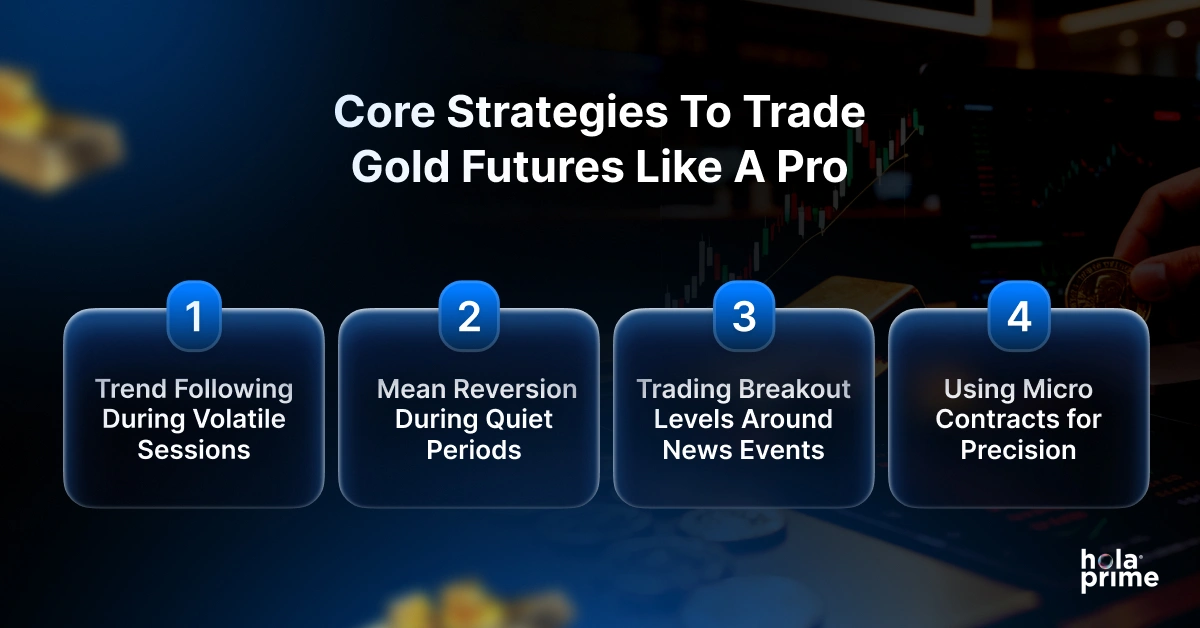
Core Strategies to Trade Gold Futures Like a Pro
To trade gold as a prop trader, you need strategies that give you structure instead of reacting emotionally to every candle. Below are methods that many consistent prop traders rely on, along with explanations to help you adapt them to your own style.
1. Trend Following During Volatile Sessions
Gold loves to trend when volatility is high. Sessions with major economic releases often see directional bursts that continue for several hours. Trend-following traders focus on breakouts, retests and areas where previous structure breaks down. Once the trend begins, the key is staying patient and letting the move play out rather than closing too early out of fear.
2. Mean Reversion During Quiet Periods
Gold isn’t always wild. During quieter sessions, especially when no major news is expected, gold tends to respect support and resistance levels. Mean reversion traders look for areas where the price stretches too far away from balance zones. When market conditions are calm, these pullbacks often provide good opportunities with controlled risk.
3. Trading Breakout Levels Around News Events
Gold often builds pressure before big news events. Traders wait for the breakout in either direction after the data is released. The key is planning scenarios ahead of time because reacting after the spike usually leads to late entries. Prop traders should be careful here since news spikes can violate risk limits if the position size is too large.
4. Using Micro Contracts for Precision
Micro gold futures (MGC) let you trade with smaller exposure, which is ideal for prop rules. Even if you’re confident about a setup, using micro contracts helps you avoid breaching daily loss limits during sudden volatility. This flexibility is one reason why so many traders prefer micros during evaluations.
Technical Tools That Help You Trade Gold Smarter
Gold responds well to technical setups, but some tools tend to work better than others. Rather than using too many indicators, most gold futures traders stick to a few reliable ones.
1. Volume Profile and Key Value Areas
The volume profile shows where the price spent the most time and where strong participation occurred. Gold tends to react sharply when it enters high-volume areas, and it often bounces or rejects low-volume zones. This helps with both entries and determining whether a trend is likely to continue.
2. Moving Averages for Trend Clarity
Simple moving averages help you see the broader trend. When gold trades above major moving averages during strong sentiment, the market usually respects the direction unless disrupted by major data.
3. Support and Resistance
Gold respects clean levels, particularly those formed during news-driven moves. Marking these levels gives you natural areas to build trade ideas.
Risk Management for Gold Futures in Prop Trading
Risk management is where prop traders separate themselves from casual traders. Staying within a prop firm’s limits is crucial, and gold requires extra care because of its speed.
Use Controlled Position Sizing
Many traders fail evaluations not because their strategy is bad, but because their positions are too large for the volatility. Using smaller contract sizes allows you to survive rough patches without violating rules.
Avoid Overtrading During News Spikes
News periods can produce large opportunities, but they also create slippage and sharp reversals. Entering too early or chasing a spike often results in unnecessary losses.
Stick to Maximum Daily Loss Plans
Create a clear rule for how much you’re willing to lose per day. If you exceed it, walk away. This single rule protects both your account and your mindset.
Why Gold Futures Are a Strong Choice for Prop Traders
Gold gives you the right blend of liquidity, volatility, and structure. It moves enough for solid intraday setups but also respects levels that allow for cleaner planning. For prop traders, this balance makes it ideal for building consistency. And when you use smaller contracts, controlled risk and a structured approach, gold becomes a powerful instrument for growing your funded journey.

 EN
EN DE
DE