In this guide, we will explore what futures trading is, how futures trading works, key markets involved, the pros and cons, tips, and instructions so you can get started as a beginner.
What is Futures Trading?
Futures trading allows you to speculate on the price movement of various assets (such as commodities, stock indices, currencies, or interest rates), without necessarily owning the asset.
As a futures trader, you can make money if the price moves in the direction you predicted. However, you may also lose money if the price moves against you.
Example - A wheat farmer might sell a futures contract to lock in a price for their crop, protecting against the risk of falling prices. Conversely, a bread manufacturer may buy that contract to secure wheat at a known cost.
A futures contract allows you to lock in the price of an asset today for a transaction that will occur at a later date, regardless of market fluctuations. Businesses use them to manage risk, whereas traders aim to profit from price changes.
How Does Futures Trading Work?
https://www.youtube.com/watch?v=y4jZJCziI4I&t=18s
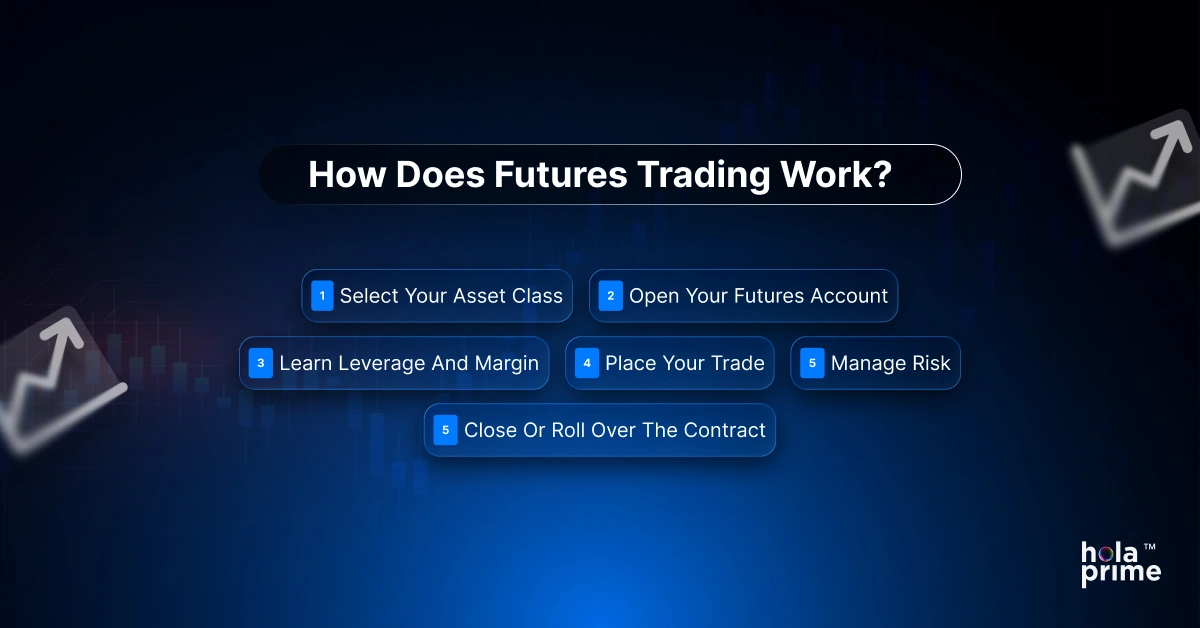
Futures trading works through exchanges – for example, the CME, ICE, or Eurex. Here’s a quick step-by-step look:
- Select your Asset Class – Many beginners opt for currencies, commodities and stock indexes.
- Open Your Futures Account – Opt for a prop firm that offers futures trading, such as Hola Prime. Be sure to utilise demo accounts to brush up on your skills.
- Learn Leverage and Margin – Futures use leverage. This means you can control a large contract with a smaller deposit (margin). (For example, controlling a $50,000 contract with $5,000 margin gives 10x leverage. Gains may be larger, but losses may also exceed your margin).
- Place Your Trade – If you're going long (buying), expect the price to rise. If you're going short (selling), expect the price to fall.
- Manage Risk – Use stop-loss orders and position sizing to control potential losses.
- Close or Roll Over the Contract – You can close your position before the expiration date or roll it over to a new contract to keep exposure.
Key Futures Terms Every Beginner Should Know
|
Term
|
Definition
|
Example
|
|
Contract Size
|
The amount of the asset covered by one futures contract
|
One E-mini S&P 500 futures contract represents 50 times the index. If the index is at 4,500, the contract value is $225,000
|
|
Expiration Date
|
When the contract must be settled or rolled over
|
A June Nasdaq futures contract expires in mid-June. A prop trader may close their position a few days before expiry to avoid rollover risk
|
|
Margin
|
Initial deposit required to open a position
|
For an E-mini S&P 500 contract worth $225,000, the initial margin might be $12,000
|
|
Leverage
|
Lets traders amplify potential gains and losses
|
Using 10x leverage, a $12,000 margin controls a $120,000 position. A 1% move in the market equals a $1,200 gain or loss
|
|
Tick Size
|
Minimum price movement of a contract
|
In E-mini S&P 500 futures, the tick size is 0.25 points. Each tick equals $12.50. If the index moves 4 ticks, that’s a $50 gain or loss
|
|
Settlement
|
Cash or physical delivery of the underlying asset
|
If a futures contract closes above your entry price, you receive the cash difference.
|
Futures Markets You Can Trade
Futures trading isn’t limited to a single type of asset – here are some of the key markets:
1. Commodities
- Energy – Oil, natural gas
- Precious metals – Gold, silver, platinum
- Agriculture – Wheat, corn, soybeans
2. Financial Futures
- Indices – S&P 500, NASDAQ 100, Dow Jones
- Interest rates – Treasury bonds and notes
- Currencies – EUR/USD, GBP/USD
3. Cryptocurrencies
- Bitcoin and Ethereum futures are becoming very popular, but are highly volatile.
At Hola Prime, we offer access to 50+ futures instruments, including commodities, indices and more. Learn more on our instruments page.
Who is Futures Trading For?
Futures trading is suitable for a variety of participants with different goals, from traders to hedgers/ producers.
- Speculators – These are traders aiming to profit from price movements. Futures markets offer high liquidity and 24-hour trading on many contracts, which makes them ideal if you’re a trader who wants to profit from short-term price fluctuations.
- Hedgers/ Producers – Producers and consumers use futures contracts to manage risk. For example, producers such as miners or oil companies may sell futures contracts to lock in prices for their products, whereas consumers such as food manufacturers may buy futures contracts to secure stable prices for raw materials.
- Investors – Futures can be a great way for investors to diversify their portfolio across commodities, indices, and currencies.
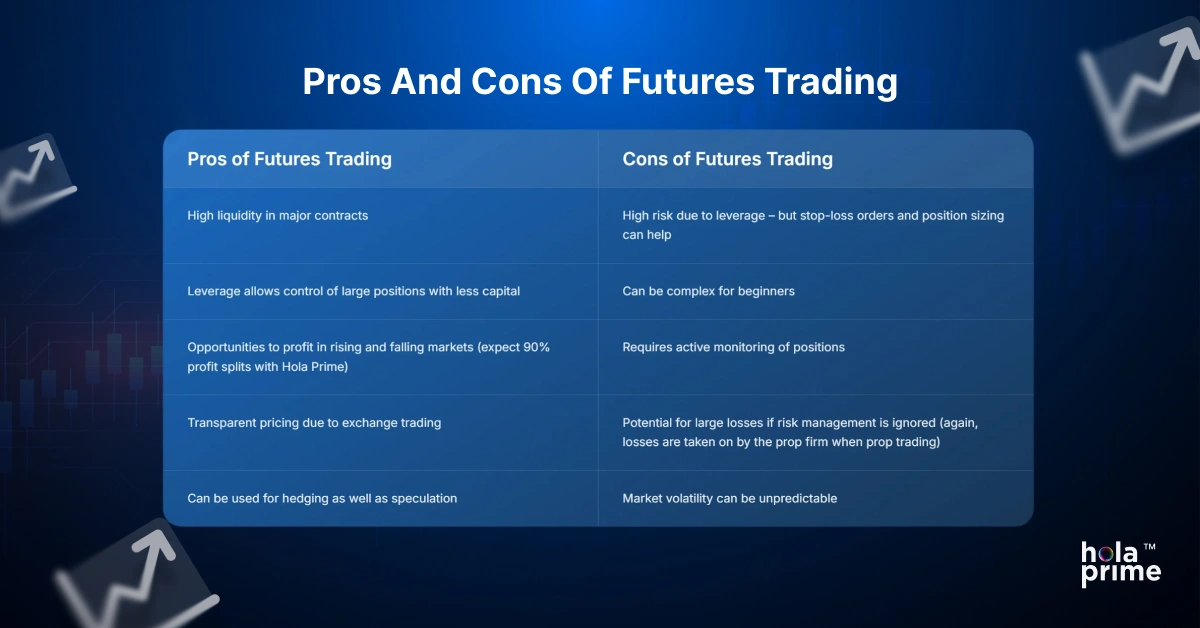
Pros and Cons of Futures Trading
How to Start Futures Trading
Step 1 – Learn the Basics
First things first, take time to learn the basics of futures trading. Get to know key terms and concepts such as margin, leverage, and open interest. Spend time studying market patterns, volatility and technical analysis, which are a must for prop trading. Some traders find it helpful to watch tutorial videos and read guides (such as the one you’re reading).
Learning from other traders can be a help too – many prop firms have active communities and Discord channels. At Hole Prime, we also offer one-on-one coaching to help you level up.
Step 2 – Select Your Prop Firm
Choose a firm that offers futures trading with low latency, competitive fees, and strong execution speeds. At Hola Prime, you can trade on top-rated platforms such as RTrader Pro, Quantower and Project X.
Ensure your prop firm of choice provides demo accounts so you can practice without risking real money, and look for firms that support high leverage and multiple futures markets suitable for prop trading (indices, commodities, currencies).
Step 3 – Open Your Demo Account
We recommend beginning with a demo account to simulate real trading conditions with virtual funds. This enables you to practice scalping, day trading, and swing trading strategies to determine which best suits your style. Get used to tracking your trades, wins, and losses in a journal – this will help you to identify patterns and improve your decision-making skills.
Step 4 – Develop Your Trading Plan
Before you begin trading with real funds, start developing your trading plan. Begin by setting expectations of your risk per trade, profit targets, and maximum daily loss. Decide the asset classes and futures markets you want to focus on, and plan your entry and exit strategies.
Step 5 – Start Trading (Start Small)
Now it's time to begin trading. Start off with a small position to limit exposure, but to gain real-world experience. Make the most of stop-loss orders and position sizing to control your losses, and focus on liquid contracts for smooth entries and exits.
Step 6 – Monitor, Review, and Refine
Whilst you're still beginning, spend time reviewing each trade at the end of the day – and make a note of any mistakes and lessons learned. Amend your strategies based on how your trades perform, and keep a record of market conditions. As your confidence grows, you can slowly begin to scale up your positions – while, of course, maintaining strict risk management.
Top 10 Tips for Beginners
- Start with a demo account before risking real money
- Focus on one or two markets (e.g. S&P 500 or crude oil)
- Learn how margin and leverage work
- Use stop-loss orders to manage risk
- Never risk more than 1–2% of your account per trade
- Trade liquid contracts to ensure smooth entry and exit
- Keep a trading journal to track performance
- Follow market news and economic events
- Stick to your trading plan (avoid emotional decisions)
- Review and refine your strategy regularly
Looking to Get Started With Simulated Funding?
At Hola Prime, we make it simple for beginners and aspiring prop traders to start futures trading with confidence. Our simulated funding programs allow you to:
- Practice trading futures in real market conditions without risking personal capital
- Build consistency and prove your strategy in a risk-free environment
- Access scalable funding opportunities once you’re ready to trade live
Start trading Hola Prime Futures today – sign up, trade on a simulated account, and take your first step toward becoming a funded trader.