If you’ve ever tried futures trading, you’ve probably heard the word margin tossed around a lot. And let’s be honest, it can sound intimidating at first. Many new traders assume margin is a fee. But that’s not what it is. In futures, margin works more like a security deposit - money you set aside to prove you can handle losses if the market swings against you.
Margins matter because they decide how much of a position you can take and how long you can hold it. Two terms that confuse almost everyone in the beginning are initial margin and maintenance margin. They look similar, but they play very different roles. The first one gets you into the trade, and the second one makes sure you can stay there without being forced out.
In this blog, we’ll walk through exactly how they work, the differences between the two, and how traders actually deal with margin calls in real life.
What Are Futures Margins?
Margins in futures aren’t like margins in stock trading. You’re not borrowing money from your broker. Instead, you’re putting up collateral. This margin works as a guarantee that you can handle the losses on the positions you open.
Here’s a simple example: say you want to trade crude oil futures. A single contract controls 1,000 barrels of oil. If crude is trading at $65 a barrel, that’s $65,000 worth of oil. But you don’t need $65,000 in your account to open the position. The exchange might only ask for $6,500 as margin. That small deposit gives you exposure to the entire contract.
Of course, leverage cuts both ways. A slight move in the price can cause massive profit or loss. That’s why margin exists - to make sure you can cover those swings.
Initial Margin: The Cost of Entry
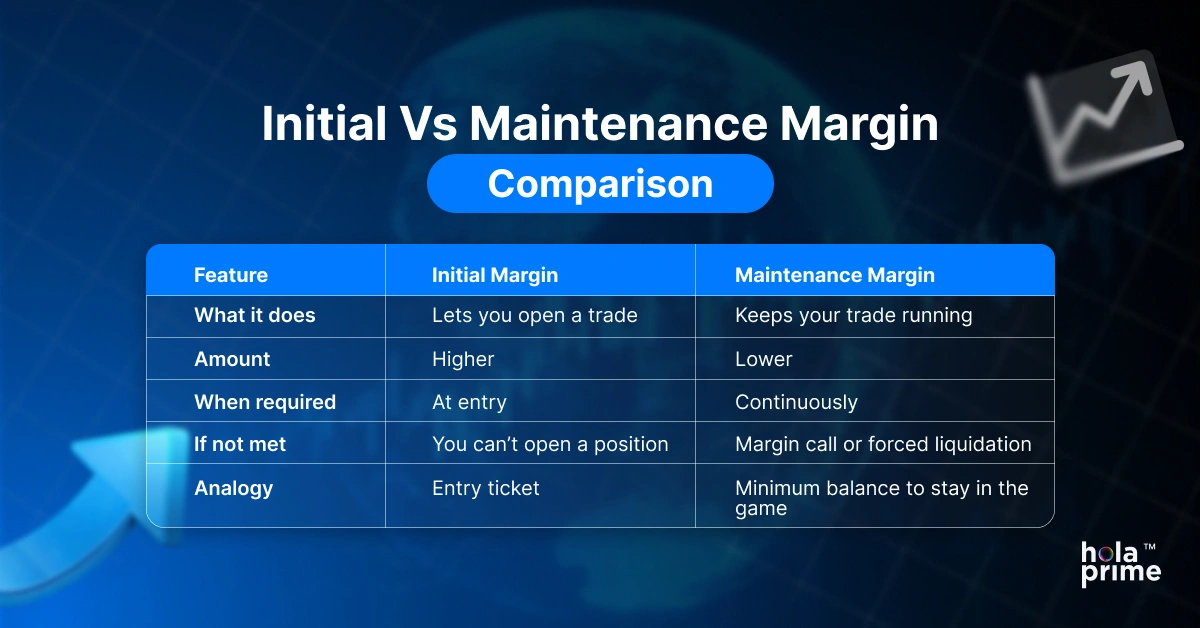
The initial margin is what you need upfront to open a position. Without it, you don’t get a seat at the table.
Take the S&P 500 E-mini futures as an example. Let’s say the exchange sets the initial margin at $21,000. That doesn’t mean you’re buying $21,000 worth of stock index - it means you need that amount as a deposit. With that deposit, you’re controlling a contract worth more than $200,000. That’s serious leverage.
Brokers can raise initial margins when markets get wild. During the pandemic crash in March 2020, margins on equity index futures spiked. Brokers knew volatility could wipe traders out quickly, so they asked for more collateral. If you weren’t prepared with extra cash, you couldn’t trade.
So think of initial margin as your ticket in. No ticket, no entry.
Maintenance Margin: Staying in the Game
Once you’re in, you can’t just forget about it. You also need to keep enough money in your account to keep the position alive. That’s where the maintenance margin comes in.
Maintenance margin is usually lower than initial margin. If the initial requirement for a contract is $12,000, the maintenance might be $9,000. As long as your account balance doesn’t fall below $9,000, you’re fine.
But if it does? That’s when you get the dreaded margin call.
Here’s a real-world type of situation: you enter a crude oil contract with $8,000 initial margin and $6,000 maintenance margin. The market drops faster than expected, and your account equity falls to $5,700. Your broker calls (or, more likely, emails) and says, “Top up your account, or we’ll close your position.” Unless you deposit more money quickly, you’re out.
Maintenance margin is like the minimum fuel level in your car’s tank. Run below it, and you won’t get far.
You need both. The first one gets you started. The second one makes sure you don’t get kicked out midway.
What are Margin Calls?
Margin calls are every futures trader’s nightmare. They usually come at the worst time - when the market just hit you hard, and you’re scrambling for cash.
Picture this: you’re long gold futures, convinced prices are about to rally. Instead, they drop $20 an ounce in a single day. Your account equity slips below the maintenance margin. Your broker issues a margin call. You either wire in more money or your position gets closed, possibly locking in a loss just before the rebound you were waiting for.
Seasoned traders avoid this by always keeping a cushion. They don’t run their accounts so close to the edge that one bad move triggers a call.
Why Margins Call Matter
Margins aren’t just red tape. They serve a purpose:
- They protect you. Without margins, traders could take positions way beyond their means. One bad day, and they’d be wiped out.
- They protect the broker and exchange. Futures markets are highly leveraged. Margins prevent defaults that could ripple through the system.
- They force discipline. Knowing the requirements pushes you to think about risk and position sizing before hitting the buy or sell button.
If you’ve ever blown up a demo account by going all-in on one trade, you’ll appreciate why margins exist in the real world.
Tips for Managing Margins Like a Pro
Here are a few practical ways to stay out of trouble:
- Always check the margin requirements for the contract you’re trading. They’re not all the same.
- Keep extra funds in your account. Don’t ride the maintenance margin line - you’ll just stress yourself out.
- Use stop losses wisely. They won’t save you from everything, but they stop small losses from snowballing.
- Start small. Don’t open full-size contracts if you’re just learning. Micro futures exist for a reason.
- Pay attention to news events. Fed announcements, jobs reports, or geopolitical headlines can all lead to sudden margin hikes.
Margins aren’t there to scare you. They’re there to make sure you survive long enough to learn how to trade well.
Conclusion
Margins in futures trading might seem like a technical detail, but they’re really the foundation of risk management. The initial margin is your entry ticket - it gets you into the market. The maintenance margin is your survival line - it keeps you in the trade once you’re there.
Traders who ignore margins usually learn the hard way, through margin calls and forced exits. Traders who respect them, on the other hand, last longer and trade with more confidence.
So, next time you’re about to place a trade, don’t just look at the chart or the news. Ask yourself: Do I have enough margin, and do I have enough cushion to handle the swings? That simple habit could save you a lot of unnecessary pain and keep you trading another day.