In simple terms, futures trading is the practice of buying and selling contracts that will then lock in at a price on a future date. Traders will use these contracts to either speculate on how price movements will change or protect themselves from potential risk in various markets, from commodities to currencies.
Key features of futures day trading include:
- Speed and precision – Trades can last from seconds to hours.
- Leverage – Small account sizes can control large contracts, magnifying gains and losses.
- Market variety – Futures can various markets such as indices (S&P 500, Nasdaq), commodities (oil, gold), and currencies.
Day traders will open and close positions within the same trading day, with the goal of profiting from short-term price fluctuations without holding their futures contracts overnight. These short-term trades can reduce exposure to overnight risk, but day trading requires focus, speed, and discipline.
Why Futures Trading Appeals to Prop Traders
Prop traders often opt for futures for their:
- High liquidity – E-mini contracts like the S&P 500 (ES) have high volume, which makes it easier to enter and exit positions without slippage.
- Accessibility – Futures don’t require a large amount of capital upfront, thanks to leverage. With a prop firm, you can trade with the firm’s capital rather than your own – you just need to pay initial costs such as the evaluation fee.
- Clear rules – Prop firms often set defined daily loss limits and profit targets, and futures trading aligns well with these because of tight stop-loss controls.
- Opportunities in all markets – Futures allow profits in both rising and falling markets, perfect for consistent evaluations.
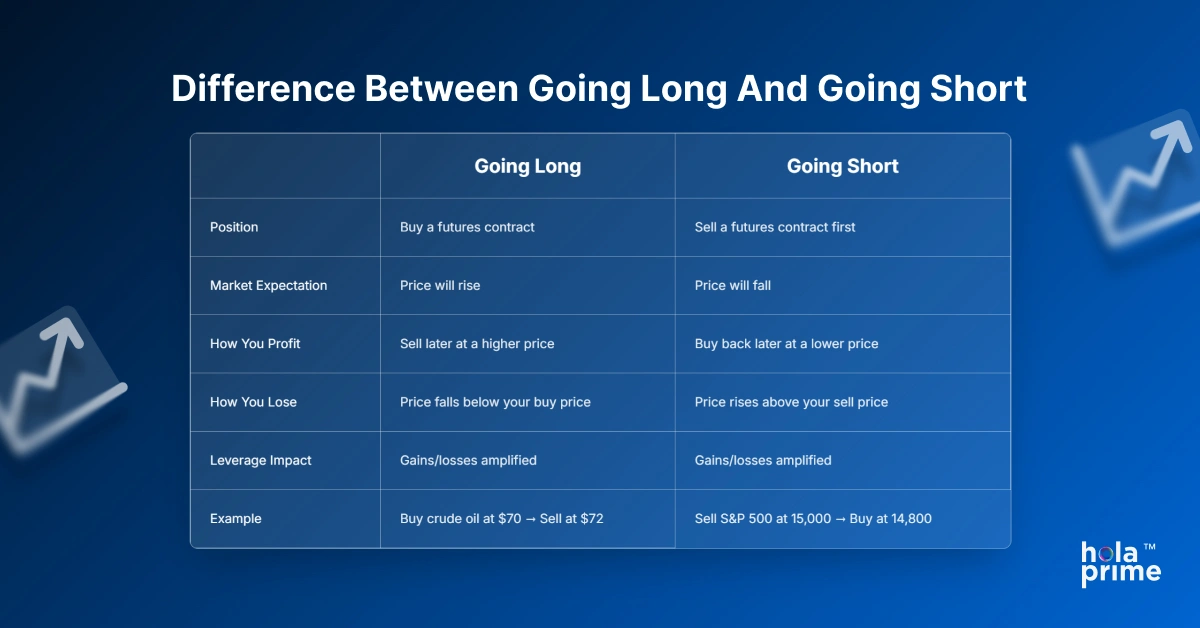
Going Long vs. Going Short
Knowing what 'going long' and 'going short' means is an absolute must when day trading futures, especially when trading under a prop firm's risk limits and trading rules. Here's a simple definition:
Going long (buy) = Expecting prices to rise.
Example: Buying an E-mini S&P 500 futures contract ahead of strong earnings reports
Going short (sell) = Expecting prices to fall.
Example: Shorting crude oil futures after bearish supply data.
Prop traders will often switch between long and short multiple times a day – this ability to adapt can be the difference between passing and failing your evaluation challenge.
Difference Between Going Long and Going Short
Best Futures Day Trading Strategies
Here are five profitable futures trading strategies widely used by professional traders:
1 - The Pullback Approach
Pullback trading involves entering trades during temporary reversals within a strong trend. So, instead of going with a trend from the beginning, you wait until the price 'pulls back' to a support or resistance level. You then enter in the direction of the trend.
Technical tools:
- Moving Averages – Identify trend direction and dynamic support/resistance.
- Fibonacci Retracements – Spot potential pullback levels.
- Volume Indicators – Confirm whether a pullback is losing momentum.
For full-time day traders, the pullback strategy allows them to capitalize on short-term market inefficiencies while staying aligned with the overall trend. It works best in volatile markets where price corrections are frequent, offering multiple opportunities to profit while following the trend.
Example: ES futures are trending higher. When the price pulls back a little to a key level (like a moving average or previous low), a trader buys, expecting the upward trend to continue.
Benefits:
- Reduces risk compared to entering at extremes
- Offers better reward-to-risk ratios since stops are tighter
- Fits well within prop firm rules so you’re less likely to hit daily loss limits
Note that there is a risk of pullbacks failing if the market reverses completely – so confirm with volume or momentum indicators.
2 - Breakout Trading
Breakout trading is when traders aim to capitalize on significant price moves that occur when a market breaks through key levels of support or resistance. Support and resistance are price points where the market has historically struggled to move lower or higher.
These levels being breached can often signal strong momentum, creating an opportunity for traders to enter positions aligned with the breakout direction.
Technical tools:
- Bollinger Bands – Identify consolidation and volatility contraction before breakouts.
- Volume Analysis – Look for spikes to confirm momentum behind the breakout.
- Pivot Points – Spot intraday breakout levels for entry and exit.
Example: Crude oil futures break above $87 after consolidating all morning. A trader enters a long position as the breakout occurs with the aim of riding the momentum.
Benefits:
- Clear entry and exit rules make it easier to follow firm guidelines.
- High potential for hitting daily profit targets quickly.
There is a risk of false breakouts, so always confirm with volume, and avoid over-leveraging when trading breakouts.
3 - Spread Trading
Spread trading – also referred to as inter-market or intra-commodity spreads – involves trading the price difference between two related futures contracts rather than the outright contract.
Some common spreads include:
- Calendar spreads – same commodity, different delivery months
- Inter-commodity spreads – related commodities (e.g crude oil vs. gasoline)
Technical Tools:
- Historical Spread Charts – Identify mean-reverting opportunities.
- Correlation Analysis – Monitor how the two instruments move relative to each other.
- ATR (Average True Range) – Gauge volatility to adjust position size and stop-loss.
Example:
Buying the December crude oil contract while selling the January contract if the historical price difference suggests a profitable convergence.
Benefits:
- Reduces directional market risk since the focus is on the relative difference.
- Often lower volatility than outright contracts, helping manage daily risk limits.
4 - Scalping
Scalping is a high-speed trading strategy in which traders aim to profit from small and quick price movements. Instead of holding positions, scalpers will enter and exit trades within just a few minutes (or even seconds), accumulating gains that can grow into substantial daily profits.
Technical Tools:
- Tick Charts – Track ultra-short-term price moves.
- Momentum Oscillators (RSI, Stochastic) – Identify micro-moves and overbought/oversold conditions.
- Volume Trends – Confirm spikes that indicate short-term opportunities.
- Limit/Stop Orders – Ensure fast execution in high-speed environments.
Example:
Buying ES futures after a small dip and exiting within minutes for a few points of profit. Doing this several times in a session can accumulate profits.
Benefits:
- Fast accumulation of profits (lots of small wins can help reach evaluation or daily targets quickly).
- Short holding times reduce the risk of large adverse moves.
Be sure to stick to high-liquidity contracts to ensure smooth entries and exits – and use tight stop-losses to limit downside on missed trades.
5 - News-Based Trading
News-based trading is when traders closely monitor events such as major economic announcements, bank updates and geopolitical events – and make their trading decisions based on these updates.
Futures markets often react within just seconds to new information. This can be high risk, but also high reward.
Some events that can influence futures trading include:
- Economic reports – Nonfarm payrolls, CPI, and GDP releases can cause sharp moves in index futures (such as ES, NQ)
- Central bank policy announcements – Fed interest rate decisions and press conferences heavily influence equity and bond futures
- Commodity-specific data – Weekly crude oil inventories or crop yield reports can shift commodity futures dramatically
- Unexpected geopolitical events – Elections, wars, or sudden policy changes can highly affect futures markets, creating fast-moving trends
Technical tools:
- Economic Calendars – Track upcoming high-impact events.
- Volatility Indicators (ATR, Bollinger Bands) – Measure expected movement and adjust position sizing.
- Pre-Event Technical Levels – Identify key support/resistance to gauge reactions.
Benefits:
- One single event can move the market enough to hit a prop firm’s profit target in minutes.
- Major futures contracts like ES, NQ, and CL see huge spikes in trading volume, making entries and exits easier.
News-based trading can be one of the fastest ways to grow a funded account, but it’s also one of the riskiest. Note that slippage and widened spreads are common, so many firms recommend smaller positions during major news events.
Risks of Day Trading Futures
Futures trading can come with risks. The good news is that when trading with a prop firm like Hola Prime, you will never lose more than your initial investment. Some risks include:
- Leverage risk
- Emotional trading
- Market volatility
Some key principles of risk management when day trading futures include:
- Set daily loss limits to avoid risking more than what your prop firm allows
- Use stop-loss orders to protect downside before focusing on profit
- Size correctly (over-leverage is the fastest way to fail a challenge)
- Keep a trade journal to learn from your mistakes
Want To Try These Strategies Out For Yourself?
If you’re looking to test these tried and tested futures day trading strategies out for yourself and start futures trading with simulated funding, you’re in the right place.
At Hola Prime, we offer traders the chance to prove their skills in futures trading with simulated funding challenges.
Check out our:
Practice your futures day trading strategies in a real-market environment and take the first step toward managing funded capital. Begin Futures Trading with Hola Prime today.

 EN
EN DE
DE