Introduction:
Trading of any sort requires skill and knowledge, and without it, you may end up incurring losses without even realizing it. Because in trading, or any business for that matter, as much as it matters to make profits, it’s equally important to have an effective risk management strategy and limit the expenses. For instance, in forex trading, if you are not mindful and don’t take into consideration the various additional costs like spreads, commissions, and swap charges, in the long run, these can pile up and reduce your profits.
In this blog, we will discuss in detail what spreads, commissions, and swaps are and how you can navigate these to keep your trading costs to a minimum. Let’s go.
What Are Spreads?
Speards, in simple words, is the difference between the bid price and the ask price. The gap between the maximum price a buyer is willing to pay for a financial instrument and the ask price of the seller is called the spread. Unlike commission, the spreads are not fixed as they depend on a lot of factors such as market volatility, trade volume at a given time, time of the session, brokers' execution speed, and more.
Generally, when the market has more volatility, spreads are generally higher. It is so because during the time of high volatility, market makers bear more risk. Further, if the speed of execution of the trading platform is fast, then the spreads would be lower as there would be less lag in the bid time and execution.
What is Commission?
Commissions are different from spreads and are the fees charged by the brokers for the execution of trades and providing you with the trading infrastructure. The amount of commissions may vary from broker to broker and the plan you choose. There are generally 3 types of commission plans: fixed spreads plan, variable spreads plan, and fixed commissions plan.
In a fixed spread structure, the trade will provide you with a fixed pip difference, no matter how volatile the market is. In variable structure, the spreads will vary based on the market volatility and other factors. At last, in the fixed commission structure, you will have to pay a fixed amount for a month, and you can trade as many times as you want.
The best plan for you is the one that aligns well with your trading strategy. Whether you are a scalper or a swing trader, you should check out the different plans available with your broker and choose the one that fits your needs.
What is Swap in Trading?
A swap in forex is the interest you either pay or earn for holding a trade overnight. It depends on the interest rate difference between the two currencies in the pair. For example, if you buy EUR/USD and the euro has a higher rate than the dollar, you may earn a small credit. If you sell it, you might pay a fee. Swaps may look minor daily, but over time, they can significantly affect your trading costs or profits.
How Do These Costs Add Up?
When you look at trading costs individually - like spreads, commissions, or swaps - they may not seem like a big deal. A fraction of a pip here, a few dollars in commission there, or a small overnight fee might feel negligible at first glance. But when you add these costs together over time, they can quietly eat into your profits.
Take the example of two traders entering the same EUR/USD position. Trader A uses a broker with no commission but a wider spread of 1.5 pips, while Trader B uses a broker with tighter spreads of 0.2 pips but pays a $7 commission per lot. On the surface, it looks like both are paying roughly the same to enter a trade. But what happens when they repeat this process 50 or 100 times in a month? The small differences start to pile up, and one may end up with noticeably lower net gains.
If either trader also holds positions overnight, swaps add another layer to the equation - sometimes working in their favor, sometimes against them. That’s why calculating the “all-in” cost of trading is crucial. Over the long run, these hidden charges can decide whether you end up profitable or barely breaking even.
How to Reduce the Trading Cost and Expenses?
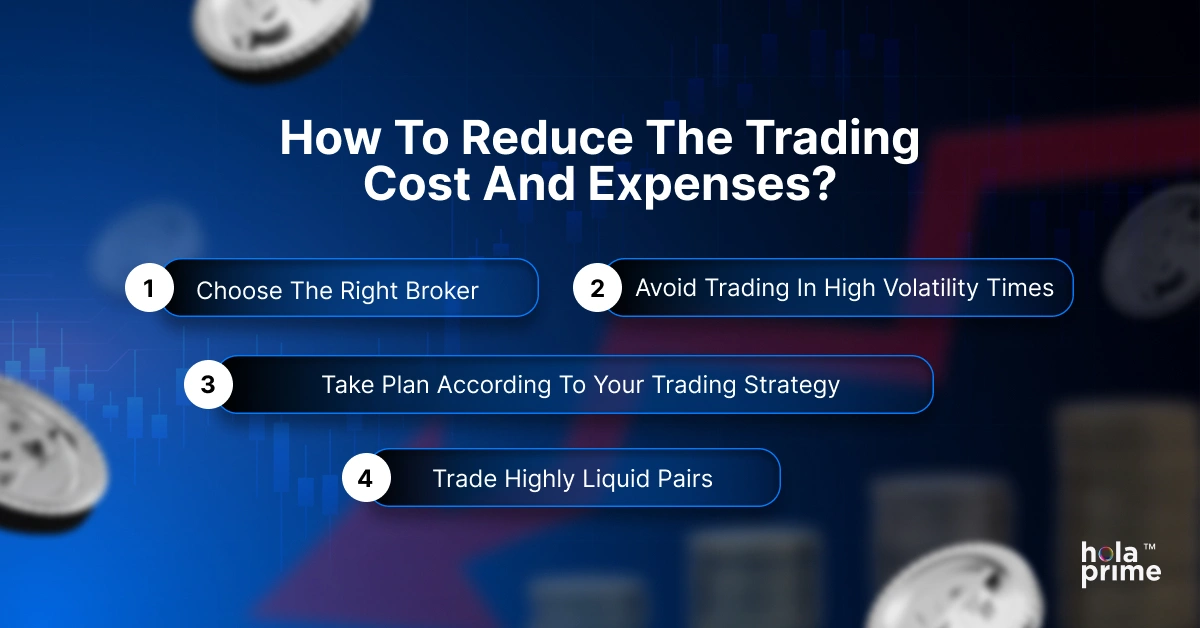
1. Choose the Right Broker:
Forex is a decentralized market, and spreads, commissions, and swaps are decided by the brokers. Your cost of trading depends on the broker you choose. Let’s say you are trading with a 5 pip spread, and another trader with another broker is getting access to the same level of trading infrastructure with 2 pips only. Hence, it is important to choose your broker wisely.
2. Take Plan According to Your Trading Strategy:
Not all plans would fit your trading style. If you are a scalper, you should look for a plan where the spreads are low. On the other hand, if you are a swing trader, you should look for an account that does not have swap charges or has very minimal charges.
3. Avoid Trading in High Volatility Times:
When the Market Volatility is High, spreads are usually higher. If you prefer to trade with a variable spread account, it is best to avoid trading in high volatility moments.
4. Trade Highly Liquid Pairs:
Some pairs, like EUR/USD or GBP/USD are more liquid than others. You can experience tighter spreads when you trade these pairs because of the high liquidity.
Do These Costs Matter in Prop Trading?
It depends on the prop firm you are trading with. Most of the prop firms don’t charge commissions or swap charges; all you have to pay is the challenge fees. This is one reason many traders are now inclined towards trading with a prop firm instead of trading with their own funds.
Conclusion:
In forex trading, each pip matters. If you don’t pay attention to small charges, they may end up piling up and reducing your profits. Hence, pay attention to how much you are paying for spreads, commissions, and swaps. Further, choose an account that aligns with your trading style so that you pay the least amount possible in expenses.
 Limited Time