Here’s the truth: neither option is “one-size-fits-all.” The best choice really depends on you, your goals, your capital, and even your personality as a trader.
Think about it. With a broker, you’re trading your own money. You’re in the driver’s seat, no rules beyond what the market throws at you. The flip side? Every loss is yours to carry. With a prop firm, you’re essentially “renting” access to someone else’s capital. They set the rules, you follow them, and in return, you get the chance to trade with much larger amounts of money than you’d ever risk on your own. It’s exciting, but it also comes with its own challenges.
Over the past few years, prop firms have exploded in popularity. Why? Because they’ve opened the door for everyday traders who might not have thousands of dollars lying around. Suddenly, with just a small challenge fee, you can get access to a six-figure trading account. But as tempting as that sounds, it’s not all smooth sailing. Strict rules, evaluation phases, and the mental pressure of trading “someone else’s money” can trip people up.
On the other hand, brokers have been around forever. They’re the old guard of forex. And while they don’t give you free capital, they give you total control. No daily drawdown limits, no evaluation challenges - just you, your money, and the markets.
So, instead of asking “Which is better?” the real question is: Which is better for you? That’s what this guide is all about. By the time we’re done, you’ll understand the ins and outs of both worlds, prop trading and broker forex trading, so you can figure out which path actually matches your style and goals.
Alright, let’s get into it.
2. What is Forex Prop Trading?
Let’s start simple. Imagine you’re a skilled trader, but you don’t have the kind of money you wish you did. Maybe you’ve got a few hundred dollars, maybe a thousand, but that’s about it. Now imagine someone comes along and says:
“Hey, if you can prove you know how to trade responsibly, we’ll let you use our money. You keep most of the profits, and we’ll just take a small cut.”
That’s forex prop trading in a nutshell.
The word “prop” comes from proprietary, which basically means the firm owns the trading capital. Prop firms don’t make their money the same way brokers do (through spreads or commissions). Instead, they make money by partnering with good traders. The idea is simple: if you win, they win too.
But of course, it’s not as easy as just signing up and being handed $100,000 to trade. Most prop firms will test you first. They call it a challenge or an evaluation phase. You pay a small fee - think of it as a ticket to prove yourself and then you have to hit certain profit targets while following strict rules about risk. If you pass, congratulations, you’re now a funded trader with access to serious capital.
Here’s an example: let’s say a firm offers you a $50,000 account. You might need to make 8% profit in a month without losing more than 5% in a single day. Sounds doable, but it can be tough under pressure. Many traders fail not because they lack skill, but because the rules test their discipline.
Once you pass, though, that’s when the fun begins. Instead of trading with your own $1,000, you’re now trading with $50,000 or even $100,000. Suddenly, those small moves in the market that would’ve made you $20 now make you $200 or $500. And the best part? You’re not risking your own money. If you mess up and blow the account, the firm takes the loss, not you. Of course, that usually means you’re out of the program, but at least your personal savings stay intact.
Another interesting twist: most prop firms have profit splits. That means if you make, say, $10,000 in profits, you might keep 80% (so $8,000 goes in your pocket) and the firm keeps 20%. Some firms even offer 90% or more to attract top traders.
So, why are prop firms booming right now? The simple answer is accessibility. They’ve opened doors for everyday people who could never afford to risk huge amounts of money. With just a few hundred dollars for a challenge fee, you can potentially manage accounts worth six figures. For many, that’s life-changing.
Of course, we’ll talk about the downsides later (because there are some big ones), but at its core, forex prop trading is about giving traders capital and structure in exchange for skill and discipline.
3. What is Traditional Forex Brokerage?
Before prop firms started popping up everywhere, there was really only one way to trade forex: through a broker. And even today, brokers are still the backbone of the forex world. But what exactly does a broker do?
Think of a forex broker as the middleman who connects you to the massive global currency market. You can’t just walk into a bank and say, “Hey, I want to trade a few lots of EUR/USD today.” You need a platform, pricing, and liquidity, and that’s what brokers provide.
Here’s how it works in simple terms: You open an account with a broker, you deposit your own money, and you start trading. Every trade you make, whether you’re buying or selling, gets routed through the broker’s system. They earn money mainly in two ways: through the spread (the small difference between the buy and sell price) and sometimes through commissions.
Not all brokers are the same, though. There are a few different models:
- Market Makers: These brokers basically take the other side of your trade. If you buy, they sell. If you sell, they buy. It sounds scary, but it doesn’t always mean they’re out to get you. Market makers often offer low minimum deposits and user-friendly platforms, which is why beginners often start here.
- STP (Straight Through Processing): With this model, the broker sends your orders directly to their liquidity providers (banks or bigger brokers). They don’t take the opposite side of your trade, they just connect you.
- ECN (Electronic Communication Network): These are the most direct and transparent brokers. They let you trade right into the global market with super-tight spreads, but they usually charge commissions per trade. Professional traders often prefer ECN brokers because of the speed and lower costs at higher volumes.
So what’s it like trading with a broker? Well, it’s total independence. You’re putting your own money on the line, and every decision is yours. There are no evaluation phases, no prop firm rules like “don’t lose more than 5% in a day,” and no profit splits. Whatever you make, it’s 100% yours.
But of course, the flip side is that when you lose, you’re losing your own money. That emotional weight can be heavy. Imagine depositing $5,000 and watching half of it disappear in a bad month. That pain feels very different compared to losing on a prop firm account, where only your challenge fee was at stake.
The beauty of brokers is freedom. Want to trade news with high risk? Go ahead. Want to hold a trade for weeks? No problem. Want to scalp five pips a hundred times a day? Totally up to you. You don’t have to worry about breaking someone else’s rules, just your own risk tolerance.
In short, a traditional forex broker gives you access to the market with your own funds. It’s the classic way to trade, and while it comes with risks, it also offers the cleanest form of independence a trader can ask for.
4. Key Differences Between Prop Firms and Brokers
Now that we’ve set the stage and looked at how both models came about, let’s break down where prop firms and traditional brokers really differ. On the surface, both let you trade the forex market. You sit at your desk, open up MetaTrader or TradingView, and click “buy” or “sell.” But behind the scenes, the way these models work and how they impact your trading life is very different.
1. Capital Access and Funding
This is probably the biggest difference. With a broker, you can only trade with what you’ve personally deposited. If you put in $1,000, that’s what you’ve got to work with. Sure, brokers offer leverage (like 1:100 or 1:500), but even then, your account size is limited by your own funds.
A prop firm, on the other hand, gives you access to large accounts, often $10,000 to $200,000, if you can prove your skills. Instead of saving up for years to build your trading capital, you can pay a relatively small challenge fee and potentially skip ahead to managing six figures. That’s a game-changer for many traders who are good but underfunded.
2. Risk Rules and Drawdowns
Here’s where things get strict. Prop firms protect their money by setting rules. They might say you can’t lose more than 5% in a day or 10% overall. Step outside those limits, and you’re out. No exceptions.
Brokers don’t have those kinds of rules. The only limit you face is your own margin. If your losses get too big, your trades will get stopped out automatically, but there’s no daily “max loss” rule. You could blow your entire account in one bad day if you’re not careful. So with brokers, the freedom is all yours for better or worse.
3. Profit-Sharing vs Keeping 100%
With a broker, every dollar you make is yours to keep. Simple as that.
With a prop firm, you usually split profits. The typical split is 70/30 or 80/20, meaning you keep 70–80% of your gains while the firm keeps the rest. Some firms even offer 90% splits to attract traders. At first, it can feel unfair - “why should they take part of my profit?” - but remember, you’re trading with their money, not yours. Without them, you wouldn’t have had access to that larger account in the first place.
4. Psychological Impact
This one is subtle but huge. Trading your own money with a broker can be stressful because every loss is personal. Blow your $2,000 account, and that’s your rent or savings gone. With a prop firm, the pressure shifts. You might feel more relaxed because you’re not risking your own capital, but you also feel the stress of rules. One wrong move and you could break a drawdown limit, losing your chance at funding.
Some traders thrive under that structured environment. Others hate the restrictions and find them suffocating. It all depends on your personality.
5. Growth Opportunities
Brokers don’t really care if you grow or not. They’ll happily take their spread and commission whether you win or lose. Scaling your account with a broker means adding more of your own money over time or compounding your profits slowly.
Prop firms often have scaling plans. If you perform well and stay consistent, they might increase your account size automatically. Imagine starting with $50,000 and, within a year, being scaled up to $200,000 or even more, without ever having to add your own funds. That’s something brokers can’t really match.
So, the key takeaway? Prop firms and brokers both get you into the forex market, but the experience is very different. One gives you freedom, but puts your money at risk. The other gives you capital but ties it to rules. Neither is better in every situation; it all comes down to which environment helps you trade at your best.
5. Advantages of Prop Trading
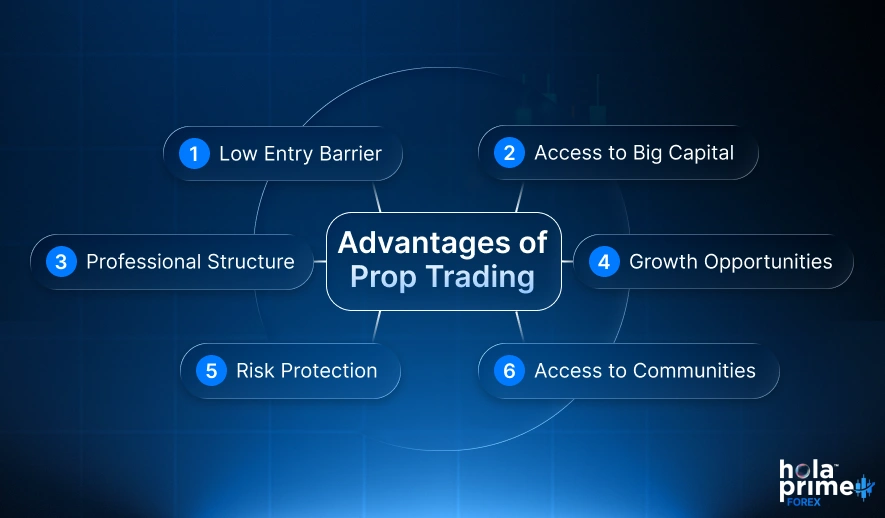
So, what makes prop trading so appealing? Why are so many traders rushing toward prop firms these days instead of just sticking with traditional brokers? The truth is, prop trading offers some unique benefits that can’t be ignored, especially for traders who don’t have deep pockets to begin with.
Let’s break down the biggest advantages.
1. Low Entry Barrier
Think about it: To open a decent trading account with a broker, you might need to deposit thousands of dollars if you want to trade comfortably and manage risk properly. But with a prop firm, you can start with a challenge fee, often a few hundred bucks, and get access to tens of thousands (sometimes even hundreds of thousands) in trading capital if you pass.
For example, let’s say you’ve only got $500 saved up for trading. With a broker, that’s your entire account, and one bad streak could wipe it out. With a prop firm, that same $500 might cover a challenge fee that opens the door to a $50,000 funded account. Huge difference, right?
2. Access to Big Capital
This is the golden carrot that prop firms dangle. You don’t need to wait years to build up your trading capital. If you’ve got skill and discipline, you can jump straight into managing a large account. And because your position sizes are tied to account size, the profits can be much more meaningful. A 2% gain on a $1,000 broker account is just $20. But a 2% gain on a $50,000 prop account? That’s $1,000.
3. Professional Structure and Discipline
Let’s be honest: most traders blow their accounts because they lack discipline. They over-leverage, chase trades, and ignore risk management. Prop firms don’t give you that luxury. Their rules - daily drawdowns, maximum loss limits, and strict targets- force you to trade like a professional.
At first, it can feel suffocating. But many traders end up realizing that these restrictions actually make them better traders. It’s like training with a coach who won’t let you cut corners. The structure helps you build habits that will serve you well, whether you stay with a prop firm or move on to trade your own funds later.
4. Growth Opportunities Through Scaling Plans
This is something brokers just don’t offer. Many prop firms have scaling plans where they’ll increase your account size as you prove consistency. You might start with $25,000, but if you hit certain milestones, you could be scaled up to $100,000, $200,000, or even more. Imagine that your trading capital is growing without you ever needing to add your own money.
5. Risk Protection for Your Personal Finances
This one is a big relief for many traders. With a broker, every loss comes directly out of your pocket. With a prop firm, the most you can lose is your challenge fee (and maybe time). That means your savings account, your rent money, or your emergency fund isn’t at risk every time you enter a trade. For traders who’ve blown accounts before, this safety net feels like a blessing.
6. Access to Communities and Learning
A lot of prop firms have built-in communities - Discord groups, mentorship programs, or trader chats. You’re suddenly surrounded by people on the same journey as you, sharing strategies, struggles, and wins. This sense of community can really speed up your growth compared to trading alone with a broker account.
In short, the appeal of prop trading boils down to this: big opportunities with small personal risk. It’s not perfect (we’ll get into the disadvantages soon), but it gives talented traders a shot at scaling up without the heavy burden of risking their own capital.
6. Disadvantages of Prop Trading
Prop trading might sound like a dream come true, and in many ways, it can be. But let’s be real for a moment. Every opportunity comes with trade-offs, and prop trading is no different. While it offers access to big capital and less personal financial risk, there are some very real downsides you need to understand before jumping in.
1. The Evaluation Challenge
For most prop firms, you don’t just sign up and get funded on day one. You first have to pass an evaluation phase - often called a “challenge.” That means proving you can hit profit targets while staying within strict rules.
Sounds simple, but here’s the kicker: the majority of traders fail these challenges. Not necessarily because they’re bad traders, but because the rules can be unforgiving. Imagine hitting the profit target but accidentally breaking the daily drawdown rule by a few dollars. Boom - failed. It’s frustrating, and it can feel like the firm is setting you up to lose so you’ll keep paying for new challenges.
2. Strict Trading Rules
Once you’re funded, the rules don’t disappear. Most firms keep limits in place to protect their money. These include things like:
- No trading around high-impact news.
- No holding positions over the weekend.
- Limits on lot sizes or risk per trade.
For some traders, these rules feel like shackles. If your strategy relies on holding trades longer or trading news spikes, a prop firm might not even allow it. With a broker, you can trade however you want.
3. Profit Splits
Yes, it’s amazing to trade with $100,000 in capital, but remember: you don’t get to keep it all. Most firms split profits with you - usually 70/30 or 80/20. That means for every $10,000 you make, a few thousand go straight to the firm.
Sure, it’s still better than trading tiny profits on your own small account, but it can sting when you realize a chunk of “your” hard work goes to someone else.
4. Payout Delays or Restrictions
Here’s something traders don’t always think about: payouts. Some prop firms have smooth, quick processes for paying you your profits. Others? Not so much. Delays, paperwork, or payout caps can make the whole thing frustrating. In the worst cases, shady firms have vanished without paying their traders at all.
5. Dependence on the Firm’s Stability
When you trade with a broker, your money is in your account (hopefully with a regulated broker). With a prop firm, you’re relying entirely on their business model staying alive. If they run into trouble, change their rules overnight, or shut down, you’re left with nothing. It’s happened before, and it will happen again in this fast-growing industry.
6. Psychological Pressure
This one’s sneaky. At first, trading with someone else’s money sounds freeing because your personal savings aren’t at risk. But the pressure of rules can mess with your head. You might avoid taking good trades because you’re afraid of hitting the daily drawdown. Or you might overtrade, trying to meet the profit target quickly. The mental game is very different from trading your own broker account.
So, while prop trading offers big advantages, it also comes with strings attached. The rules, evaluations, and reliance on the firm itself can turn what looks like a golden opportunity into a tough grind. The key is knowing yourself: if you can handle structure and play by the rules, prop trading might fit. If not, the frustrations could outweigh the benefits.
7. Advantages of Trading with a Traditional Forex Broker
Sometimes the old ways have their own charm. While prop trading firms are the buzz of the moment, there are still plenty of reasons why a regular broker account can be a better fit - especially if you value freedom, flexibility, and full control.
1. Absolute Freedom
With a broker, you’re the boss. There are no profit targets to meet, no daily drawdown limits to watch, and no restrictions on when or how you trade. Want to scalp during news events? Go for it. Want to hold trades over the weekend? No one’s stopping you. This freedom is priceless for traders whose strategies don’t fit neatly into the rulebooks of prop firms.
2. 100% of Profits Are Yours
One of the best feelings about trading with a broker account? Whatever you earn stays in your pocket. There’s no profit split, no firm taking a cut. If you make $5,000 in a good month, that entire $5,000 is yours to keep. Sure, you’re trading with less capital than a prop firm might give you, but the money you do make is completely yours.
3. Direct Ownership of Your Account
With brokers, the account is in your name, under your control. You’re not depending on a firm’s stability, policies, or payout process. If you’ve chosen a regulated, trustworthy broker, your funds are protected and accessible. That kind of security can give traders peace of mind that no prop firm can fully match.
4. Flexible Withdrawals
Most brokers let you deposit and withdraw funds quickly, often within a day or two. Contrast that with some prop firms where payouts happen once a month, or where you might face extra hoops before seeing your money. With a broker, the money is yours when you want it.
5. No Evaluation Stress
Perhaps the biggest advantage? You don’t need to “prove” yourself before you start trading. With prop firms, evaluations are a stressful hurdle that many fail. With a broker, the only thing you need to bring to the table is your own money and your own plan. There’s no one grading your performance.
6. Easier to Experiment and Grow
If you’re still learning, a broker account gives you the freedom to experiment without worrying about breaking rules or failing challenges. You can test strategies, make mistakes, and learn at your own pace. Many traders also like to scale their own accounts over time - compounding profits, reinvesting gains, and building a personal fund that doesn’t rely on anyone else.
7. No Ties to a Third Party
With a prop firm, you’re effectively in a partnership - you trade their rules, their money, and share profits with them. With a broker, you’re independent. You answer to no one, which makes the journey simpler and more personal.
In short, a traditional broker account may not give you instant access to six-figure capital, but it gives you something equally important: freedom, ownership, and full control of your trading journey. For some traders, that independence is worth more than any funded account a prop firm could offer.
8. Disadvantages of Trading with a Traditional Forex Broker
Trading with your own broker account sounds empowering, and it is, but it’s not all sunshine. There are some real challenges that can make it harder for traders to grow quickly, especially if you’re starting with limited funds. Let’s break it down.
1. Limited Capital Growth
This is the big one. With a broker, your growth is limited by how much you personally fund the account. If you only have $500 or $1,000 to start with, even the best strategy will take time to build significant profits. Compare that to a prop firm giving you $50,000 or $100,000 to trade, the earning potential is worlds apart.
2. Emotional Pressure Is Higher
When it’s your own money on the line, every loss feels heavier. Losing $200 of your hard-earned cash stings in a way that losing $200 of a prop firm’s capital doesn’t. This emotional pressure often causes traders to second-guess their decisions, close trades too early, or even revenge trading. In short, personal risk can mess with your psychology.
3. Slower Compounding of Profits
Scaling your account with a broker is a marathon, not a sprint. Sure, you keep 100% of the profits, but building a small account into something meaningful takes patience. For traders dreaming of going full-time quickly, this slower pace can be frustrating.
4. No Safety Net
With a broker, if you blow up your account, that’s it - the money is gone. Prop firms, on the other hand, absorb the loss when you fail an account (though you do lose the challenge fee). Having no safety net means you carry the full burden of mistakes.
5. Temptation to Over-Leverage
When you’re trading your own funds, there’s often a temptation to “go big” and over-leverage in hopes of growing the account faster. But this usually backfires, leading to blown accounts. Brokers offer high leverage, but that power in inexperienced hands can be dangerous.
6. Less Structure and Accountability
Prop firms come with rules that keep you disciplined, max drawdowns, daily loss limits, and consistency requirements. With brokers, you’re free, but that freedom can sometimes be a curse. Without structure, some traders spiral into bad habits: overtrading, revenge trading, or abandoning their plan altogether.
7. Harder to Scale Into Full-Time Trading
Unless you already have significant capital, trading with a broker alone can make it tough to transition into a full-time career. For many, the small gains from a $1,000 or $2,000 account just aren’t enough to cover real-life expenses.
So, while traditional brokers give you independence, they also make the climb steeper. You’re funding your journey alone, carrying all the emotional weight, and facing slower growth. For some, that’s fine. For others, it’s the very reason prop firms feel so appealing.
9. Key Differences Between Prop Firms and Brokers (A Direct Comparison)
Both prop firms and traditional brokers offer traders a way to access the markets, but the experience you’ll get with each is very different. To make it simple, let’s put them head-to-head.
1. Capital Access
- Prop Firm: Gives you access to large funded accounts ($10,000 to $500,000 or more) after passing an evaluation. You’re trading someone else’s money.
- Broker: You only trade what you personally deposit. Whether that’s $500 or $50,000, growth depends on your own pocket.
2. Profit Share
- Prop Firm: You usually keep between 70% to 90% of the profits. The rest goes to the firm.
- Broker: You keep 100% of your profits since it’s your money.
3. Risk
- Prop Firm: If you blow the account, you lose only the challenge fee (and possibly the live account access). The firm absorbs the actual trading loss.
- Broker: Every loss comes straight from your own money. No cushion.
4. Rules and Restrictions
- Prop Firm: Strict rules - daily loss limits, max drawdowns, news trading restrictions, etc. Break the rules, and you lose the account.
- Broker: No restrictions beyond margin requirements. You can trade however you want.
5. Emotional Impact
- Prop Firm: Easier to stay calm since it’s not your personal savings on the line. Still, rules can add pressure.
- Broker: Higher stress since every dollar lost is yours. But total freedom can be liberating for disciplined traders.
6. Growth Potential
- Prop Firm: Fast track. If you prove yourself, scaling up to six-figure accounts is possible.
- Broker: Slower growth, especially if you’re starting small. Compounding takes time and discipline.
7. Long-Term Sustainability
- Prop Firm: Great for learning, building discipline, and accessing large capital. But you’re always dependent on someone else’s rules.
- Broker: Ultimate independence. Over time, building your own funded account gives you complete control.
So, what’s the takeaway?
Prop firms feel like a launchpad - they give you fuel (capital) and structure (rules) to get started quickly. Brokers feel like the long road - slower, tougher, but ultimately, you’re in the driver’s seat with no one looking over your shoulder.
10. Which Option is Better for You? (Prop Firm vs Broker)
There’s no one-size-fits-all answer. The truth is, both prop firms and brokers have their place - and the “better” option depends on who you are as a trader and what you want from your journey. Let’s break it down in a more human way.
If You’re Just Starting Out
Prop trading can feel like the safer bet. Why? Instead of putting your savings at risk, you only pay a challenge fee to get access to big capital. It’s like renting a Ferrari to test your driving skills instead of buying one outright. Even if you crash, you don’t lose your life savings, just the rental fee.
On the other hand, starting with a broker means you’ll need to put real money in the markets right away. If you don’t yet have a proven strategy or emotional control, you might burn through that account quickly.
Verdict: Beginners often find prop firms a more forgiving way to learn, provided they can handle the pressure of strict rules.
If You Have Limited Capital
Let’s be honest: most people don’t have $20,000 lying around to risk in forex trading. If that’s you, a prop firm is a lifeline. For a few hundred dollars in fees, you can get access to a $50,000 or $100,000 account.
With a broker, if you only fund $500 or $1,000, you’ll be stuck trading tiny lot sizes. Growth is possible, but it will take years.
Verdict: Prop firms give you leverage when your wallet can’t.
If You Value Complete Freedom
Maybe you hate rules. Maybe you want to hold trades over the weekend, use grid systems, or risk 5% per trade if you feel like it. In that case, a prop firm will drive you crazy. Their rules are designed to protect their capital, not to give you free rein.
A broker gives you complete independence. You’re the boss. No one cares how you trade, as long as you manage your own risk.
Verdict: If freedom is everything to you, brokers are the way to go.
If You’re Already Consistently Profitable
This is where things get interesting. A consistently profitable trader can use prop firms as a way to scale up quickly. Imagine you’re trading your own $5,000 account and making 5% per month ($250). With a $100,000 funded account, that same performance could bring $5,000 per month. Huge difference.
But if you’ve built enough of your own capital, brokers might still feel better long-term since you keep 100% of the profits and don’t have to split them with anyone.
Verdict: Use prop firms to scale fast, but keep building your own broker account for ultimate independence.
If You Struggle With Discipline
This might sound strange, but prop firms can actually teach discipline. Their rules force you to respect risk limits. For traders who tend to overtrade or revenge trade, this structure can act as a safety net.
With a broker, there’s nothing stopping you from blowing your account in a single bad day. It’s like having access to an open bar with no bartender telling you to slow down.
Verdict: If discipline is your weakness, a prop firm might help you build it.
So, which is better? Here’s the truth: it doesn’t have to be one or the other. Many traders start with prop firms to gain capital, build discipline, and scale quickly, while simultaneously growing their own personal broker account in the background. Over time, this gives you the best of both worlds.
Conclusion
At the end of the day, the question of “Should I go with a prop firm or a broker?” isn’t about which is universally better. It’s about which one fits you - your goals, your stage of trading, and your comfort with risk.
If you’re just starting out or don’t have much capital, a prop firm can be the stepping stone that gives you access to big opportunities without draining your savings. If you crave total freedom and already have money to trade, a broker might feel more natural. And if you’re serious about building a long-term career in trading? You’ll likely end up using both, taking advantage of prop firms to scale quickly while growing your own independent account for the future.
The most important thing to remember is this: neither path guarantees success. Trading is still trading. It requires patience, discipline, and a strategy you trust. But by choosing the setup that matches your situation, you’re giving yourself the best chance to grow without unnecessary setbacks.
So, instead of asking, “Which is better, prop firm or broker?” - try asking, “Which one gives me the best chance to trade consistently, confidently, and sustainably?” That’s the real game changer.


 EN
EN DE
DE