Play DUNK Trade & Get 15% OFF
Play Now
Hola PrimeLogin/Register

Forex Market Sessions Explained: How Timing Impacts Trading

Oct 6, 2025
Forex Market Sessions Explained: How Timing Impacts Trading

When people first hear that forex is open 24 hours a day, five days a week, it sounds like a dream. The idea that you can trade anytime - before work, after dinner, or even at 3 a.m. - is part of what draws so many to the market. But it doesn’t take long to realize that “open all day” doesn’t mean “active all day.” Some hours are painfully slow, while others feel like you’re trying to catch a moving train.

One Time

20% discount

on all accounts
Get Funded

That difference comes down to market sessions. Forex isn’t run from one central exchange; it’s driven by banks and institutions across different time zones. Sydney kicks things off, Tokyo builds momentum, London turns up the volume, and New York brings in the heavy hitters. Each of these sessions has its own character, and if you don’t understand that, you’ll probably find yourself trading at the wrong time, wondering why nothing moves.

Let’s walk through these sessions, the overlaps, and how timing can completely change your forex trading results.

What Are Forex Sessions?

Think of forex like a global relay race. As one financial hub closes, another picks up the baton. Sydney opens first, then Tokyo, London, and finally New York. By the time the U.S. winds down, Sydney is back at it, and the cycle continues.

The reason this matters is simple: different parts of the world care about different currencies, and that affects liquidity and volatility. The yen gets busy in Tokyo. The euro and pound dominate London hours. The U.S. dollar is king during New York hours. If you’ve ever wondered why your EUR/USD trades barely moved overnight but suddenly jumped 50 pips after breakfast, it’s probably because London just opened.
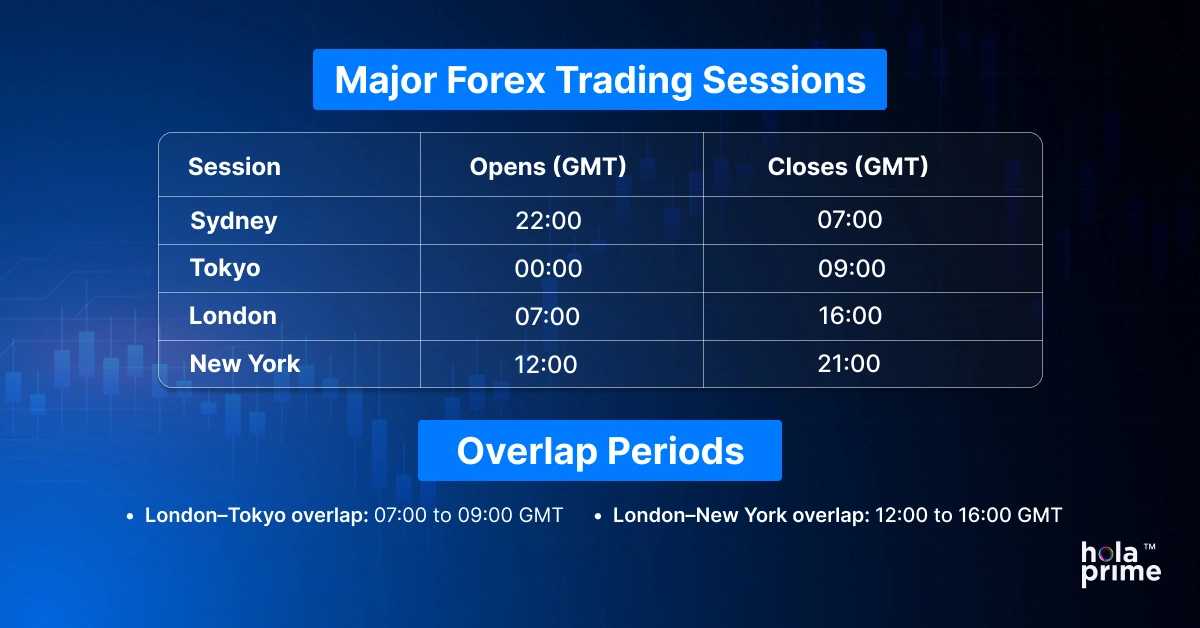
Infographic with major forex trading sessions, their timings and overlap periods.

Sydney Session: The Warm-Up Lap

Sydney opens at 10 PM GMT, which feels like the “quiet before the storm.” It’s not dead - pairs like AUD/USD or NZD/USD can still move - but don’t expect fireworks. Spreads are usually wider, volume is thin, and majors like EUR/USD or GBP/USD tend to drift sideways.

That doesn’t mean Sydney is useless. Some traders like the calmer pace. It’s easier to mark support and resistance, and you can sometimes spot ranges forming that carry into the Asian session. 

Tokyo Session: Asia Gets Moving

When Tokyo opens around midnight GMT, things pick up. The yen takes center stage, and you’ll often see USD/JPY, EUR/JPY, and AUD/JPY come alive. This is also when banks and funds in places like Hong Kong and Singapore start their day.

What’s interesting is how often the Asian session sets ranges. If you look back at charts, you’ll notice that during Tokyo hours, pairs tend to bounce between well-defined levels. Range traders love this because they can scalp small moves with tight stops. 

London Session: The Real Action Begins

Then comes London at 8 AM GMT, and this is when forex feels alive. London has been a global finance hub for centuries, and today, about 40% of forex volume still flows through it. If you want liquidity, this is it.

Spreads tighten, orders flood in, and pairs tied to the euro and pound start to run. Traders even have a name for it - the “London breakout.” If EUR/USD or GBP/USD has been stuck in a sleepy 20-pip box during Asia, London often smashes through one side as European banks open shop. We have seen it happen too many times to count. Some traders build entire strategies around just this move.

New York Session: News and Noise

New York opens at 1 PM GMT, overlapping with London for a few hours. This overlap is the heavyweight round of forex. Both centers are active, liquidity is at its peak, and news from both Europe and the U.S. can move markets within seconds.

If you’ve ever traded around U.S. Non-Farm Payrolls or CPI releases, you know what we are talking about. EUR/USD can jump 80 pips in a blink, spreads widen, and you either catch the move or get knocked out. This volatility is why many traders plan their entire week around U.S. data drops.

Once London closes, New York still runs, but it’s noticeably calmer. You’ll still get moves in USD pairs, but the energy starts to fade as the day winds down.

Why Overlaps Matter

The overlaps are where the real opportunities are.

London–New York (1–4 PM GMT): This is prime time. Two giants are trading at once, and the liquidity is unmatched. Breakouts are common, trends strengthen, and news can add fuel to the fire.

Tokyo–London (8–9 AM GMT): Shorter but still important. Sometimes you’ll see the ranges from Asia get broken when London comes in.

Most day traders I know focus on overlaps because that’s where the market moves fast enough to create opportunities but with enough liquidity to keep spreads tight.

How Trading Session Timing Shapes Strategy

The session you trade isn’t just about convenience - it should match your strategy.

If you’re a range trader, Asia can be perfect. The market respects levels, and you can trade bounces without worrying about surprise breakouts.

If you’re into breakouts or trends, London is your friend. Moves happen quickly, and momentum traders thrive here.

If you’re a news trader, New York gives you plenty of events to play, from U.S. jobs data to Fed speeches.

I’ve seen traders struggle not because their strategy was bad, but because they were using it at the wrong time. A scalper trying to work Sydney hours will feel like they’re watching paint dry, while a patient range trader in London will just get frustrated by all the breakouts.

Other Factors That Shape Trading Sessions

It’s not just about the clock. A few extra things to keep in mind:

News releases: A Bank of Japan policy change can shake Tokyo hours. U.S. CPI can dominate New York.

Holidays: If London is closed for a bank holiday, don’t expect normal liquidity.

Days of the week: Mondays can be slow as markets find their footing. Fridays often get choppy as traders close positions before the weekend.

Seasons: Summer tends to be quieter. December trading thins out as institutions shut their books.

Practical Advice

If there’s one piece of advice we would give, it’s this: don’t try to trade all day. Pick a session that matches your lifestyle and your strategy. If you’re in Europe and can only trade evenings, focus on the London–New York overlap. If you’re in Asia, embrace the Tokyo session and specialize in yen pairs.

And always remember - volatility is both an opportunity and a risk. Overlaps bring big moves, but they can wipe you out if you’re careless. Adjust your position sizes and never underestimate the impact of news.

Conclusion:

The forex market never sleeps, but traders need to. The trick isn’t being glued to charts all day - it’s finding the hours where the odds are in your favor. Sydney sets the tone, Tokyo builds ranges, London drives momentum, and New York delivers news and volatility. Somewhere in that cycle is the session that fits you.

We have seen traders improve dramatically just by changing when they trade. Same strategy, same pairs, different timing - and suddenly they’re catching moves instead of sitting through dead hours. That’s the real lesson of market sessions: timing isn’t just a detail, it’s half the battle.

About the Author: Sam Saleh

Sam Saleh, a London-based trader, began his trading journey at 19 while studying Business at the University of Bedfordshire. With expertise in trading and a background in marketing, he now coaches at Hola Prime, where he develops educational content aimed at building trader confidence, consistency, and financial literacy.

One Time

20% discount

on all accounts
Get Funded

Trending Articles

See More Trending

FAQs

Still Have Questions?

Feel free to get in touch with us today!

Book a MeetingArrow
The London–New York overlap is usually the most volatile. Both financial hubs are active, spreads tighten, and news from both regions can create sharp moves.
It can be, but it’s usually slower. Sydney is ideal for AUD or NZD pairs and for traders who prefer calmer, range-bound markets.
Tokyo tends to set ranges and is especially active for yen pairs like USD/JPY or EUR/JPY. Many range traders love it for its predictability.
London sees the highest forex volume - about 40% of global trading. It’s when euro and pound pairs are most liquid, and breakout strategies often work best.
Yes. Mid-week (Tuesday to Thursday) tends to be more active. Mondays are slower as markets adjust, while Fridays can get messy with position-closing before the weekend.
Big announcements often dominate their regional session. For example, BOJ news shakes Tokyo, ECB news drives London, and U.S. data moves New York.

Disclaimer

All information provided on this site is for educational purposes only, related to trading in financial markets. It is not intended as financial advice, business or investment recommendation, or as an opportunity or recommendation to trade any investment instruments. Hola Prime only provides an educational environment to traders, including tools, materials and simulated trading platforms which have data feed provided by Liquidity Providers. The information on this site is not directed at residents in any country or jurisdiction where such distribution or use would be contrary to local laws or regulations.

Our Community

Join our discord server to connect with our community of active traders.

Join Discord

24/7 Customer Support

Our support staff is available to you 24/7.

About: Simulated trading operations are managed by Hola Prime Limited, a company registered at L1, Shaw House, 201 Wan Po Road, Tseung Kwan O, Hong Kong.
Holaprime Limited a company registered in Cyprus having registration number HE 454359 is a 100% subsidiary of Holaprime Limited Hong Kong.
For MT4 And MT5: Hola Prime Limited, with Company registration number 220248, and registered office at 4th Floor, Docks 4, The Docks, Caudan, Port Louis, Mauritius, is authorized and regulated by the Financial Services Commission (FSC) of Mauritius as an Investment Dealer (Full Service Dealer, excluding underwriting) under license number GB24203729.
For DXTrade, cTrader and MatchTrader: Gooey Trade, GT Tech LLC 6800 Broken Sound Parkway Northwest Suite 150 Boca Raton, FL 33487 US

RISK DISCLOSURE:
All of the information provided on this website and by Hola Prime Ltd, or its affiliates, is intended solely for Educational purposes. Nothing on this website is to be construed as investment advice, nor an offer or invitation to buy or sell any financial instrument, nor does it endorse, recommend, or sponsor any financial product, company, or fund. Testimonials on the Company’s website may not be reflective of the experience of other clients or customers and should not be considered as an assurance of future performance or success. Hola Prime only provides services of simulated trading and educational tools for skill assessment and enhancement of traders. Hola Prime does not act as a broker and does not accept any deposits. Any purchases made should not be regarded as deposits. There are no promises of rewards or returns. Trading in financial markets is inherently high-risk and speculative. The content and information provided on this website are not intended for distribution to, or use by, any person or entity in any jurisdiction or country where such distribution or use would be contrary to local law or regulation.

HYPOTHETICAL PERFORMANCE DISCLOSURE:
ACFTC Rule 4.4-Hypothetical performance results have many inherent limitations, some of which are described below. No representation is being made that any account will or is likely to achieve profits or losses similar to those shown. In fact, there are frequently sharp differences between hypothetical performance results and the actual results subsequently achieved by any particular trading program. One of the limitations of hypothetical performance results is that they are generally prepared with the benefit of hindsight. In addition, hypothetical trading does not involve financial risk, and no hypothetical trading record can completely account for the impact of financial risk of actual trading. For example, the ability to withstand losses or to adhere to a particular trading program in spite of trading losses is material points, which can also adversely affect actual trading results. There are numerous other factors related to the markets in general or to the implementation of any specific trading program, which cannot be fully accounted for in the preparation of hypothetical performance results and all of which can adversely affect trading results. Testimonials appearing on this website may not be representative of other clients or customers and are not a guarantee of future performance or success.

EVALUATION DISCLOSURE:
The customer pass rate of the Challenge/Evaluation program was 35% between 10th November, 2024 – 29th May, 2025, who traded at least one evaluation and obtained a Hola Prime Account during this time period. The Challenge and Hola Prime Accounts are meant to be a realistic simulation of trading under actual market conditions, including commissions, to mimic real market conditions, as much as possible. The evaluation is difficult to pass even for experienced traders. The Evaluation is not suggested for individuals with little to no trading experience.

CUSTOMER COMPENSATION DISCLOSURE:
All trades presented for compensation to customers should be considered hypothetical and should not be expected to be replicated in a live trading account. Hola Prime Accounts may represent simulated accounts or live or copied accounts. Hola Prime does not provide services to the residents of certain countries including – Afghanistan, Belarus, Burundi, China, Cuba, Congo, Sudan, Sri Lanka, North Korea (Democratic People’s Republic of Korea) and Yemen.

This is the only website for Hola Prime. We are not using any third party websites or links. Any link, outside of this website that claims to be ours, could be fraudulent and users are advised to not use it.