Intraday trading the E-mini Nasdaq 100 futures (NQ) is like surfing high-energy waves. The movement is fast, the momentum can be breathtaking, and if you know how to ride it properly, the rewards feel worth every second of risk you took. But make no mistake - trading NQ is not about guessing what the market will do. It’s about having a game plan that’s structured, repeatable, and responsive to volatility.
The Nasdaq 100 is driven by tech giants, algorithmic flows, economic data, and market sentiment around innovation. That makes NQ uniquely explosive during the US session, especially around key events like FOMC speeches, inflation releases, and earnings season.
If you’re trading the E-mini Nasdaq 100 futures intraday, your strategy must fit the rhythm of this fast market. Below, we’ll break down the best intraday strategies that professional and prop traders use to consistently survive and thrive - trading NQ.
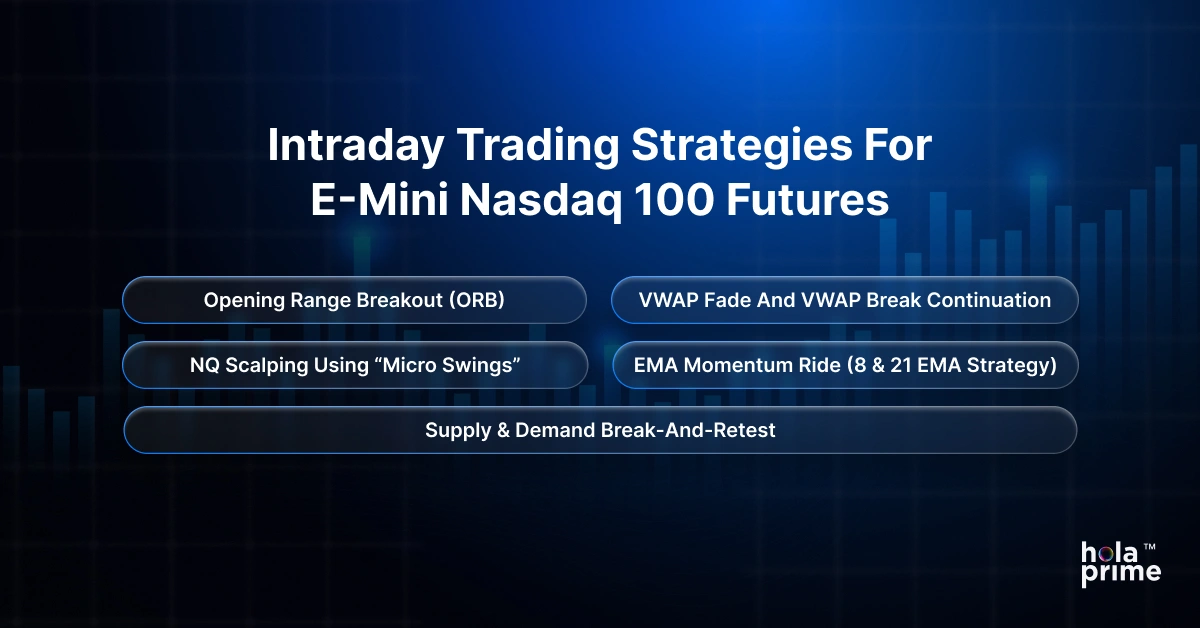
Strategy #1: Opening Range Breakout (ORB)
If you enjoy motion, the opening bell offers some of the best volatility of the day. The first 5–15 minutes of market open often set the tone for the session.
How It Works
- Mark the high and low from 9:30 AM to 9:45 AM (or 9:35 AM if using a tighter window).
- Wait for a breakout with strong volume.
- Enter in the direction of the breakout.
- Stop loss goes inside the range, not outside.
Why It Works for NQ
- Nasdaq responds heavily to liquidity at market open.
- Tech sentiment moves aggressively with overnight futures pricing.
- Algorithms push early momentum.
Pro Tip
Avoid ORB on low-volume opens or pre-market heavy gaps - these tend to fade rather than continue.
Strategy #2: VWAP Fade and VWAP Break Continuation
VWAP (Volume-Weighted Average Price) behaves like a magnet in markets dominated by institutional order flow - just like the Nasdaq 100.
How It Works
- When price stretches far above VWAP, traders look to fade back toward VWAP.
- When price consolidates just above VWAP and breaks with volume, traders look to continue the move.
Use Cases
Market Behavior | Trade Type |
Price overstretched above VWAP | Short fade |
Price overstretched below VWAP | Long fade |
Price consolidates above VWAP | Break continuation long |
Price consolidates below VWAP | Break continuation short |
Pro Tip
Avoid fading against strong trend days. If price sticks to one side of VWAP with strong volume, treat VWAP as support/resistance - not a magnet.
Strategy #3: NQ Scalping Using “Micro Swings”
Scalpers use 6–30 tick moves repeatedly when volatility spikes. This works beautifully on NQ because it respects zones quickly and violently.
Setup
- Use 1-minute chart + Order Flow / DOM (optional).
- Identify micro-support and micro-resistance (short-term highs/lows).
- Enter on pullbacks with tight stops.
Entry Example
- Trend up → Higher low forms → Buy the pullback.
- Trend down → Lower high forms → Short the bounce.
Why It Works
- NQ volatility gives 4–10 trades a day with micro-range precision.
- Stops remain small, risk stays controlled.
Strategy #4: EMA Momentum Ride (8 & 21 EMA Strategy)
The 8 and 21 EMA crossover is widely used in algorithmic trading, especially with momentum-driven indices like Nasdaq.
Rules
- Bull trend: 8 EMA above 21 EMA → look for pullbacks to 8 EMA.
- Bear trend: 8 EMA below 21 EMA → short pullbacks to the 8 EMA.
- Avoid entries when EMAs are flat and tangled.
Confirmation Tools
Use any one (not all):
- MACD histogram slope
- RSI above 55 (for longs) or below 45 (for shorts)
- Volume spike breakout
Best Time to Use
- During trend days (after strong economic news or gap continuation).
Strategy #5: Supply & Demand Break-and-Retest (Institutional Zones)
Institutions love Nasdaq. They accumulate and distribute at very obvious price zones once you learn how to spot them.
Setup Example
- Identify consolidation zone → mark base.
- Wait for breakout above or below.
- On the retest of that base area, enter.
- Stop loss goes behind the zone.
Why It Works
- Large institutions stack orders around these levels.
- Nasdaq obeys these levels more consistently than many other indices.
Bonus Tip
Combine these zones with liquidity sweeps around previous highs/lows to find more precise entries.
Risk Management for Intraday NQ Trading
A strategy is useless without risk rules. In NQ, risk management is half the game.
Here are non-negotiable rules:
✔ Risk a Fixed Dollar Amount Per Trade
Never risk based on “gut feeling”. The volatility will punish you.
✔ Avoid Trading the First 1 Minute
Let algorithms and market orders settle.
✔ Use Hard Stop-Loss (Never Mental Stops)
NQ moves too fast to guess your exit.
✔ Take Profits Systematically
Use partial profit-taking if possible:
- Take 50% at 1:1 R/R
- Let the rest ride with a trailing stop
✔ Define a Daily Loss Limit
Once hit, stop trading. Don’t fight NQ’s momentum - ride it another day.
Who Should Not Trade Intraday NQ?
Even though it’s profitable, NQ is not for everyone. Avoid intraday NQ if:
- You fear fast movement.
- You hesitate at entries.
- You constantly move stops.
- You don’t like volatility.
Nasdaq rewards courage + discipline, not emotional traders.
Final Thoughts: Trade the Movement, Not the Prediction
The best traders in E-mini Nasdaq 100 futures don’t try to be right - they try to trade well. You’re not here to predict tech’s future; you’re here to manage risk and capture opportunity.
If you:
- follow structure,
- respect volatility,
- and apply strategies with discipline…
…NQ becomes one of the most rewarding markets to trade intraday.
Trade smart, not loud. Let the chart show you the trade - don’t chase it.

 EN
EN DE
DE