In trading, success depends on more than just instinct or luck. Traders must rely on solid data and proven methods to build reliable strategies, and that’s where forex backtesting comes in.

 ENEN
ENEN DE
DE
In trading, success depends on more than just instinct or luck. Traders must rely on solid data and proven methods to build reliable strategies, and that’s where forex backtesting comes in.
Backtesting is the process of applying a trading strategy to historical market data to see how it would have performed in the past. The goal? To determine whether a strategy has potential before using it with real money.
While it sounds simple, the truth is that many traders fall into common backtesting traps that lead to failure once they go live. Some strategies perform perfectly in simulation but collapse in actual trading conditions.
In this article, we’ll uncover why most forex strategies fail after backtesting and how to avoid these pitfalls. Understanding proper trading backtesting techniques can help you avoid costly mistakes.
Before risking capital in live markets, traders need confidence that their system can perform under pressure. Forex backtesting provides that assurance.
When done correctly, backtesting helps you:
However, a big problem arises when traders rely too heavily on backtesting results without accounting for market changes, execution speed, and psychological factors. This overconfidence often leads to the downfall of most “perfect” strategies.
Backtesting involves applying your trading rules to historical data to simulate trades. This process can be done manually or through automated software.
You go through charts, candle by candle, applying your strategy rules manually to record potential entries, exits, and profits.
Pros: Deep understanding of your strategy’s behavior.
Cons: Time-consuming and prone to human bias.
Using platforms like MetaTrader 4, MetaTrader 5, or TradingView, traders can automate the entire process. The system executes trades based on your predefined conditions.
Pros: Fast, objective, and data-rich results.
Cons: May overlook nuances like slippage or changing spreads.
When done correctly, backtesting provides a solid picture of how your system might behave. When done incorrectly, it can paint a dangerously misleading picture of profitability.
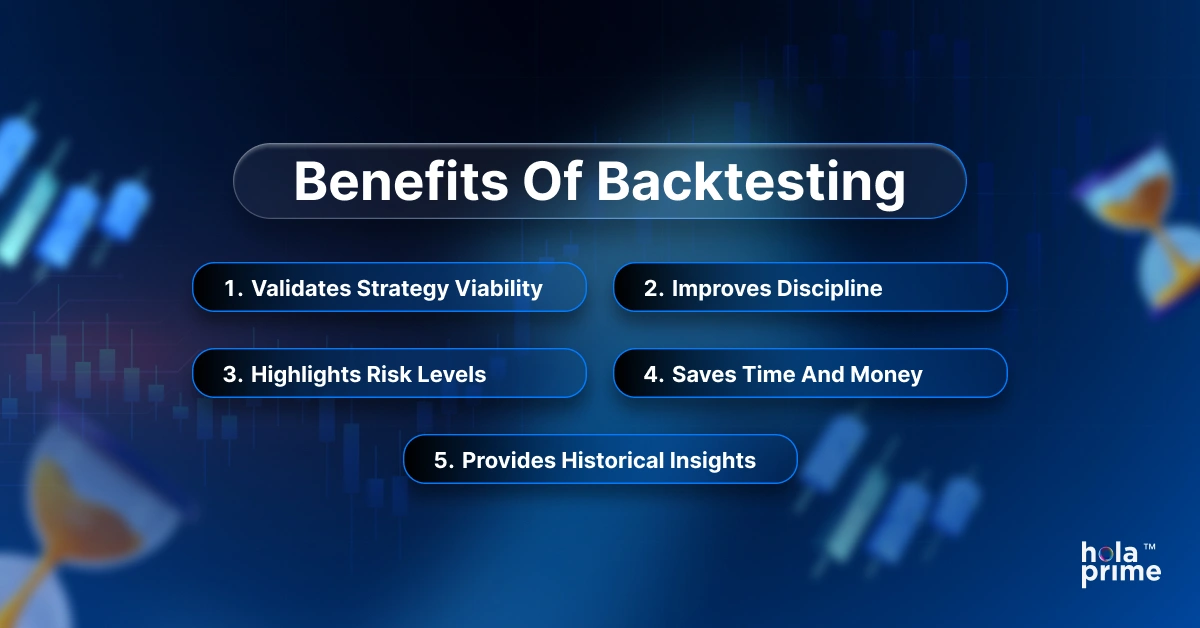
A well-executed backtest can transform an average trader into a data-driven professional. Here’s how:
In essence, backtesting builds trust between you and your system. However, that trust must be grounded in reality - not in overly-optimized or cherry-picked data.
Despite its benefits, forex backtesting can easily mislead traders if done incorrectly. Here are the most frequent pitfalls that cause strategies to fail:
This happens when a strategy is overly customized to fit past data perfectly. It may show excellent backtest results but fails miserably in live markets.
Backtests often assume perfect trade execution. In reality, spreads fluctuate, and orders don’t always fill at the ideal price.
Using incomplete or low-quality data can skew results. For example, missing price spikes during volatile events can hide a strategy’s weaknesses.
Markets change - from trends to ranges to high volatility. Testing a strategy on only one type of market gives a false sense of reliability.
Manual backtests are vulnerable to confirmation bias, where traders unconsciously favor results that validate their beliefs.
Avoiding these mistakes requires awareness and strict testing discipline - something we’ll dive deeper into in upcoming sections.
Overfitting - also known as curve fitting - is one of the most dangerous traps in forex backtesting. It happens when traders fine-tune a strategy so precisely to historical data that it performs flawlessly in the past, but fails miserably in the future.
Imagine creating a strategy that only works perfectly on last year’s EUR/USD chart. You tweak every parameter - moving averages, RSI thresholds, entry timings - until the strategy shows 99% accuracy.
But when you apply that same system to this year’s data, it collapses. Why? Because it wasn’t designed to adapt to new market conditions - it was designed to fit old ones too perfectly.
In short, the system learned the noise, not the pattern.
Overfitting gives you a strategy that looks like a Ferrari in backtesting - but performs like a broken bicycle in live trading.
The quality of your backtest is only as good as the data you feed it. Using incomplete or low-quality data can distort your results, giving you a false sense of security.
Many traders rely on free or low-quality data sources. These often contain gaps, missing candles, or inaccurate price feeds. Even a small error can completely change your backtest results.
For instance:
If your data skips a few pips during volatile events, your stop-loss might appear to have held - when, in reality, it would’ve been hit.
Remember: garbage in, garbage out. No matter how smart your strategy is, bad data will always produce bad results.
Many traders assume that every trade in a backtest gets executed at the exact entry and exit price. Unfortunately, that’s not how real trading works.
Ignoring these two can drastically inflate your backtesting profits.
Your backtest shows a 20-pip average gain per trade.
Now, if the spread is 2 pips and the average slippage is 3 pips, your real-world gain drops to just 15 pips - or even less when volatility hits.
Even a difference of 1–2 pips per trade can add up to hundreds or thousands of dollars over time.
One of the most overlooked aspects of trading backtesting is ignoring how different market conditions affect performance.
Forex markets constantly evolve - trending one month, ranging the next, and sometimes behaving unpredictably. A strategy that performs beautifully in a trending market might bleed money during consolidations.
If you only backtest during one type of market, you’ll end up with a half-tested strategy. For example:
A truly robust strategy should perform adequately in all conditions, not just one.
Even in a data-driven field like forex trading, human psychology plays a massive role. Many traders unknowingly inject bias into their manual backtesting, leading to misleading outcomes.
These biases create a false sense of accuracy. You may believe your system is bulletproof - until it faces the realities of live markets.
In essence, backtesting is about objectivity. The more emotions or assumptions you inject, the less reliable your results become.
To make your backtest meaningful, it must mirror real trading conditions. Below is a step-by-step approach to conducting accurate forex backtesting that yields reliable insights.
Start with a clear set of entry and exit conditions. Avoid vague criteria like “enter when the market looks bullish.” Instead, be specific:
Use a minimum of 5–10 years of historical data to ensure your strategy faces different market environments.
As discussed earlier, ensure your data includes all price movements (preferably tick-level). Missing candles or inaccurate feeds can distort results.
Include:
Execute the test manually or automatically, depending on your software. Track trade results, drawdowns, and win/loss ratios.
Look beyond profitability. Evaluate risk, consistency, and worst-case scenarios. A system that earns modest but steady profits is more valuable than one with extreme highs and lows.
Optimization fine-tunes parameters - but overdoing it can cause overfitting. Always re-test your optimized strategy on out-of-sample data.
Before going live, test the strategy on a demo account to confirm it behaves similarly in real conditions.
By following these steps, you create a realistic picture of your strategy’s potential while minimizing common testing errors.
Forward Testing After Backtesting
Once your backtest shows promising results, the next step is forward testing - also known as paper trading or demo testing.
Forward testing involves running your strategy in real-time market conditions using a demo or small live account. It verifies whether your backtested system can handle actual price movements, spreads, and execution delays.
Backtesting shows how your system could have performed in the past.
Forward testing shows how it will likely perform in the future.
If your forward test matches your backtest results closely, it’s a strong sign your system is robust and ready for live deployment.
A successful forex backtesting process isn’t just about profits - it’s about performance consistency and risk control. Below are key metrics every trader should evaluate after a backtest.
The percentage of trades that end in profit.
Example: 55% win rate means you win 55 out of every 100 trades.
High win rates aren’t everything - if your losses are bigger than your wins, your system still fails.
The average amount of profit gained for every unit of risk taken.
A 1:2 ratio means you risk $1 to make $2.
The maximum percentage loss from a peak to a trough in your equity curve.
Low drawdown = sustainable strategy.
High drawdown = risk of blowing the account.
Total profit divided by total loss.
A profit factor above 1.5 is considered decent; above 2 is excellent.
Measures risk-adjusted returns.
The higher the Sharpe ratio, the more efficiently your system earns profits relative to its volatility.
The average amount you can expect to win or lose per trade over time.
Check whether profits are spread evenly across months or concentrated in short bursts. Consistency is key for long-term survival.
A strategy with balanced metrics across these categories is much more reliable than one with high profits but erratic performance.
You might wonder - if backtesting and forward testing go well, why do so many strategies still fail in live trading?
Here are the main reasons:
The forex market is dynamic. Economic cycles, monetary policies, and liquidity flows constantly change. A system that worked in 2020 might not survive 2025 conditions.
Real markets introduce latency, order slippage, and liquidity issues that no simulation can fully replicate.
Backtesting doesn’t account for fear, greed, or overconfidence. In live trading, emotions can lead to rule-breaking and poor decisions.
Many traders forget to include swap fees, commissions, and spread fluctuations, which can eat into profits over time.
Rigid strategies that can’t adjust to new volatility levels or economic shifts often fail quickly.
As discussed earlier, overfitted systems crumble when faced with new, unseen data.
A successful backtest doesn’t guarantee future profits - it merely gives you a statistical edge. To survive in forex trading, you must continuously monitor, adapt, and evolve your strategy as markets change.
So, how can traders ensure their forex backtesting results are reliable and realistic? Here are the best practices to avoid common traps:
Markets evolve. A good test should cover different regimes - bullish, bearish, and ranging periods - to gauge adaptability.
Always include spreads, slippage, commissions, and swap fees. Even minor costs can drastically affect your edge.
Backtesting with 6 months of data is not enough. Use at least 5–10 years of historical data across multiple currency pairs.
If a strategy performs perfectly on one dataset but fails on another, it’s likely overfit. Simplify your rules and test again.
Divide your data into training and testing segments. Optimize on one portion, then validate on another to see if the strategy generalizes well.
Keep a record of your parameters, outcomes, and tweaks. Transparency in testing helps you identify what truly works.
Numbers tell one side of the story, but context matters too. Understand why a strategy works, not just how.
By following these steps, you’ll minimize bias, avoid unrealistic expectations, and build a foundation for long-term consistency.
The rise of AI and machine learning has revolutionized how traders approach forex backtesting. Instead of manually optimizing strategies, algorithms can now identify profitable patterns automatically.
AI is not replacing traders - it’s empowering them. The key is to use AI as a decision-support system, not as a blind replacement for experience and intuition.
Many traders are shocked when their backtested strategy doesn’t perform the same way in live trading. That’s because there are major differences between the two.
Aspect | Backtesting | Live Trading |
Data Type | Historical (fixed) | Real-time (dynamic) |
Execution | Instant, ideal fills | Delays, slippage, re-quotes |
Costs | Often ignored | Always present |
Emotions | None | Fear, greed, stress |
Market Conditions | Static | Constantly changing |
Control | Full (simulation) | Limited (real-world constraints) |
A robust trader understands that backtesting is a map, not the territory. It helps guide decisions, but you still need real-world adaptability to thrive.
Even the best forex backtesting can’t account for one unpredictable variable - human emotion. Fear, greed, and impatience are often the true reasons strategies fail.
In forex trading, psychology is the final frontier. A trader who masters his emotions can execute even an average strategy profitably - while an undisciplined trader can destroy a great one.
Forex backtesting is one of the most powerful tools a trader can use - but only if it’s done correctly.
When done right, it helps you:
When done wrong, it creates a dangerous illusion of success.
To recap the essentials:
In the end, backtesting is not about predicting the future - it’s about preparing for it. The goal isn’t to find a perfect system, but a resilient one that adapts and evolves with the ever-changing forex market.
Sam Saleh, a London-based trader, began his trading journey at 19 while studying Business at the University of Bedfordshire. With expertise in trading and a background in marketing, he now coaches at Hola Prime, where he develops educational content aimed at building trader confidence, consistency, and financial literacy.
Still Have Questions?
Feel free to get in touch with us today!

All information provided on this site is for educational purposes only, related to trading in financial markets. It is not intended as financial advice, business or investment recommendation, or as an opportunity or recommendation to trade any investment instruments. Hola Prime only provides an educational environment to traders, including tools, materials and simulated trading platforms which have data feed provided by Liquidity Providers. The information on this site is not directed at residents in any country or jurisdiction where such distribution or use would be contrary to local laws or regulations.
ISO 9001:2015
Quality Management System - QMS
ISO 22301:2019
Business Continuity
Management System - BCMS
ISO/IEC 27001:2022
Information Security
Management System - ISMS
About: Simulated trading operations are managed by Hola Prime Limited, a company registered at L1, Shaw House, 201 Wan Po Road, Tseung Kwan O, Hong Kong.
Holaprime Limited a company registered in Cyprus having registration number HE 454359 is a 100% subsidiary of Holaprime Limited Hong Kong.
For MT4 And MT5: Hola Prime Limited, with Company registration number 220248, and registered office at 4th Floor, Docks 4, The Docks, Caudan, Port Louis, Mauritius, is authorized and regulated by the Financial Services Commission (FSC) of Mauritius as an Investment Dealer (Full Service Dealer, excluding underwriting) under license number GB24203729.
For DXTrade, cTrader and MatchTrader: Gooey Trade, GT Tech LLC 6800 Broken Sound Parkway Northwest Suite 150 Boca Raton, FL 33487 US
RISK DISCLOSURE:
All of the information provided on this website and by Hola Prime Ltd, or its affiliates, is intended solely for Educational purposes. Nothing on this website is to be construed as investment advice, nor an offer or invitation to buy or sell any financial instrument, nor does it endorse, recommend, or sponsor any financial product, company, or fund. Testimonials on the Company’s website may not be reflective of the experience of other clients or customers and should not be considered as an assurance of future performance or success. Hola Prime only provides services of simulated trading and educational tools for skill assessment and enhancement of traders. Hola Prime does not act as a broker and does not accept any deposits. Any purchases made should not be regarded as deposits. There are no promises of rewards or returns. Trading in financial markets is inherently high-risk and speculative. The content and information provided on this website are not intended for distribution to, or use by, any person or entity in any jurisdiction or country where such distribution or use would be contrary to local law or regulation.
HYPOTHETICAL PERFORMANCE DISCLOSURE:
ACFTC Rule 4.4-Hypothetical performance results have many inherent limitations, some of which are described below. No representation is being made that any account will or is likely to achieve profits or losses similar to those shown. In fact, there are frequently sharp differences between hypothetical performance results and the actual results subsequently achieved by any particular trading program. One of the limitations of hypothetical performance results is that they are generally prepared with the benefit of hindsight. In addition, hypothetical trading does not involve financial risk, and no hypothetical trading record can completely account for the impact of financial risk of actual trading. For example, the ability to withstand losses or to adhere to a particular trading program in spite of trading losses is material points, which can also adversely affect actual trading results. There are numerous other factors related to the markets in general or to the implementation of any specific trading program, which cannot be fully accounted for in the preparation of hypothetical performance results and all of which can adversely affect trading results. Testimonials appearing on this website may not be representative of other clients or customers and are not a guarantee of future performance or success.
EVALUATION DISCLOSURE:
The customer pass rate of the Challenge/Evaluation program was 35% between 10th November, 2024 – 29th May, 2025, who traded at least one evaluation and obtained a Hola Prime Account during this time period. The Challenge and Hola Prime Accounts are meant to be a realistic simulation of trading under actual market conditions, including commissions, to mimic real market conditions, as much as possible. The evaluation is difficult to pass even for experienced traders. The Evaluation is not suggested for individuals with little to no trading experience.
CUSTOMER COMPENSATION DISCLOSURE:
All trades presented for compensation to customers should be considered hypothetical and should not be expected to be replicated in a live trading account. Hola Prime Accounts may represent simulated accounts or live or copied accounts. Hola Prime does not provide services to the residents of certain countries including – Afghanistan, Belarus, Burundi, China, Cuba, Congo, Sudan, Sri Lanka, North Korea (Democratic People’s Republic of Korea) and Yemen.
This is the only website for Hola Prime. We are not using any third party websites or links. Any link, outside of this website that claims to be ours, could be fraudulent and users are advised to not use it.
© 2026 Hola Prime All rights reserved.