When you start exploring the trading world, one of the first crossroads you reach is the decision between futures and stocks. At first glance, stocks feel more familiar because we all know companies like Apple, Tesla, or Amazon. We use their products, we read about them in the news, and we see their stock prices being discussed almost daily. Futures, on the other hand, sound a bit more technical, and many beginners assume they’re only for professionals. But the truth is, both futures and stock trading are open to anyone with the right knowledge. The question is not which one is better overall, but rather which one is better for you, depending on your goals, your capital, and how you prefer to trade.
What Does Stock Trading Really Mean for a Trader?
Trading stocks is the most direct way of investing in companies. When you buy a stock, you own a piece of that company, no matter how small. For example, if you buy 10 shares of Tesla, you are technically a part-owner of Tesla. You benefit if the company grows, and you take a hit if it underperforms. That ownership element makes stock trading very tangible.
But stock trading is not just about buying and holding. Traders approach stocks in different ways. Some focus on day trading, making small moves during the trading hours of the exchange. Others swing trade, holding for days or weeks based on technical setups. Then there are long-term investors who keep their positions for years. The problem with stocks is that sometimes your returns depend too much on company-specific factors. If a company misses its quarterly earnings, the stock could fall 20% overnight, regardless of how good your analysis was. This makes stock trading both appealing and frustrating at times.
What Is Futures Trading and Why Does It Work So Differently?
Futures trading takes a very different approach. Here, you are not buying ownership in a company. Instead, you are entering into a contract that represents the price of an asset at a future date. That asset could be almost anything - crude oil, gold, the S&P 500 index, or even agricultural products like wheat. For instance, an airline might use crude oil futures to lock in fuel prices so that a sudden spike doesn’t hurt its business. As a trader, you are less interested in the actual delivery of oil or wheat and more focused on the price changes of those contracts.
Futures trading gets you pumped because of all the different markets you can tap into. You're not stuck just betting on how well companies do anymore. Instead, you can make trades based on what's happening around the world. Let's say OPEC decides to cut back on oil production - this might cause crude oil futures to jump up fast. Or if the U.S. gets inflation numbers that are higher than people thought, it changes what folks expect about interest rates, and this makes equity index futures move. Having access to more options like this means you can mix up your trading game way more than if you dealt with stocks. But here's the thing - with all this freedom to trade comes a big responsibility. Futures use leverage, which makes your wins bigger but also makes your losses hurt more. A lot of newbies don't get this and end up putting too much on the line.
Futures vs Stock Trading: Understanding the Major Differences
The Distinction Between Ownership and Contracts
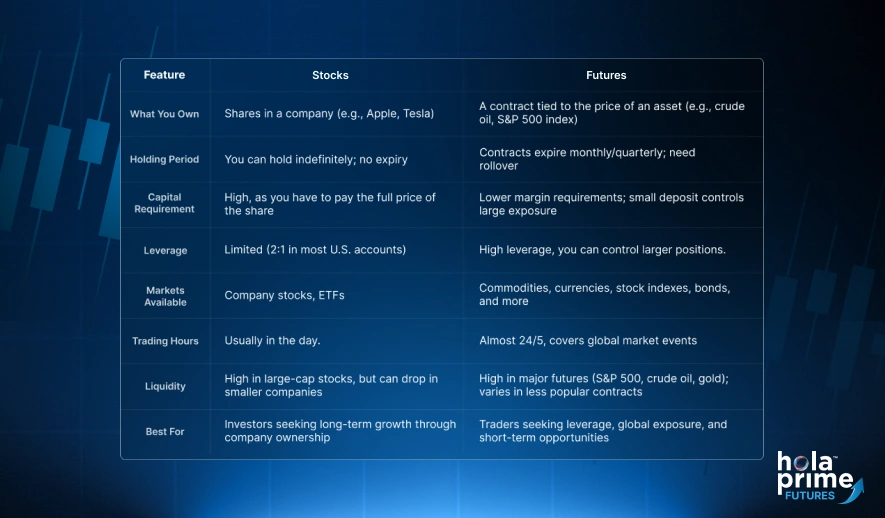
The biggest difference is that with stocks, you own a piece of a company. You can hold it for decades if you wish. With futures, you never own the underlying asset. Instead, you are speculating on its future price through a contract. For example, buying Microsoft shares means you are invested in the company itself. Buying an S&P 500 futures contract means you are betting on the movement of an index that represents hundreds of companies together. This difference alone shows why stocks attract investors while futures mostly attract traders.
The Breadth of Markets You Can Trade in Futures Compared to Stocks
With stocks, you're limited to companies and industries. You pick a technology, healthcare or energy business, but it comes down to their earnings and performance. Futures also give you access to commodities like gold, agricultural products like corn, currencies like the euro, and indexes. If you want to trade inflation levels - you can't do it with a single stock, however, you can do it with gold futures. This allows you the broad exposure to the market, which is one reason prop traders tend to choose futures.
How Leverage Changes the Game Between Stocks and Futures
At this point things become serious. So let's take a basic example: If you would like to buy 100 shares of Apple at $237/share, you will need $23,700. Even using margin will require thousands of dollars in cash upfront. For example, if you want to trade an S&P 500 E-mini futures contract, which controls approximately $200,000 of exposure, your margin requirements may only be as low as $12,000. That is the advantage of leverage. It will allow you to control a much larger position with less money, but it also means that a 1% move against you could wipe out your account. Leverage is the attraction of trading futures and the danger of trading futures. Leverage is also the reason why some people think that trading futures is better than stocks.
The Difference in Trading Hours and Flexibility
Stock markets have predetermined hours. For the U.S. markets, that time is 9:30 a.m. to 4:00 p.m. EST. If something huge happens at 8 p.m., you can't react until the next day, except for limited pre-market or post-market trading. Futures trading doesn't have that limitation - you can be in a futures market almost 24 hours a day for five days a week. For example, if a central bank makes an unexpected announcement in Asia overnight, you can immediately react with futures while stock traders are waiting for the first opening bell in the morning. That flexibility is attractive for global traders not wanting to be anchored down to a single time zone.
Liquidity, Settlement, and Expiry Dates
You can trade shares from some famous companies like Microsoft or Amazon with much more liquidity than trading shares from smaller companies. Trading futures contracts or an ETF futures contract like a crude oil contract, gold contract or S&P 500 index contract are also traded with high liquidity. This means that you will have narrow spreads and speedy execution. Settlement is yet another point of departure. You can hold shares for as long as you wish, including for years, with no expiration. Futures, on the other hand, are expiration items - some contracts are end-dated or expired quarterly. To keep your position active and moving along you have to roll over a position with a day-to-day trade and this requires management and following closely the expiration details.
Stocks vs Futures: Comparison
Which One Should You Choose - Stocks or Futures?
The type of trader you aim to be shapes your choice. If you plan to invest long-term, like digging into company research, and can wait years, stocks make sense. Take Apple shares from a decade ago - holding them has proven a smart long-term move. But if quick trades appeal to you, you want to tap global markets, and you're okay with leverage, futures might suit you better.
Some folks mix both approaches. They keep stocks in their portfolio for the long haul while using futures to chase short-term gains. Picture someone holding onto Microsoft for years but jumping into oil futures when OPEC talks stir things up. You don't have to pick just one - using both can help balance steady growth and quick profit chances.
Conclusion
Trading stocks and futures is not a dilemma in trading. It's very different. Stocks are direct ownership of a company and have more of a historical background to appeal to long-term investors who like to hold a position for some time. Futures are contracts tied to an asset, offer leverage, and allow the trader the flexibility to move around and use exposure to multiple markets or swings in price.
As a trader, it depends not so much on which market is better, but rather which market is a better fit for you and what you're trying to accomplish. If you're a trader who pays attention to the story of the companies you are trading, their financial reports, and they do enhance on a consistent basis over time, then of course stocks are a better fit, However, if you look forward to the quick moves in the market based on global events and competition of supply and demand and like the challenge of trading with leverage and win-lose scenarios, then maybe you are much better suited for futures!

 EN
EN DE
DE