In this blog, we’ll break down what drawdown limits are, why prop firms use them, and most importantly, how you can navigate these rules effectively during a challenge. Whether you’re attempting your first evaluation or have failed a few already, understanding this part of the game can make the difference between passing and starting over.
What Are Drawdown Limits in Prop Challenges?
In most prop trading challenges, a drawdown limit is the maximum amount of loss you’re allowed to take before you fail the evaluation. It acts as a built-in risk control mechanism. Firms want to see that traders can manage their downside just as well as they can chase upside.
There are typically two kinds of drawdown limits: daily drawdown and overall drawdown. A daily drawdown cap restricts how much you can lose in a single day, while the overall drawdown is the maximum loss allowed from your starting or peak balance. Both need to be respected at all times, even if your trade idea is solid. One or two careless moves can breach the limit and end the challenge prematurely.
Why Prop Firms Enforce Drawdown Rules?
Prop firms allocate simulated capital to thousands of traders. The drawdown limits serve two purposes. First, they ensure traders can operate within controlled risk parameters. Second, they help identify traders who can stay disciplined under pressure.
Firms know that anyone can hit a big trade once in a while. What separates consistent traders from reckless ones is how they handle losses and control position sizes. By enforcing drawdown rules, firms filter out those who over-leverage or let emotions take over. For traders, this means that passing the challenge isn’t just about hitting profit targets; it’s about proving you can trade like a professional.
Understanding Daily vs Overall Drawdown
This is where many traders get caught off guard. Let’s say you’re trading a $50,000 evaluation account with a daily drawdown limit of $2,500 and an overall drawdown of $5,000. If you lose $2,501 in a single day, even if your overall drawdown is still below $5,000, you fail the challenge. Likewise, if you slowly lose over time and your total loss reaches $5,001, you’re also out.
Some firms calculate drawdown from your starting balance, while others use trailing drawdown, which adjusts as your equity reaches new highs. For example, if your trailing drawdown starts at $45,000 on a $50,000 account and you grow your balance to $52,000, the trailing drawdown might move up to $47,000. If your balance then drops below $47,000, you fail. Understanding whether your firm uses static or trailing drawdown is crucial for planning.
Common Mistakes Traders Make with Drawdown Limits
Many traders fail challenges not because their strategy is wrong, but because they mismanage risk relative to the drawdown structure. A classic mistake is trading too big too soon. Opening large positions early in the day can eat up your daily limit within minutes if the market moves against you. Another mistake is not accounting for floating drawdown. Some traders assume that if they’re in profit during the day, they can risk more. But if that profit disappears before the day ends, the drawdown calculation still applies.
Another common error is ignoring the trailing aspect. For example, you might be up nicely, but a sudden reversal brings your balance below the trailing threshold, and the challenge is over even if you’re still above the starting balance. These mistakes are avoidable if you plan position sizing and daily risk levels carefully.
How to Structure Your Risk Around Daily Limits
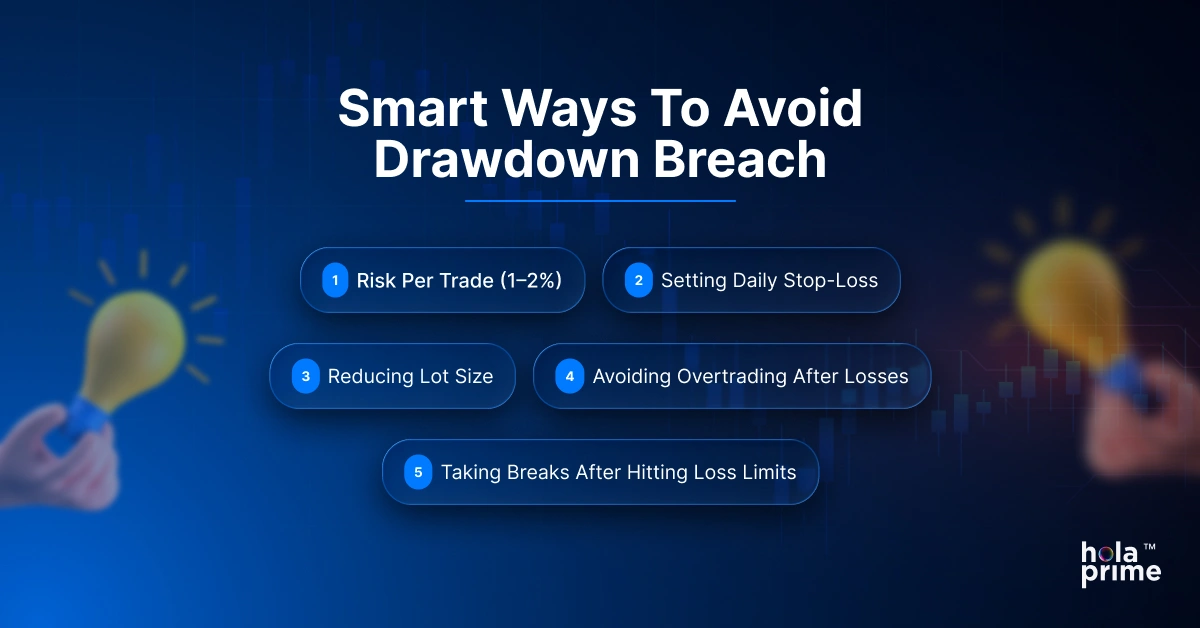
One of the simplest ways to stay within daily drawdown rules is to set a personal daily loss limit that’s slightly below the firm’s official limit. For instance, if the daily drawdown is $2,500, you might cap your own daily loss at $2,000. This gives you a buffer in case of slippage or spread widening.
It also helps to break down your daily risk into multiple trades rather than putting all your risk on one idea. For example, if you’re willing to lose $2,000 in a day, you could allocate $500 risk per trade across four trades. This gives you room to be wrong a few times without failing the challenge in one shot. Traders who survive prop evaluations often think less about hitting targets and more about staying alive.
Managing Position Size in Line with Overall Drawdown
Your overall drawdown should influence your position sizing and strategy selection throughout the challenge. If your maximum overall loss is $5,000, risking $1,000 per trade gives you only five losing trades before you’re out. That might be fine if your strategy has a very high win rate, but for most traders, it’s too aggressive.
A more suitable method involves employing a risk per trade that provides a comfortable buffer. Risking between $250 and $500 per trade enables you to enter 10 to 20 trades, which is much more rational when considering the entire challenge timeframe. When you combine this with a legitimate daily risk limit, you'll have a robust framework that enables you to trade with a little more freedom while at the same time not having to worry about ultimately failing if you have one down day.
How to Handle Floating Profits and Trailing Drawdown
When it comes to trailing drawdown, it can be difficult to navigate because, as you make profits, your trailing drawdown threshold is moved higher, but if you give back the profits, the drawdown level does not move back down. For example, let's say you are up $3,000 in your $50,000 account, making your equity $53,000. If your trailing drawdown is set to $5,000, it may now trail at $48,000. If you then lose $5,500, bringing you to $47,500, you have officially failed the challenge despite the fact that your starting balance was $50,000.
The key here is to lock in gains strategically. You can reduce position size after strong days to protect new highs. Another method is to treat the trailing level as your real account balance and plan trades accordingly. This keeps you from giving back too much and slipping below the adjusted drawdown line.
Building a Daily and Weekly Risk Plan
Having a clear plan is the difference between passing smoothly and failing due to chaos. Start by setting a maximum daily loss and a maximum weekly loss that are both below the firm’s limits. If you hit your daily loss early, stop trading for the day. If you hit your weekly limit midweek, take a break to regroup instead of forcing trades to recover.
Some traders divide the total drawdown allowance into weekly segments. For example, if your overall drawdown is $5,000 and the challenge is four weeks long, you might allocate $1,250 of allowable loss per week. This way, one bad week won’t knock you out of the entire challenge. This kind of structure builds consistency and helps you avoid emotional decision-making.
Staying Emotionally Disciplined Under Drawdown Pressure
Even experienced traders can make poor decisions when they see their challenge account nearing drawdown limits. Fear of failure can lead to hesitation, revenge trading, or doubling down in an attempt to recover quickly. This emotional spiral is one of the biggest challenge killers.
One practical method to handle this is to separate your evaluation mindset from your live trading mindset. In a prop challenge, your goal is not to maximize profit but to stay within rules and demonstrate control. If you think of it like a driving test rather than a race, you’ll approach it with more patience. Taking breaks, reviewing trades, and keeping daily targets realistic can help keep your emotions in check.
Final Thoughts
Navigating drawdown limits isn’t about playing it safe to the point of paralysis. It’s about understanding the rules deeply and building your strategy around them. Daily and overall drawdown limits are not traps; they’re risk management tools. Traders who respect these limits and trade with structure often find the challenge far less stressful than those who try to wing it.
If you treat drawdown management as part of your edge rather than a restriction, passing prop challenges becomes more about execution and less about luck. Plan your risk, stay disciplined, and remember that surviving is often the hardest part of the game.